


Regulatory costs put Napa County wine future at risk
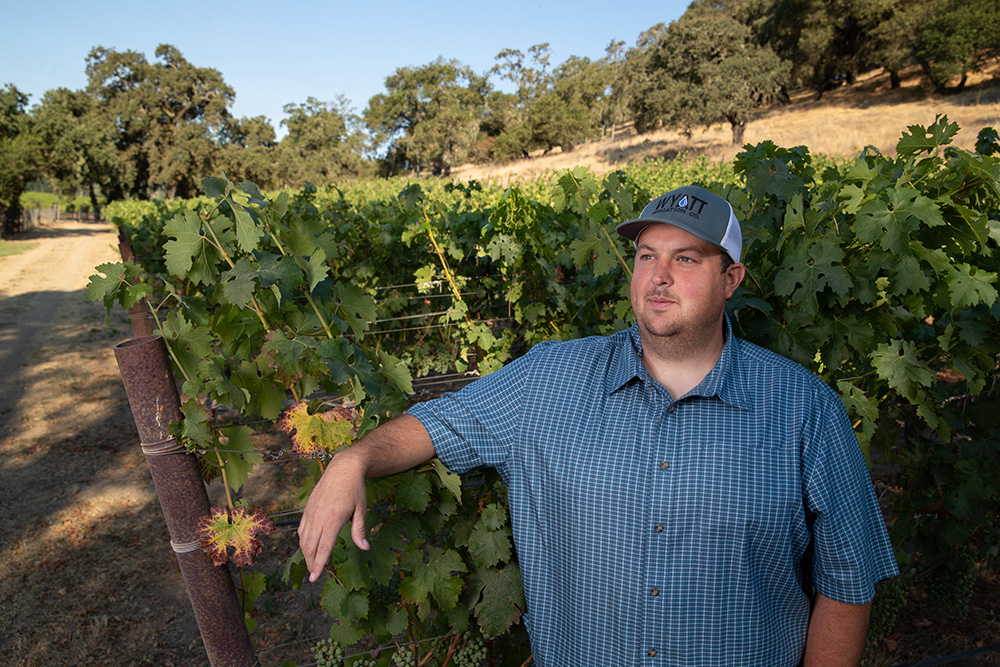
Napa County winegrape grower Johnnie White says the regulatory costs of farming in the region have pushed individual farms to a breaking point, threatening the future of agriculture in California.
Photo/Fred Greaves


By Johnnie White
Our family has farmed in Napa County for six generations. Through droughts, recessions, changing markets and evolving technologies, we have adapted time and again to keep our land productive and business viable. We have never expected farming to be easy. But we have always believed it would remain possible.

Today, that assumption is no longer safe. The mounting weight of regulations continues to push many of us to a breaking point, threatening not just individual farms but the future of agriculture in California.
The state’s long-standing commitment to agriculture has helped make it the nation’s leading agricultural producer. This success did not happen by accident. It was built over generations by farmers willing to invest, innovate and endure uncertainty. But today, that legacy is at risk. A growing regulatory burden—layered, complex and often duplicative—is steadily eroding the economic foundation that has sustained farming communities for decades.
 A recent study from Cal Poly, San Luis Obispo, quantifies what many winegrape growers have known intuitively for years: Regulatory compliance is no longer a manageable cost of doing business. It has become an existential threat. According to the study, a large Napa County vineyard faces compliance costs of $1,744 per acre. Smaller vineyards face costs of $1,131 per acre.
At first glance, these numbers might not seem catastrophic when expressed as a percentage—roughly 8% to 12% of total production costs. But percentages obscure reality. Napa Valley winegrape growers are already operating within increasingly narrow margins. Wine consumption has declined, inventories remain high, prices are under pressure, and contracts are harder to secure. In that context, an additional 8% to 12% in fixed costs can determine whether a vineyard survives another season.
Winegrapes appear to carry some of the highest regulatory costs relative to production of any crop in California. At the same time, growers face intensifying competition from imported bulk wine, which is often blended and sold under American labels. This practice depresses prices and puts local growers at a distinct disadvantage. We are competing with global supply chains operating under minimal regulatory frameworks.
No one is asking for a free pass. Farmers understand the importance of environmental stewardship, water conservation and worker safety. The land is our livelihood, and protecting it is in our direct interest.
What we ask for is balance. Regulations should achieve their intended goals without making farming economically unworkable. Right now, that balance is off. Compliance often requires navigating overlapping rules from multiple agencies, each with its own reporting requirements, timelines and enforcement mechanisms. The administrative burden alone can require dedicated staff or expensive consultants—resources smaller farms simply do not have and few farms can afford.
These regulatory costs are not inevitable; they are the result of policy decisions. That means they can also be addressed through thoughtful reform. The Cal Poly study highlights a striking comparison: Similar farming operations in Oregon face roughly half the regulatory costs of those in California. This disparity should raise serious questions. Are California’s environmental and labor outcomes twice as effective? Or are we imposing unnecessary complexity and cost without proportional benefit?
The situation is poised to become even more challenging. The study’s findings do not yet account for new regulations on the horizon, including groundwater management fees under the state’s Sustainable Groundwater Management Act, which are expected to add about $98 per acre this year. For some growers, that additional cost will be the tipping point.
Napa Valley winegrape growers have always been resilient. We have adapted to changing climates, evolving consumer preferences and economic volatility. But resilience has limits. It is not a sustainable business model to continuously shoulder rising costs without corresponding increases in revenue. At some point, the math simply stops working.
When farms go out of business, the consequences extend far beyond the families that work the land. Productive agricultural acreage may be sold, converted to other uses or left idle. Local economies suffer job losses, reduced business activity and declining tax revenue, while rural communities face diminishing economic vitality. Once farmland is removed from agricultural production, it is rarely restored. The long-term risks to California’s food system and environmental landscape are significant.
Policymakers must take these realities seriously. If California wants to maintain its leadership in agriculture, it must ensure that farming remains economically viable. That does not mean abandoning important protections. It means designing them in ways that are efficient, coordinated and grounded in real-world conditions.
My family hopes to farm this land for many more generations. That aspiration reflects a broader truth shared by farmers across the state. We are not looking for short-term relief; we are looking for a path forward that allows agriculture to endure. The sustainability of Napa County—and of California agriculture as a whole—hangs in the balance. The numbers are on paper. What happens next will depend on whether policymakers are willing to act with urgency, pragmatism and an understanding of what is truly at risk.
Johnnie White is a winegrape grower in St. Helena and serves on the board of directors of Napa County Farm Bureau, California Farm Bureau and the California Association of Winegrape Growers.
In this edition…
• Labor expenses push farmers to automate
• Policymakers, ag leaders gather to discuss key issues
• Regulatory costs put Napa County wine future at risk
• CCA Today: Managing soil health using biostimulants
• Counties struggle with new abandoned orchard law
• On the Record: How farmers can help fight wildfires
• Virtual workshop on disaster relief funding is July 9
• Local farmers grow malting barley for brewing beer
• How can growers monitor and control citrus scale pests?
• Water uniformity tool helps farmers identify savings
• Fix poor infiltration with gypsum and water tests
• Dial 811 first to protect your land, workers and neighbors
• Advocacy in Action: Farm Bureau tackles New World screwworm, USDA support, fungicide strategy, Colorado River and employment technology





.svg.png)
