


Local farmers grow malting barley for brewing beer

Different kiln-drying times for malted barley give beer different flavors and colors.
Photo/Vicky Boyd



By Vicky Boyd
Not all barley is created equal, as Ron Silberstein, co-founder of Admiral Maltings in Alameda, will quickly tell you.
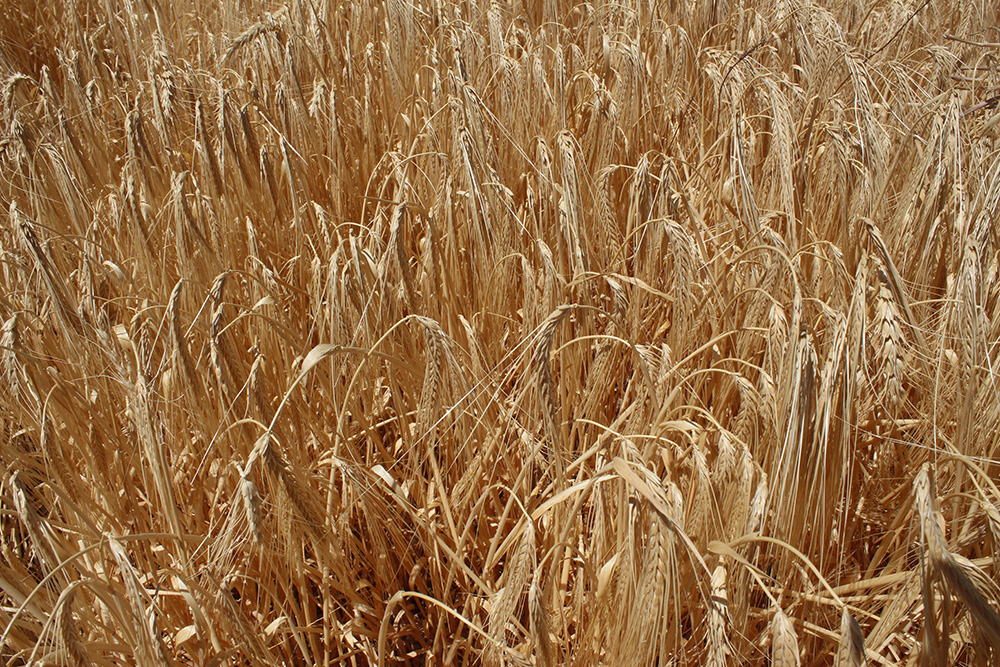
The barley he seeks to malt for distilling, beer brewing and food production is lower in protein and has only two grain rows, yielding less than higher-protein six-row varieties grown for grain.
Lower protein levels, ideally below 11.5%, produce crisp, clear shelf-stable beers without off-flavors. The malting barley also must meet more than a dozen other chemical thresholds.
In return, Admiral contracts with growers and pays them a premium to grow malting barley, as well as wheat and rye using earth-friendly or carbon-sequestering practices such as no-till. Silberstein called the grower partnerships part of the company’s sustainability program.
Photo/Ching Lee
The effort also involves grain freshness, minimizing the number of miles between grower-suppliers, the malt house and end users, and impacts on the local economy beyond the farmer.
“It’s not the cheapest, but it’s all about sustainability,” Silberstein said.
The grain premiums haven’t been lost on Fritz Durst, who grows organic no-till wheat for Admiral in the hills of Dunnigan in Yolo County.
“Everybody thinks sustainability is about soil that’s healthy—and that’s part of it,” he said. “But part of sustainability is right here, paying a fair price to the grower.”
Bob Schaupp, who grows no-till barley near Esparto for Admiral, said the premiums allow him to stay in business. Using no-till, he plants barley following corn and applies only about 10-20 pounds of nitrogen during the season.
The small-grain crop can mine nutrients left over from the corn. Higher nitrogen rates can promote undesirable high protein levels in malting barley.
Photo/Vicky Boyd
Strangely, barley grown during drought years seems to have better quality than when it’s grown during a wet year, Schaupp said.
Schaupp’s family goes back generations producing malting barley in Yolo County. He remembered hearing about how his grandfather started growing it in the early 1900s. Eventually, it fell out of favor to other crops.
When Silberstein approached him and Durst about growing malting barley in the 2010s, they tried varieties developed for Idaho and Montana. The experiment quickly turned sour as the grains succumbed to fungal and viral diseases endemic to California.
The malting pioneers then contacted Lynn Gallagher, the University of California, Davis, barley breeder at the time. Working with the U.S. Department of Agriculture, he bred a handful of varieties, such as Butta 12, which has become one of the most popular.
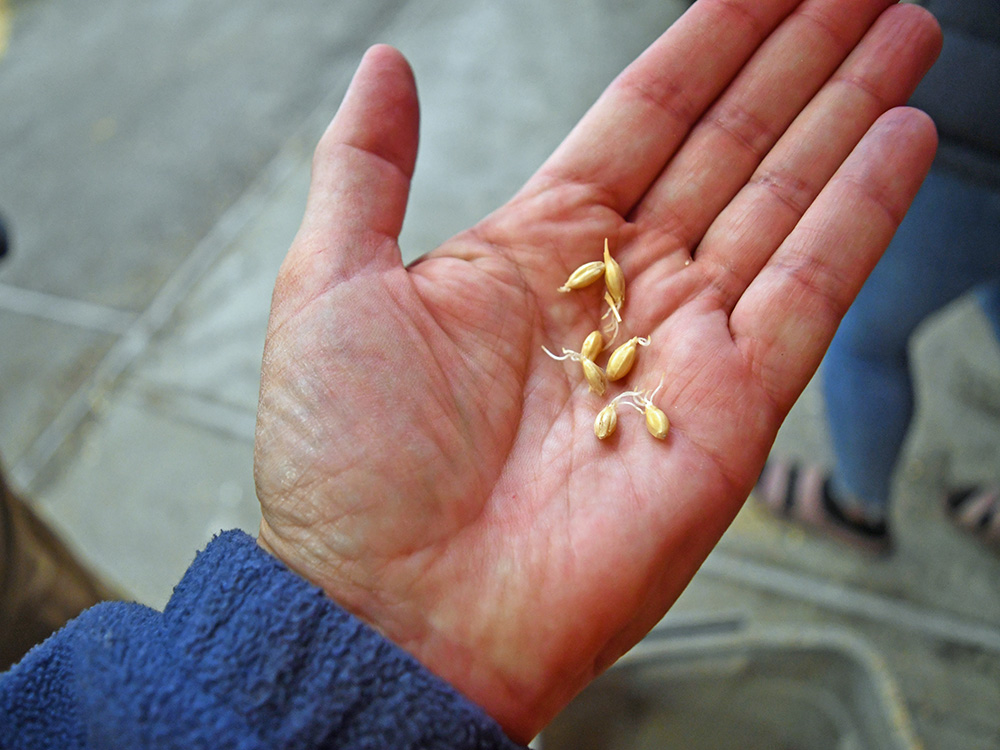
Not only did the varieties hold up against disease pressures, but they also worked well for floor malting. Malting is an essential step that breaks down long-chain starches within the kernels so they’re available to fermentation yeasts.
“What malting does is simply follow nature,” Silberstein said. “It converts energy that’s stored in the seed to grow a plant, but as maltsters, we don’t let it grow a plant. “
Malting starts with steeping grain in a large stainless-steel tank and applying warm water to start an enzymatic reaction and seed germination. The tank is aerated for about 20 minutes every hour so the grain doesn’t drown.
After about 14 hours of soaking, workers drain the grain and let it sit another 16 hours to equalize the moisture. A second soaking raises the grain moisture to about 44% to 45%.
“We want that endosperm to be very uniformly soaked with water,” Silberstein said.
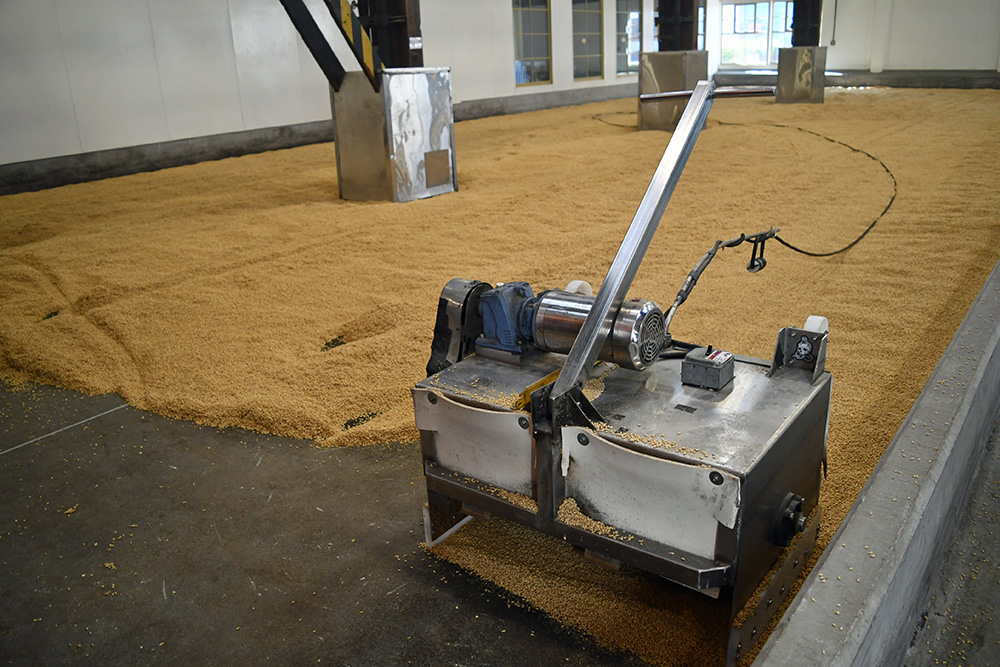
From there, workers spread the malt onto chilled cement floors, an ancient and labor-intensive process known as floor malting.
The chilled floors help reduce heat naturally produced as the grain germinates. An electric rototiller-like machine turns the grain twice a day to improve uniformity.
Silberstein said he believes the gentle handling used in floor malting is worth the added expense because it affects the flavor of the finished grain.
“The microbiome will be a little different,” he said. “If people do side-by-side tasting, they significantly prefer the floor malt.”
Photo/Vicky Boyd
Once the ascospire, or rootlet, is the full length of the seed—which happens after about four to five days—workers transfer the grain to a kiln to stop germination. A screen within the kiln tumbler breaks off the ascospires, which are sent to a livestock producer for feed.
Depending on the temperature, air flow and duration, the drying process reduces moisture to about 4% to 5% from 46% to 47%. Further time in the kiln adds colors ranging from gold to deep brown and flavors like fresh-baked bread, coffee or bitter baking chocolate.
But Silberstein said kiln drying is a balancing act because more than one-third of the enzymes important for starch conversion to sugar can be lost during the mash step in brewing.
“You have to be careful that you don’t destroy all of the enzymes because the enzymes are heat-sensitive, and you need them to break down the starches,” he said. “This is truly an art. You can have perfectly grown malt and then mess it up in there.”
Silberstein said although malt is best used fresh shortly after drying, he realizes that isn’t always feasible. He affixes a born-on date on his company’s bags and recommends using the grain within six months of kiln drying.
Vicky Boyd is a reporter in Modesto. She can be reached at agalert@cfbf.com.

In this edition…
• Labor expenses push farmers to automate
• Policymakers, ag leaders gather to discuss key issues
• Regulatory costs put Napa County wine future at risk
• CCA Today: Managing soil health using biostimulants
• Counties struggle with new abandoned orchard law
• On the Record: How farmers can help fight wildfires
• Virtual workshop on disaster relief funding is July 9
• Local farmers grow malting barley for brewing beer
• How can growers monitor and control citrus scale pests?
• Water uniformity tool helps farmers identify savings
• Fix poor infiltration with gypsum and water tests
• Dial 811 first to protect your land, workers and neighbors
• Advocacy in Action: Farm Bureau tackles New World screwworm, USDA support, fungicide strategy, Colorado River and employment technology





.svg.png)
