


Labor expenses push farmers to automate
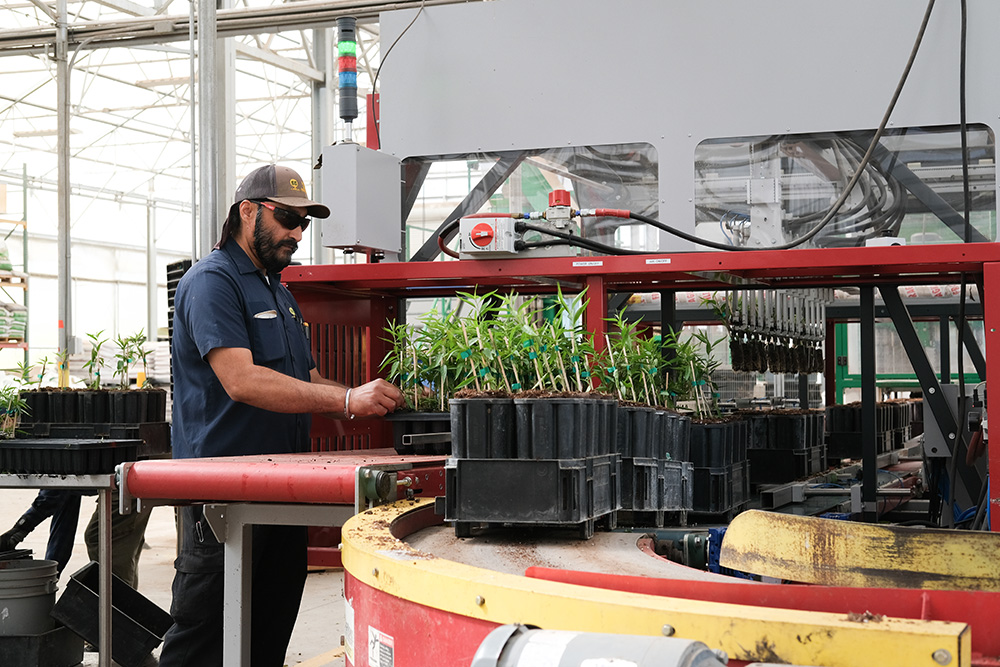
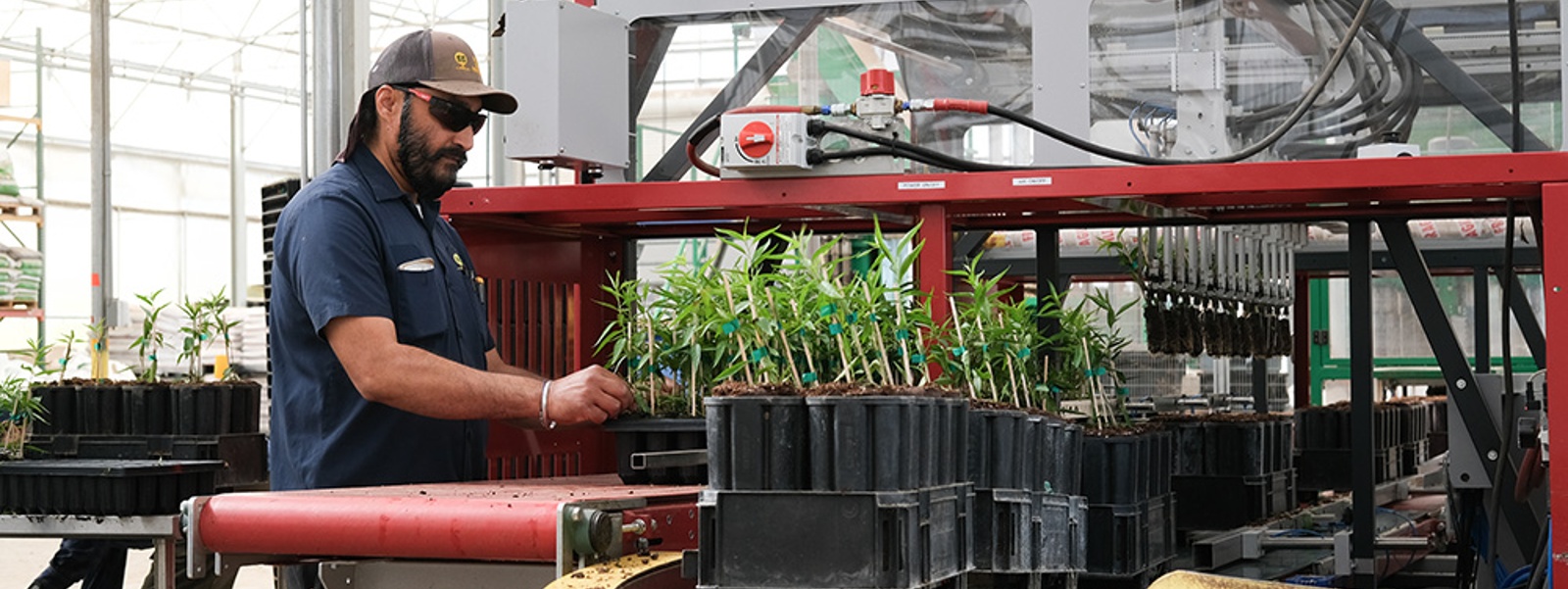
Jasvinder Pabla, maintenance manager at Sierra Gold Nurseries in Yuba City, inspects almond rootstock as it comes out of a robotic transplanter this month. The Sutter County nursery, a major supplier of fruit and nut trees, purchased the robotic transplanter last year in response to rising labor costs.
Photo/Caleb Hampton


By Caleb Hampton
Before almond orchards are planted across the Central Valley or apple trees take root in the Pacific Northwest, many of the plants begin their lives at Sierra Gold Nurseries in Yuba City.
The Sutter County tree nursery is a one-stop shop, propagating the plants from orchard cuttings and in a tissue culture laboratory, then potting, suckering and budding the trees, and nurturing them for more than a year before shipping them to growers across the country.
The labor-intensive operation, which produces millions of trees each year, requires more than 300 employees during its peak season, with labor making up about 60% of the nursery’s input costs.
 Josh Puckett, vice president of operations at Sierra Gold, said rising labor costs combined with a depressed farm economy in recent years threatened the nursery’s profitability. To adapt, the company invested in new technologies to reduce manual labor and make its operation more efficient.
“We’ve implemented a lot more automation,” Puckett said.
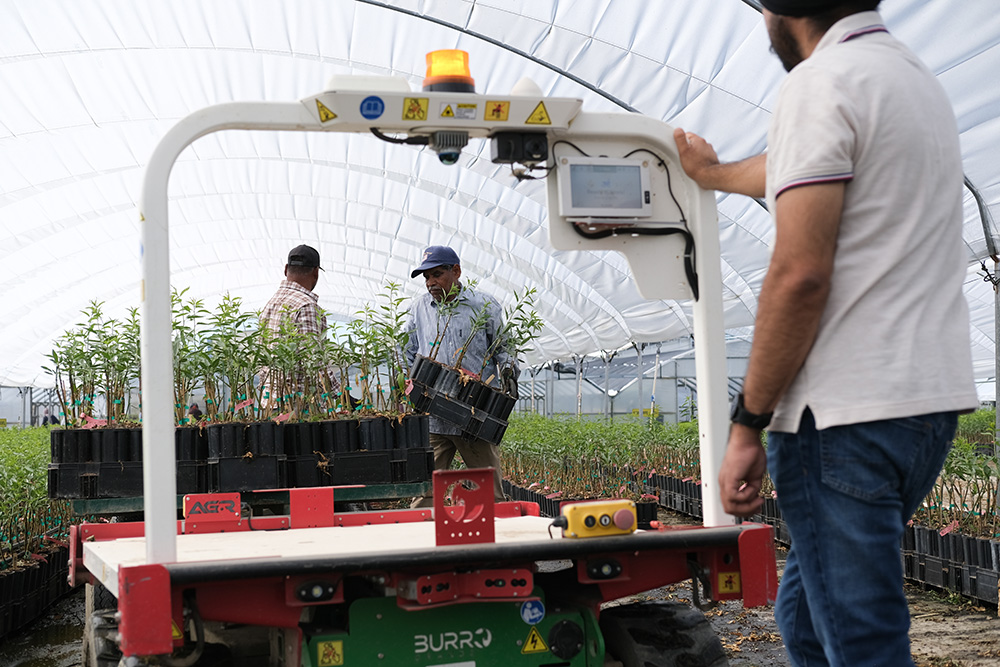
This month, where a potting line of 12 people once worked, a 12-armed robot transplanted rootstock into pots of soil. In place of utility vehicles, autonomous shuttles ferried plants around the 65-acre facility, transporting them from one growing environment to another.
Across California’s specialty crop sectors, growers and industry leaders said state labor laws—and costs associated with them—have pushed farms to seek labor-saving technology in an effort to remain financially viable.
“We’re seeing much more openness from farmers to adopt new technologies because they know if they don’t, they’re not going to survive,” said Tim Bucher, co-founder and CEO of the Bay Area-based company Agtonomy, which develops software for agricultural equipment manufacturers.
Rising costs
During the past decade, multiple state laws increased the cost of farm labor. Since 2016, when a statewide minimum wage law took effect, that wage increased 40%, rising faster than inflation and farm revenue.
Meanwhile, California phased in an agricultural overtime law, entitling farmworkers to overtime benefits when they work more than eight hours a day or 40 hours a week. The law further increased farm labor costs—or, in many cases, resulted in lost productivity as farms shortened the workweek to avoid paying overtime premiums.
“Both hit us at once,” Puckett said of the two wage laws.
Photo/Caleb Hampton
Lynn Hamilton, an agribusiness researcher at Cal Poly, San Luis Obispo, said wage figures tell only part of the story.
In a study published last year, Hamilton found the cost of regulatory compliance for California lettuce growers increased 64% from 2017 to 2024, with labor-related regulations such as workers’ compensation insurance comprising most of those costs.
Hamilton said the research was not intended to find fault with California’s worker protections.
“They obviously exist for a reason,” she said. “But the bottom line is those regulations add hidden costs onto the growers.”
Because farmers sell perishable goods in a global marketplace, they are often unable to pass along production cost increases to buyers, according to experts. For example, Hamilton found that farm-gate prices for lettuce increased less than 1% during the study period even as growers’ costs soared.
Automation
At Sierra Gold, the shift to automation came partly as a direct response to the overtime law, with the technology helping make up for reduced work hours.
“We are adapting to the conditions” created by the law, Puckett said.
Other farms have adapted similarly.
Yolo County farmer Bruce Rominger, who grows tomatoes for Campbell’s Soup Co. and other processors, said his employees wanted to work more hours. But with tomato prices declining in each of the past three years, “our commodity prices do not justify the overtime hours,” he said.
In 2024, Rominger purchased a robotic tomato transplanter that requires just four employees to plant a field instead of a crew of 30 contract laborers. The cost savings paid for the transplanter within two years, he said.
Rominger said the overtime law generally incentivized growers to invest in equipment rather than human labor, whether it be new technology or a larger tractor capable of pulling wider implements that cover more ground.
“The equipment doesn’t charge me for working more than eight hours a day,” he said.
California’s winegrape sector, a major source of employment for the state’s farmworkers, also has turned to automation as growers battered by a global downturn in wine sales seek to limit the cost of growing fruit they may be unable to sell.
Jeff Bitter, president of the grower-owned marketing group Allied Grape Growers, which represents about 500 growers, said the overtime law “without a doubt” created more urgency among growers to mechanize vineyard work. While winegrapes have been machine-harvested in the Central Valley for years, he said growers have increasingly mechanized other labor-intensive work such as pruning and leaf-pulling.
“When growers look at their bottom line and where their costs lie, it’s highly concentrated in labor,” said Bitter, who grows winegrapes in Madera County. “Any grower is looking at ways to minimize labor, and mechanization is definitely one of those options.”
Industry experts said other labor-saving technologies that have gained traction in recent years include autonomous sprayers, self-propelled harvest platforms and optical sorters for packinghouses. For large-scale vegetable growers, million-dollar laser weeders have replaced entire work crews, reducing weeding costs by about 40%, according to a 2024 study by the Western Growers Association.
Workforce transition
Despite the development of some labor-saving technology, growers and researchers said California’s farm workforce remains vital to the industry.
One reason is that growers face barriers adopting technology. A difficult farm economy means some growers lack the capital to make new investments. State regulations limiting the use of driverless farm equipment have also slowed adoption.
Most significantly, researchers said, fresh produce is still harvested largely by hand. Stavros Vougioukas, an agricultural robotics researcher at the University of California, Davis, said that “for the foreseeable future,” robots will not match skilled farmworkers at reaching through foliage, finding fruit and quickly conveying it unblemished into bins.
“Replacing people is not easy,” Vougioukas said.
Industry leaders said that, ideally, the transition to automation in agriculture complements an ongoing demographic transition in California’s experienced but aging farm workforce, with labor supply and demand declining in tandem, and new jobs emerging that appeal to younger, more educated people entering the workforce.
It’s not a perfect transition.
Guadalupe Gonzalez, a farm crew leader in Napa County, said she was disappointed by the lack of work during last year’s winegrape harvest.
“Farmers are more often choosing to use machines,” Gonzalez said in Spanish. “People are working less.”
At Sierra Gold, Puckett said, automation provided efficiency while improving working conditions for employees.
Jasvinder Pabla, maintenance manager at Sierra Gold, said that after “some hesitation,” nursery employees embraced the changes.
“They’ve seen where it makes their work easier, assisting with the harder aspects of the work and the more tedious tasks,” Pabla said.
Instead of 12 workers potting plant after plant by hand, eight workers were trained to run the robotic transplanting line—a job that is more technical and less strenuous.
For years, Pabla said, the Yuba City nursery was able to hire local workers, many of them immigrants who had lifelong experience in agriculture and who faced educational or language barriers to entering other fields. But they are aging out of the workforce, he said, and their U.S.-born children have different dreams and career prospects.
Pabla said he hoped Sierra Gold’s shift to automation will attract some to the nursery.
“It’s hard to find the next labor force to do this kind of work unless we make it interesting,” he said.
Caleb Hampton is an editor at Ag Alert. He can be reached at champton@cfbf.com.

In this edition…
• Labor expenses push farmers to automate
• Policymakers, ag leaders gather to discuss key issues
• Regulatory costs put Napa County wine future at risk
• CCA Today: Managing soil health using biostimulants
• Counties struggle with new abandoned orchard law
• On the Record: How farmers can help fight wildfires
• Virtual workshop on disaster relief funding is July 9
• Local farmers grow malting barley for brewing beer
• How can growers monitor and control citrus scale pests?
• Water uniformity tool helps farmers identify savings
• Fix poor infiltration with gypsum and water tests
• Dial 811 first to protect your land, workers and neighbors
• Advocacy in Action: Farm Bureau tackles New World screwworm, USDA support, fungicide strategy, Colorado River and employment technology





.svg.png)
