


Policymakers, ag leaders gather to discuss key issues
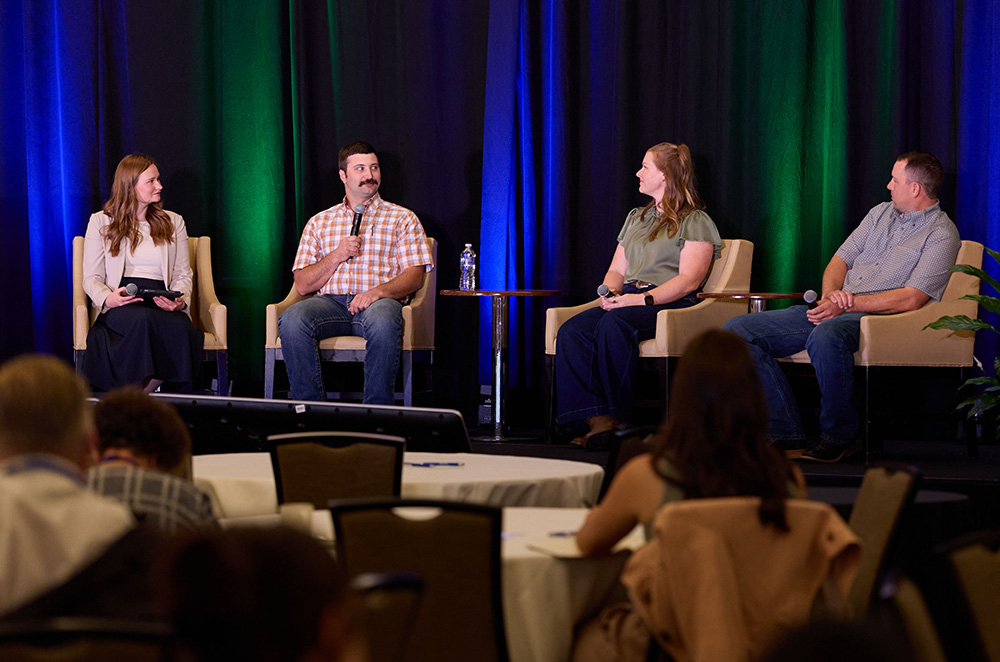
A moderator, left, discusses farming and affordability with farmers Josh Pippitt, from right, Tara Beaver Coronado and Matthew Vosseler at the 2026 Agri-Pulse Food & Ag Issues Summit on June 2, 2026.
Photo/Courtesy of Agri-Pulse


By Manola Secaira
Labor shortages, rising costs and water access emerged as key concerns for California farmers during discussions at the 2026 Agri-Pulse Food & Ag Issues Summit.
The annual conference, held earlier this month in Sacramento, brought together policymakers and agricultural leaders.
Impacts vary across agricultural sectors, with the wine industry, in particular, struggling more than others, according to some farmers.
Matthew Woolf, a specialty crop analyst for Terrain, a Farm Credit service, said alcohol consumption in the U.S. has been declining, with wine sales taking the hardest hit.
Tara Beaver Coronado, owner of Beaver Vineyards in Sacramento County, started growing winegrapes on land leased from her parents. She credits this access point with making the entire operation possible.
After a profitable first harvest in 2020, her farming business struggled. She noted that young farmers today commonly face similar financial uncertainty in agriculture.
“You’re really just hemorrhaging money for years—and (having) a lot of sleepless nights, as all farmers experience,” she said.
Sonoma County farmer Matthew Vosseler, a member of Sonoma-Marin Young Farmers & Ranchers, said rising entry costs have forced young farmers to get creative. Rather than buying property, some are breaking into the industry by leasing land or striking agreements with landowners.
“That’s where I see, at least in our county, how we’re able to keep farming as young farmers,” Vosseler said. “We may not own the land, but we can help preserve it for the future.”
Changes affecting immigrant laborers have caused uncertainty for some farmers. Woolf said efforts to raise wages for farmworkers could further complicate their finances.
Dan Sumner, an agricultural economist at the University of California, Davis, said the threat of immigration crackdowns adds to the uncertainty.
“There’s a bunch of fear out there, and I don’t think it would take more than an incident or two to make real chaos for hired farm labor,” Sumner said. “We really will see incredible stress on all of agriculture and, of course, the families involved.”
Evolving technologies were a central point of the discussions, which weighed their societal benefits and potential harms.
One panel focused on data centers, which have been around for years, housing servers needed for everyday online services such as internet searches and video streaming. But the birth of generative artificial intelligence has exponentially raised the water and energy needs of these centers.
Adria Tinnin, director of race equity and legislative policy for The Utility Reform Network in Oakland, emphasized the need to prevent data centers’ water and energy demands from driving up utility costs, especially for people who work in agriculture, an industry already facing financial stress.
“We have to step in and take action to make sure that we’re getting this right, that if a data center is going to come in, that they really, truly do pay for themselves,” Tinnin said.
Michael Boccadoro, executive director of the Agricultural Energy Consumers Association in Sacramento, said it is important to understand the impacts of data centers before inviting them into a state already struggling with resource scarcity.
He noted last year’s legislative attempts to require data centers to share information about their energy and water use were unsuccessful. Boccadoro said more details are needed to help create a sustainable plan for the centers.
“Why are they so afraid to share about their operations both in terms of energy use and water?” he said. “If they were more willing to share about their real needs, I think there’d be a lot more acceptance, and it gives us an opportunity to gain a full understanding.”
Boccadoro and Tinnin said they support new legislation to improve transparency regarding data centers’ water and energy consumption.
Although financial uncertainties may continue to impact farmers, panelists discussed different ways to support people in agriculture.
Vosseler said autonomous agricultural equipment such as self-driving tractors could help reduce labor costs if California amends legislation to more easily allow its use.
“That’d be a game changer,” he said.
As it stands, state law limits the use of automated agricultural equipment without supervision.
Beaver Coronado stressed the importance of encouraging Californians to purchase food grown in the state. She said she tries to promote this message in her documentary-style YouTube video series “Field Trips with Tara,” in which she highlights California farms and ranches.
“If you have the ability to support a California farmer,” she said, “I hope I’m changing your perspective just a little bit.”
Manola Secaira is a staff writer for Ag Alert. She can be reached at msecaira@cfbf.com.

In this edition…
• Labor expenses push farmers to automate
• Policymakers, ag leaders gather to discuss key issues
• Regulatory costs put Napa County wine future at risk
• CCA Today: Managing soil health using biostimulants
• Counties struggle with new abandoned orchard law
• On the Record: How farmers can help fight wildfires
• Virtual workshop on disaster relief funding is July 9
• Local farmers grow malting barley for brewing beer
• How can growers monitor and control citrus scale pests?
• Water uniformity tool helps farmers identify savings
• Fix poor infiltration with gypsum and water tests
• Dial 811 first to protect your land, workers and neighbors
• Advocacy in Action: Farm Bureau tackles New World screwworm, USDA support, fungicide strategy, Colorado River and employment technology





.svg.png)
