


Counties struggle with new abandoned orchard law
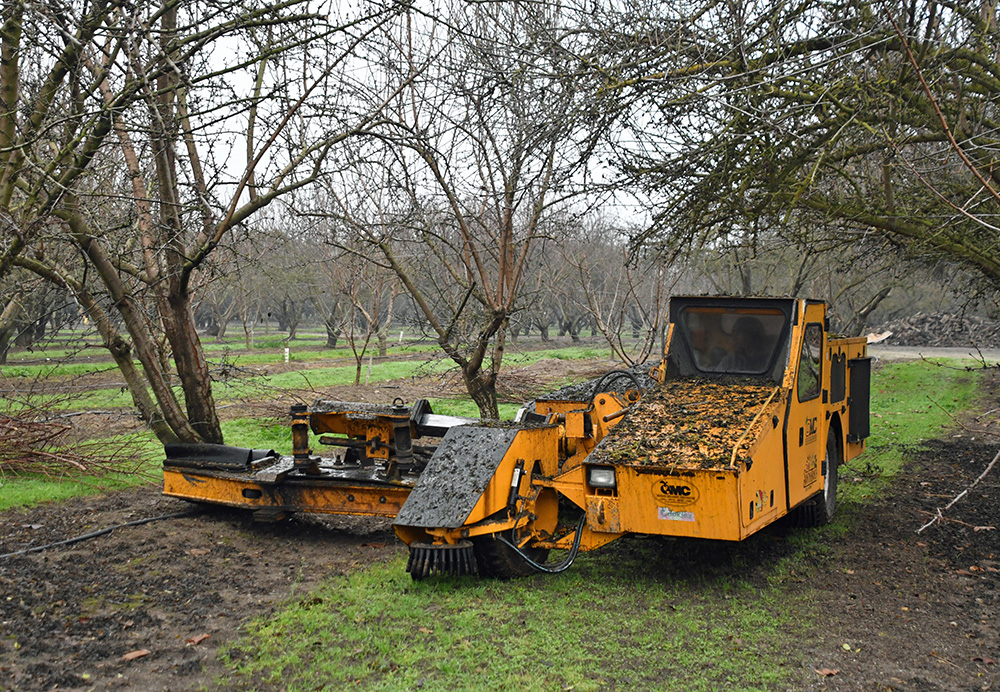
Removing leftover nuts after harvest remains crucial to controlling the navel orangeworm. Although a new state law empowers agricultural commissioners to fine owners of pest-ridden abandoned properties, counties have struggled to enforce the rules.
Photo/Vicky Boyd


By Tim Hearden
A coalition of agriculture advocates that successfully pushed for stronger enforcement against abandoned orchards and vineyards last year is now frustrated that the law they championed—Assembly Bill 732—has yet to be enforced.
The bill by Assemblymember Alexandra Macedo, R-Tulare, allows county agricultural commissioners to assess fines of up to $1,000 per acre for properties deemed a public nuisance. It passed unanimously in both chambers and was signed by Gov. Gavin Newsom in October.
Agricultural commissioners say the bill gives them a tool with which to warn landowners whose neglected properties harbor pests and diseases that can affect neighboring farms. The threat of additional fines “typically puts some more fire under the situation and makes things happen a little quicker,” said Christopher Greer, Tulare County’s assistant agricultural commissioner.
But so far, the legislation has had little impact on mismanaged orchards, said Roger Isom, president and CEO of the Western Tree Nut Association.
“We were one of the big supporters of the bill and testified at a couple of the hearings,” Isom said. “We thought it would make things happen, but unfortunately it hasn’t moved the needle at all.”
Several weeks ago, Isom and other advocates asked for a meeting with San Joaquin Valley agricultural commissioners to ask about implementation.
“What I found out was they’re going to tiptoe carefully,” Isom said. “We don’t want to bankrupt somebody, but we’ve got to get these orchards and vineyards addressed.”
However, the expectation “that this was going to make an immediate impact was probably unrealistic at some level,” countered Fresno County Agricultural Commissioner Melissa Cregan, president of the California Agricultural Commissioners and Sealers Association.
“One of the things you have to show is the abandoned property is (causing) damage to neighbors,” Cregan said. “Unless it is reported, I don’t have the resources to go around the county and be the abandoned ag land police.”
The bill was pushed through amid reports that landowners stopped irrigating or harvesting vineyard and orchard crops because of unprofitable prices paid for those commodities. Unmanaged crops can harbor large populations of troublesome pests that can infest neighboring crops.
Commissioners said counties face two key enforcement challenges. First, maintaining anonymity is difficult because counties must provide evidence of harm to neighboring properties, Cregan said. Second, budget constraints limit agencies’ ability to abate problem properties and create the risk that counties will be left to cover the costs.
County-led abatement forces the local government to pay prevailing wages, a requirement that Cregan noted can easily double cleanup costs. The law aims to pressure landowners into resolving property issues independently, sparing public resources. He acknowledged that collecting fines remains a challenge and the law is an imperfect tool, but he emphasized it serves as a critical regulatory “nudge” for owners to maintain their land and eliminate neighborhood nuisances.
Orchard removal funds through the San Joaquin Valley Air Pollution Control District are drying up because of heavy demand and limited state budgets. With open burning phased out by the California Air Resources Board, the air district said wait times and funding gaps are common. Isom said the closure of valley biomass plants in recent years has made the situation worse.
Farm groups have urged state and federal lawmakers to restore biomass funding, Isom said. They’re also considering invoking an exception in the burn ban for instances in which there is no economically viable alternative, he added.
If funding is not secured, he said, farm groups will be forced to apply for burning permits. He noted that while they want to avoid open burning, “we’re left with no choice.”
“We’ve got to get this material taken care of,” Isom said. “It’s harboring pests. It’s not fair to surrounding orchards that there’s no control over that.”
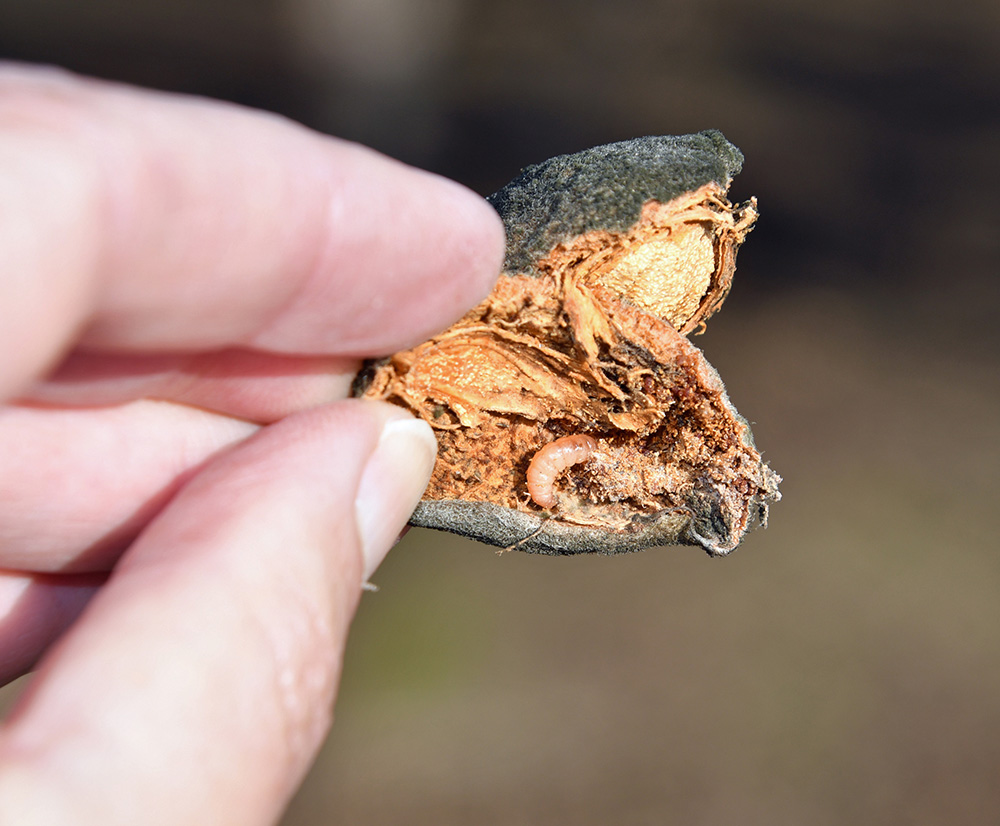
Photo/Courtesy of the U.S. Department of Agriculture
The issue comes as harvest for the earliest almond varieties rapidly approaches, accelerated by unseasonably warm temperatures during bloom in February. Ryan Jacobsen, a grower and CEO of the Fresno County Farm Bureau, said the season appears to be running two to three weeks early depending on the location.
“We could see shakers in certain areas not long after the Fourth of July” if an early-summer heat wave doesn’t slow the progress, Jacobsen said.
Jhalendra Rijal, a University of California integrated pest management adviser, said high temperatures in February and March spurred unseasonably early pest activity, which likely intensified due to low winter mortality following a mild season.
Some growers sprayed earlier than usual this year for the navel orangeworm, the leading pest for almonds. The Almond Board of California has called for vigorous orchard sanitation to reduce infestations. Almond board spokesman Taylor Hillman said earlier hull split should not impact worm pressure.
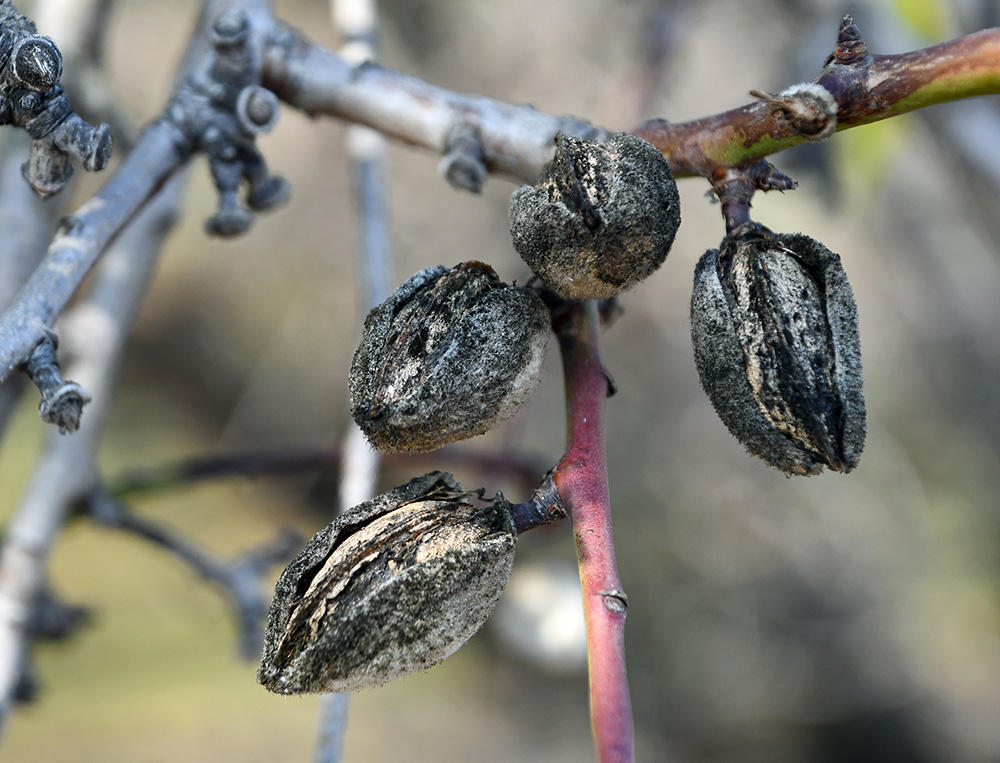
Photo/Vicky Boyd
“If anything, it may help it with less time spent in the trees, which means a generation or two less of the pest,” he said. “That’s just theoretical, though.”
Growers and farm advisers are also concerned about the carpophilus beetle, which emerged three years ago and has been found in every San Joaquin Valley county. Biocontrol options remain limited, and the use of chemical control is challenging because the insect tunnels into the kernel, inhibiting full coverage, the almond board said.
Land IQ’s 2026 Standing Acreage Initial Estimate this spring found that bearing almond acreage in California decreased by 15,227 to nearly 1.386 million bearing acres. But the state has seen a reduction in overall almond acreage for the past four years, Hillman said, making it difficult to know to what degree the threat of stiffer penalties contributed to the pullouts.
Compliance with the Sustainable Groundwater Management Act, aging orchards and simple economic pressures may have also driven removals, he added.
Tim Hearden is a reporter in Redding. He can be reached at agalert@cfbf.com.

In this edition…
• Labor expenses push farmers to automate
• Policymakers, ag leaders gather to discuss key issues
• Regulatory costs put Napa County wine future at risk
• CCA Today: Managing soil health using biostimulants
• Counties struggle with new abandoned orchard law
• On the Record: How farmers can help fight wildfires
• Virtual workshop on disaster relief funding is July 9
• Local farmers grow malting barley for brewing beer
• How can growers monitor and control citrus scale pests?
• Water uniformity tool helps farmers identify savings
• Fix poor infiltration with gypsum and water tests
• Dial 811 first to protect your land, workers and neighbors
• Advocacy in Action: Farm Bureau tackles New World screwworm, USDA support, fungicide strategy, Colorado River and employment technology





.svg.png)
