


Study: Maximize winter cereal yields with less water
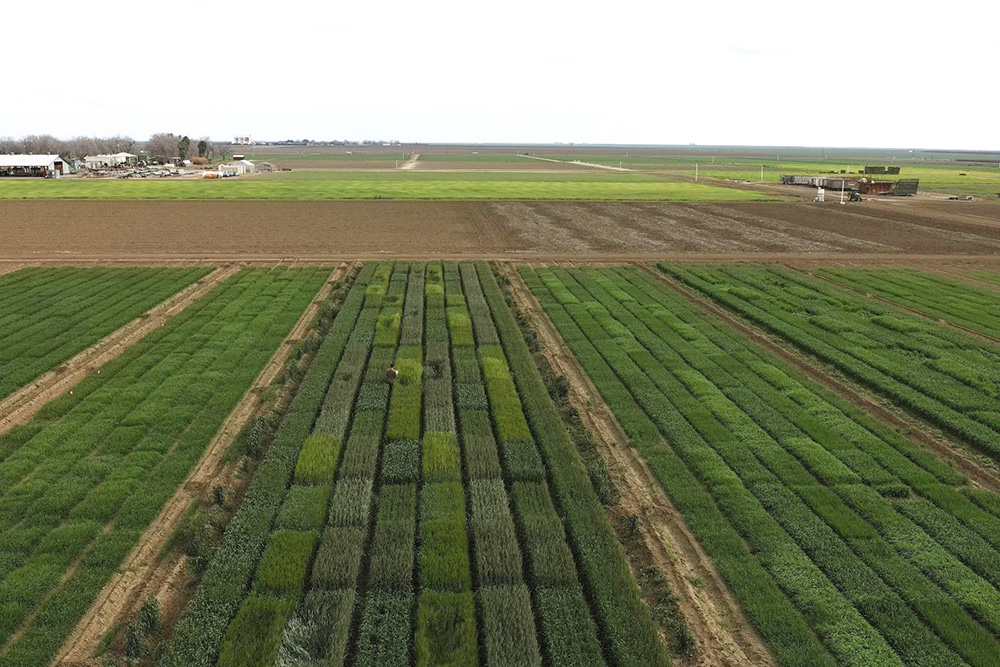
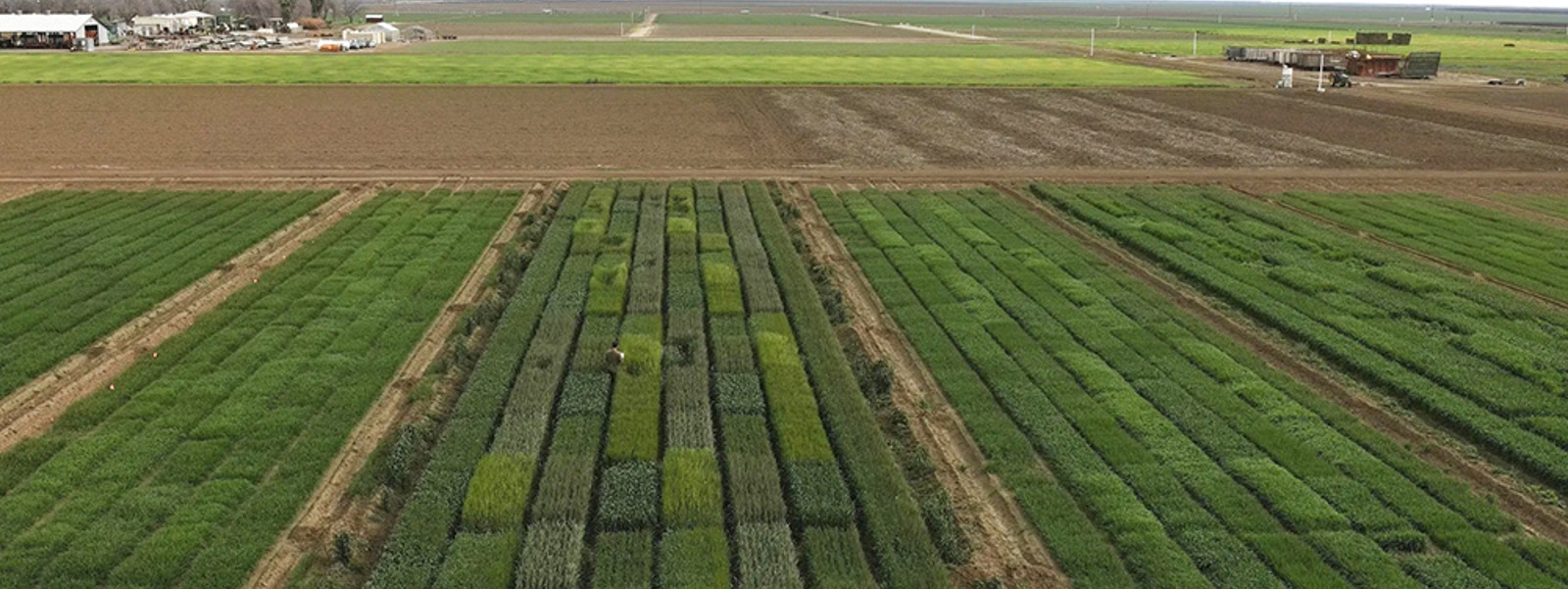
In this February 2024 aerial photo, small grain plots grow at the University of California’s West Side Research and Extension Center in Fresno County. The main field is an October 2023 planting that received 4 inches of irrigation. UC researchers planted the two-year trial to examine ways to maximize the productivity of winter cereal crops with as little water as possible.
Photo/Mark Lundy, University of California


By Vicky Boyd
With 500,000 acres of cropland expected to be fallowed by 2040, university researchers are looking at winter-grown cereals as potential options to help farmers stay in production while also protecting the environment.
By planting in early fall and applying just 4 inches of irrigation, researchers found a stronger possibility to make a profit with small grains compared to relying on a totally rain-fed system.
“It’s really risky if you’re just rain-fed,” said Mark Lundy, a University of California, Davis, associate professor of Cooperative Extension and grain cropping systems specialist. “Early rains can get the crop moving, but it’s not enough to get it established enough to take that risk off the table.”
That’s where the 4-inch irrigation helps. Planting in October enables the crop to take advantage of warm fall weather. Applying the water at planting promotes strong root and canopy system development that helps the crop better weather later stressors.
Even with the starter irrigation, Lundy said the system carries risks, depending on individual farmer’s situations. Market prices for forage and grain plus water costs also play roles in potential profitability.
Finding ways to maximize crop production per unit of water has taken on new meaning as the Sustainable Groundwater Management Act is implemented, Lundy said.
Jim Parsons, who grows citrus and mostly dryland wheat for hay near Ducor, agreed.
“To me, this type of research is very important, and I have a feeling there are other areas that will benefit from it too,” he said.
One unknown is whether southern San Joaquin Valley growers would have to maintain fallow fields to meet anticipated SGMA pumping restrictions or whether they could still grow a dryland crop.
“You really don’t know because (the regulators) haven’t put anything out,” Parsons said. “I’d like to see it go to where you can grow a crop that doesn’t use a lot of water and qualify for SGMA.”
Although Lundy has also heard concerns about applying water to a low-value crop, he said the system, if done correctly, doesn’t result in a net water loss.
“The reason is you’re losing more than 4 inches just in a fallow situation,” Lundy said. “If you applied that 4 inches and you have a crop, then you have something to show for yourself. You might have avoided some of those costs of controlling weeds on the fallow land.
“By having a crop in place, you’re actually getting more effective precipitation and better infiltration,” he added. “Once you begin to take (the crop) past March, then you start to lose that water.”
Small grains such as wheat, barley and triticale are prime candidates for this type of system because they are low maintenance, offer flexible management, take advantage of winter rainfall and require minimal additional irrigation, he said. They also offer additional environmental benefits of keeping vegetation on what would otherwise be barren fields subject to erosion.
Lundy said if farmers plant a winter grain crop following a processing tomato crop, for example, they also may be able to tap residual soil nitrogen of possibly 10-20 parts per million. That’s equivalent to 50-70 pounds of nitrogen fertilizer.
“If you put the (small grain) crop in the ground and don’t fertilize it or just put on a starter fertilizer, it will take up that nitrogen and stabilize it in the form of crop roots and crop leaves, more of a fixed form,” he said.
Lundy and UC Davis colleagues conducted a two-year trial at the UC’s West Side Research and Extension Center in western Fresno County examining systems that could potentially maximize winter grain production per unit of available water. Their calculations combined water from rain and irrigation.
Photo/Vicky Boyd
The researchers compared plots planted in mid-October, mid-November and mid-January—all of which received 4 inches of irrigation at planting—to rain-fed plots planted in mid-December and mid-January. The later planting of the rain-fed systems allowed for potential moisture accumulation in the soil.
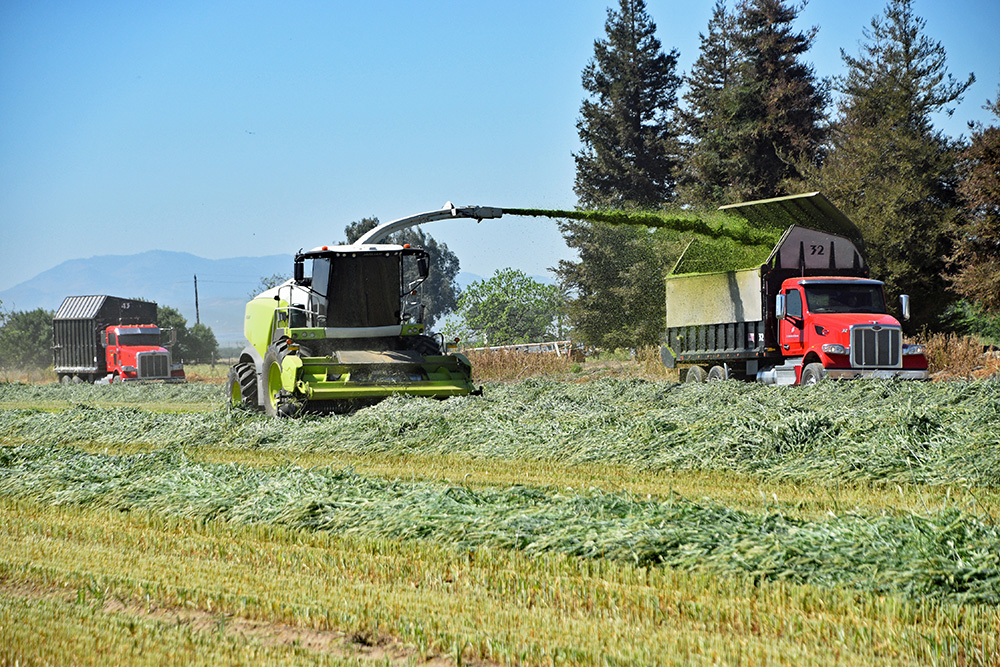
Within each treatment, the researchers grew four varieties each of wheat, barley and triticale and harvested them for forage and grain. Forage harvest occurred when the crop was at the soft-dough growth stage.
The 2023-24 growing season was marked by higher-than-average rainfall, while the 2024-25 season had lower-than-average rainfall.
Lundy said although they’re still analyzing data, several trends are already apparent. Triticale had generally higher forage yields with early planting and starter irrigation compared to wheat. While the late-planted, rain-fed plots made a grain crop in 2024, Lundy said that wasn’t the case in 2025 because of significantly less winter rainfall.
“Because of the dry conditions, the grain outcomes were definitely less consistent than the previous year,” he said. “That early planted (crop) still does the best overall, and we got much worse grain outcomes on average with that late planting. The low rainfall caused stress during grain fill.”
Regardless of the crop, he said there were wide yield variations among varieties within each type. Varieties with good early leaf production and a relatively fast early grain-fill period seemed to do the best.
The West Side center receives a 10-year average rainfall of 7.6 inches annually, with precipitation increasing toward the north. As a result, Lundy said the types of systems researchers examined may not be as well suited for producers in wetter regions such as the Sacramento Valley because the systems are intended for those challenged by water shortages.
“There’s so much variation in rainfall from year to year,” he said. “But if you have less than a 12- to 13-inch annual average, I think this approach is probably your best bet that can get you a reliable outcome.”
The researchers plan to share their findings at the UC Small Grains and Alfalfa/Forages Field Day on May 7 at the UC Davis Agronomy Field Headquarters in Davis.
The West Side field trials followed an earlier project in which the researchers ran a computer simulation model that examined potential winter small grain production based on weather during the prior 10 years. They also included average grain and forage prices.
“The grain isn’t quite as consistent,” Lundy said. “The best overall, from an economics perspective, seems to be forage production.”
Vicky Boyd is a reporter in Modesto. She can be reached at agalert@cfbf.com.

In this edition...
• Big cats complicate ranchers' livelihoods
• California weighs 'truth in labeling' wine industry law
• Water guides discussion at global agriculture forum
• Dry conditions push farms to new irrigation strategies
• Study measures regulatory costs for Napa vineyards
• Researchers study ways to control flatheaded borer
• New CDFW director addresses priorities, predators
• National survey shows most farmers can't afford fertilizer
• What options are available to manage citrus thrips?
• Efficient irrigation through smart and informed irrigation purchases
• Going farm fresh: School districts look to growers as they ditch ultraprocessed foods
• Bountiful Finds: A curated collection of goods made by Farm Bureau members
• Super Snacks: Big California Flavor
• Peaches signal arrival of prime fruit season
• The Scenic Route: Pit stops at California farms and ranches
• From auction ring to dinner table: Coalition ensures no junior livestock exhibitor goes without a sale
• Why calling 811 before you dig is essential for California farmers
• Study: Maximize winter cereal yields with less water





.svg.png)
