


Dry conditions push farms to new irrigation strategies
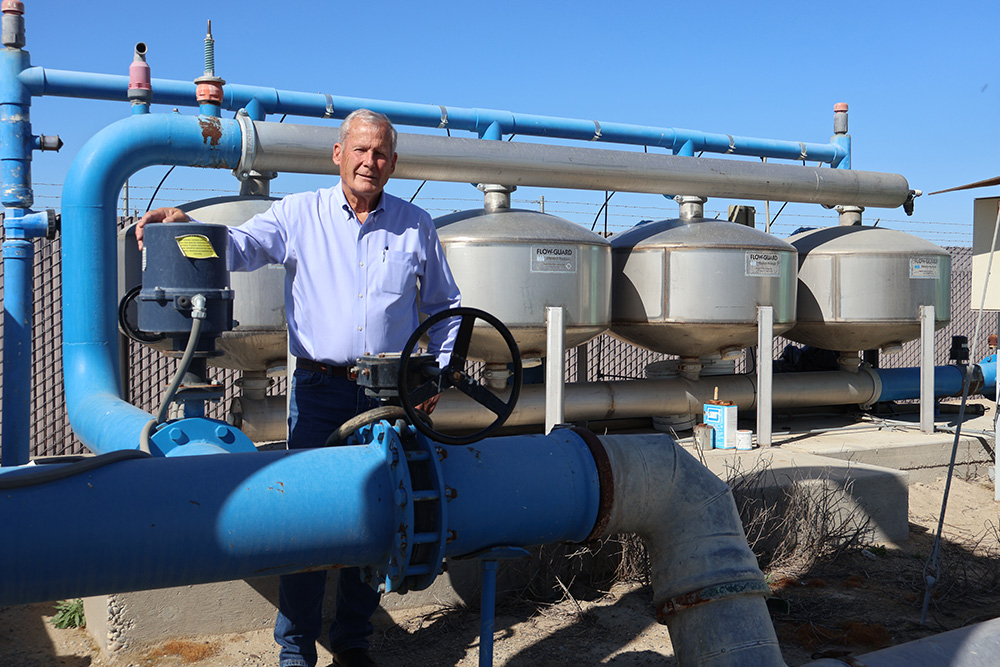
Don Cameron stands next to drip filters and diverter valves used to send any “first, dirty water" elsewhere and not into the filters automatically as part of the automatic startup.
Photo/Amy Torijano


By Katie Rodriguez
With California facing its second-lowest April snowpack on record and recent warm temperatures triggering early snow melt, farmers anticipate constraints on their irrigation plans, especially those who farm south of the Sacramento-San Joaquin River Delta.
Some technologies and methods are emerging to help farmers adapt their irrigation practices, although what proves useful and cost-effective continues to evolve.
 Farmer Dan Errotabere, who grows 5,000 acres in Fresno County that include almonds, pistachios, winegrapes, tomatoes and cotton, will need to work with a 20% water allocation from the federal Central Valley Project—a 5% bump from an initial 15% announced in February.
The largest water strain is on his annual row crops on the west side of the San Joaquin Valley, which gets its water from Westlands Water District. The area is more exposed to water scarcity due to its elevation, reliance on imported water and delivery constraints.
“We’re also beginning our fourth year of our SGMA program,” Errotabere said, referring to the state’s Sustainable Groundwater Management Act, which shifts farmers away from unlimited groundwater pumping to regulated water use. He noted water restrictions will require him to fallow 20% to 30% of his acreage this year.
Errotabere said he has responded to water stress during the past two decades by deploying 100% drip irrigation and increasing intensive monitoring. Though his soils are highly uniform and using drip plus soil-moisture monitoring has helped, he said it has hit a ceiling.
“Our efficiencies are pretty high without a whole lot of benefit,” he said. As such, he said he is shifting this year from a diversified operation to focus on permanent crops while farming fewer acres.
Errotabere has also been experimenting with biochar to increase water and nutrient-holding capacity. While not a new method, he said he sees it as an emerging approach that could gain more federal or state support if regenerative farming practices and carbon credits are prioritized.
“It’s such a new and evolving process that a lot of things are being learned on what to do and not to do,” he said, adding that the method is still in its first couple years of trialing. “We don’t have the results yet, but I think it has a lot of merit.”
Improvements to modern drip emitters have allowed growers to ration water and deliver it directly to their crops’ root zone, and now different kinds of software are being integrated into those systems to squeeze out more savings, said Eric Hadden, executive director of the Water, Energy and Technology Center at California State University, Fresno.
“It is about smart management,” Hadden said. “The newest advancement in that field is the integration of AI (artificial intelligence) and the ability to analyze the data, look at it and make decisions.”
Don Cameron, general manager of Terranova Ranch in Fresno County, has been working with LoRaWAN, or long-range wide area network, as the wireless communication backbone for the farm’s automated drip irrigation systems.
In recent years, the farm has installed LoRaWAN nodes across its 900 acres, starting with tomato and onion fields, with plans to install more. The nodes control irrigation by automatically turning pumps on, opening and closing valves, and communicating data from the field to their cloud-based dashboard.
The system enables the farm to significantly reduce its labor and energy use with better scheduling while improving the precision of water application.
“I didn’t want to use cellphones,” Cameron said, noting poor connectivity on the ranch. “We’re using portable equipment that we can keep in a field for maybe 135 days, then take it out and even possibly move it to another field and use it again, so it’s very flexible and low profile. Tractors can drive over the top of it without damaging it.”
While many farms already collect a lot of data about their soil and water consumption, Hadden said a software platform made by AgMonitor has been making strides by helping farmers track water and energy use so they can minimize pumping while still meeting their water needs.
AgMonitor’s platform uses an AI algorithm to mine existing energy data with smart meters to track energy use and cost, and water data using satellite images to track water demand from evapotranspiration.
The company started with 20,000 acres of trials funded by the California Energy Commission in collaboration with the University of California, Fresno State and West Hills College. Today, it has more than 350,000 acres of farmed land using the software platform.
On average, farms such as Terranova Ranch that have installed the system can reduce irrigation by 10% to 15% by tracking how much water they apply versus what the plants need. They also can reduce energy costs by irrigating during off-peak hours and integrating solar energy, said AgMonitor founder Olivier Jerphagnon.
“Because it was so warm in March, we are losing a lot of that surface water that we have stored in the Sierras,” Hadden said. “When you turn those pumps on to extract from the ground, in some cases, you’re encountering over-usage fees from PG&E, and your kilowatt hour rate goes through the roof.”
In regions particularly vulnerable to severe water shortages, agave is being considered as a less water-intensive alternative crop. Farming D in Five Points manages about 150 acres of the succulent, which is used to make syrup and spirits such as mezcal. Another 75 acres are being planted this month, said Tim Simonich, who provides logistical support for the farm. The effort is in conjunction with Stuart Woolf of Woolf Farming in Fresno County, an early adopter of commercial agave in California who reportedly planted some 550 acres with plans to expand.
Meanwhile, researchers continue to develop new tools to improve irrigation efficiency. A system led by Elia Scudiero, UC Riverside associate professor of precision agriculture and director of the university’s Center for Agriculture, Food and the Environment, aims to improve soil-moisture sensors and reduce overwatering.
To help farmers save water, the robot-powered system maps out which trees are thirsty by measuring how electricity travels through the soil. The readings are combined with data from fixed soil-moisture sensors to estimate water content across an entire field.
Using just a few soil sensors “doesn’t really tell you much,” Scudiero said, adding it would cost farmers much more to deploy enough sensors to capture the variability of soil moisture in a field. But with his system, he said, “now you have an actual value for the soil, and that’s pretty much translatable to every single tree.”
The system is being prepared for field trials, with a related version already in use on golf courses.
“These types of (systems) are probably going to be what enables the next generations of growers to keep California as the leading agriculture powerhouse that it is,” Scudiero said.
Katie Rodriguez is a reporter in Monterey County. She can be reached at agalert@cfbf.com.


In this issue...
• Big cats complicate ranchers' livelihoods
• California weighs 'truth in labeling' wine industry law
• Water guides discussion at global agriculture forum
• Dry conditions push farms to new irrigation strategies
• Study measures regulatory costs for Napa vineyards
• Researchers study ways to control flatheaded borer
• New CDFW director addresses priorities, predators
• National survey shows most farmers can't afford fertilizer
• What options are available to manage citrus thrips?
• Efficient irrigation through smart and informed irrigation purchases
• Going farm fresh: School districts look to growers as they ditch ultraprocessed foods
• Bountiful Finds: A curated collection of goods made by Farm Bureau members
• Super Snacks: Big California Flavor
• Peaches signal arrival of prime fruit season
• The Scenic Route: Pit stops at California farms and ranches
• From auction ring to dinner table: Coalition ensures no junior livestock exhibitor goes without a sale
• Why calling 811 before you dig is essential for California farmers
• Study: Maximize winter cereal yields with less water





.svg.png)
