


Researchers study ways to control flatheaded borer
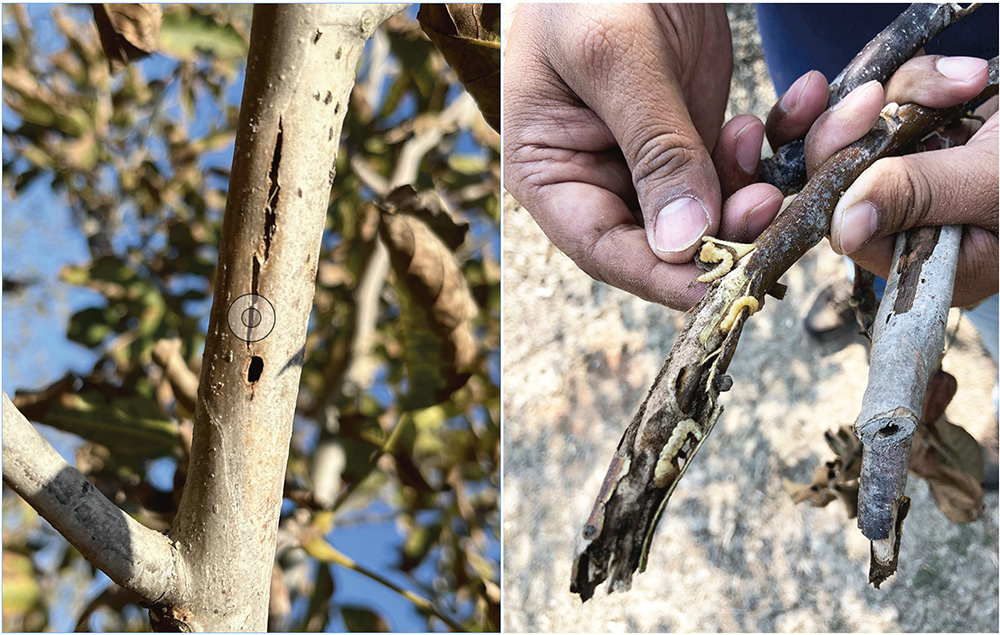
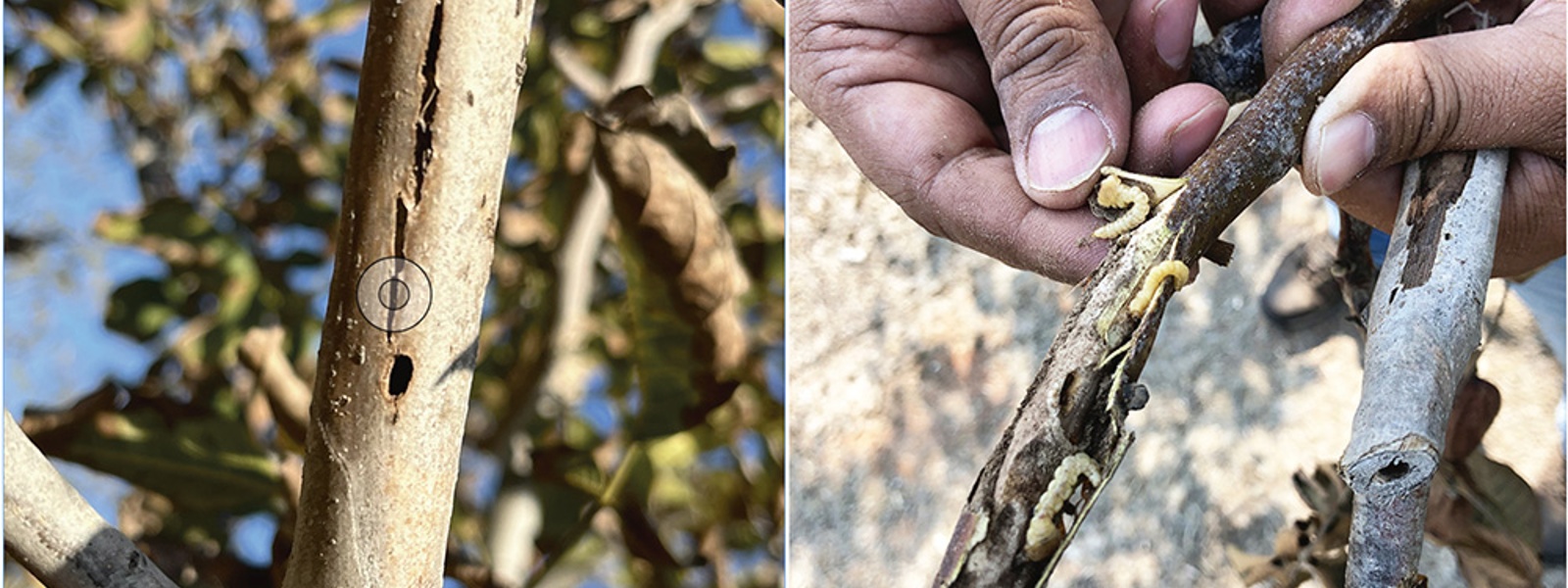
Pacific flatheaded borer larvae pupate in the spring, with the adults emerging in late spring and early summer. They leave behind telltale D-shaped exit holes, left. The larvae are rarely seen because they spend most of their life under tree bark. At right, using a knife to peel the bark in suspected branches reveals feeding channels packed with sawdust-like frass, or excrement, and cream-colored larvae.
Left photo/Samaneh Sakaki, University of California
Right photo/Jhalendra Rijal, University of California


By Vicky Boyd
Once an occasional pest of young walnut trees, the native Pacific flatheaded borer has been expanding its range and now is scattered throughout the Central Valley attacking walnuts of all ages.
While researchers continue to trial possible traps, attractant lures and chemical treatments, they say reducing tree stress is currently the best way to address potential beetle attacks. That’s because adult females seeking egg-laying sites are attracted to young trees with sunburned bark, stressed trees and diseased or injured limbs.
“We are exploring efficient control methods, but the most important step to manage this pest is to minimize the pest population,” said Samaneh Sakaki, a research entomologist working under the University of California Cooperative Extension area integrated pest management adviser in Stanislaus County.
One method that’s already proven helpful in protecting young trees from sunburn and borer attacks is to whitewash tree trunks with a 50-50 mixture of water and white indoor latex paint.
Native to the Pacific Northwest, Pacific flatheaded borers feed on more than 70 trees and shrubs. Researchers reported finding the pest as far back as the early 1900s. Until recently, it was only an occasional problem of young, sunburned walnut trees and rarely plagued healthy orchards and mature trees.
Scientists don’t know why the pest has become more of a problem, but Sakaki said they suspect increased walnut acreage could be a contributor. As a cost-cutting move, many producers also have moved away from using tower crews to annually prune their trees. The yearly practice may have removed branches that were unknowingly infested with flatheaded borers.
In addition, accelerating warm temperatures and heat waves coupled with drought-induced water shortages may be increasing tree stress.
Sakaki pointed to 2018, the first year that researchers led by area UCCE IPM adviser Jhalendra Rijal recorded marked increases in Pacific flatheaded borer damage in many orchards in the northern San Joaquin Valley. That year, California experienced the warmest average July temperatures on record, and many walnut producers couldn’t keep up orchard irrigation needs, stressing trees. Since then, Rijal’s team has conducted research to better understand the pest’s biology and to develop monitoring and management tools for walnut growers.
Photo/Samaneh Sakaki, University of California
In addition to northern San Joaquin Valley, Pacific flatheaded borers have been confirmed infesting walnut orchards scattered throughout the state. UCCE farm adviser Elizabeth Fichtner has reported the pest in a few orchards in Tulare and Kings counties. Northern Sacramento Valley IPM adviser Sudan Gyawaly said he also has received a few reports of borers from pest control advisers, with most of the damage in young orchards. In a couple cases, the PCAs told him it was “quite serious.”
Flatheaded borer monitoring in late spring and early summer involves looking for 0.1-inch-long D-shaped holes in branches or trunks used by emerging adult beetles.
In the fall after harvest, scout for dead or flagged branches and larval feeding wounds, which may be surrounded by dark, oozing sap. Using a knife to peel the bark in suspected branches, look for feeding channels packed with sawdust-like frass, or excrement, and cream-colored larvae.
Pruning crews should remove the weakened, injured or damaged branches where mature larvae overwinter. Chipping infested pruning material kills the larvae.
In young trees, check for trunk damage, especially on trees’ south or west sides preferred by female borers for egg-laying. Also inspect graft unions of young trees and pruning wounds that provide potential borer entryways.
Since attending a UCCE flatheaded borer field meeting about 18 months ago, Turlock-based PCA Andrew Malagon has kept his eyes peeled for signs of the pest.
“This year so far, I haven’t seen any flatheaded borer, which I guess would be a good thing,” he said. “I’ll know more in a couple of weeks when we start hanging codling moth traps and we start being out more in the walnuts.”
To help with monitoring adult beetles, Sakaki is leading field trials that examine optimum trap designs, trap colors and attractive lures.
“I think it’s most important to check for the symptoms first and if there’s anything suspicious to put in the traps to make sure,” she said.
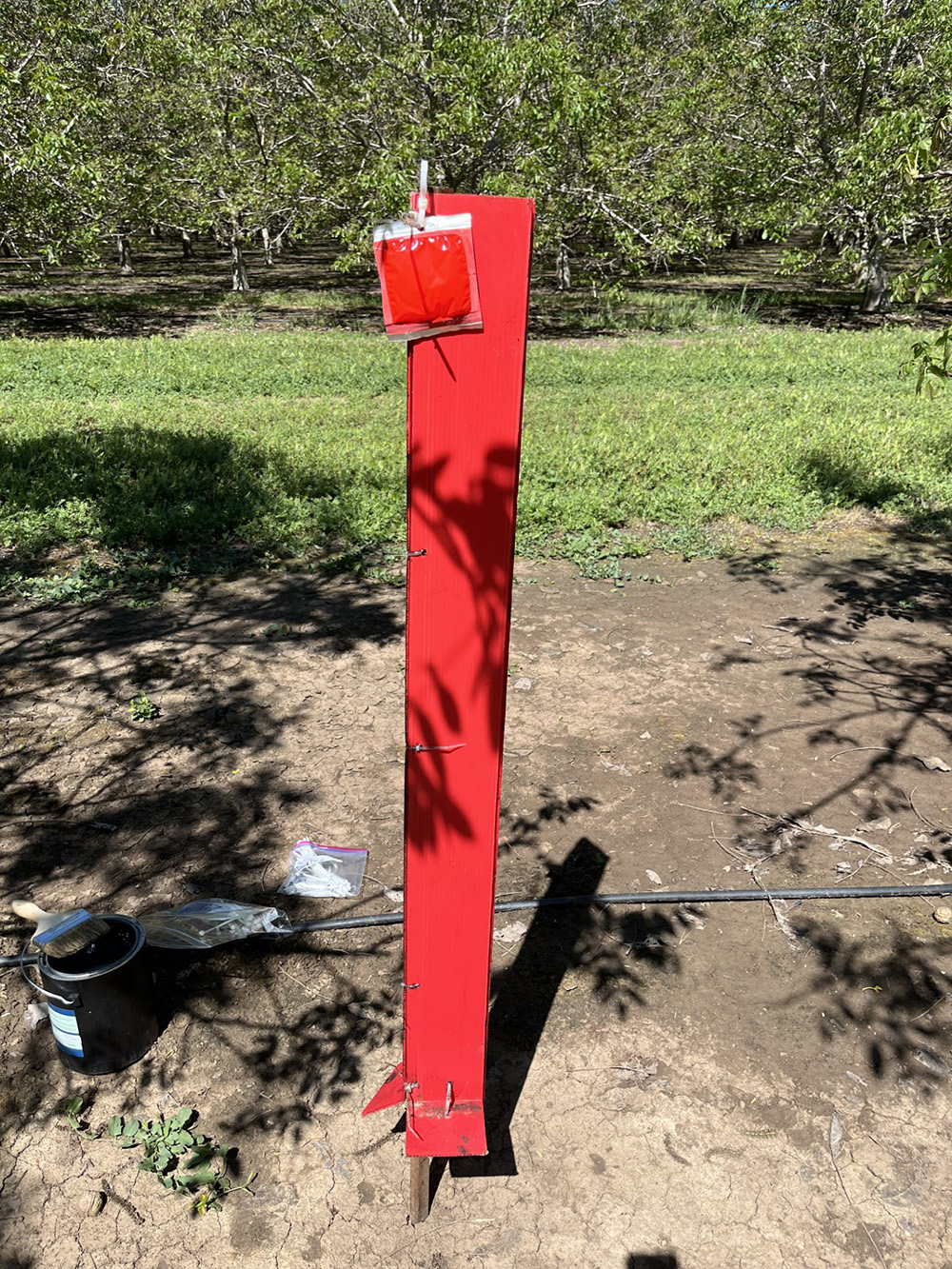
In 2024, researchers built 4-foot-tall triangle traps from six different colors of corrugated plastic and coated with a sticky substance such as Tanglefoot. They wanted to test the results of East Coast trials that found purple was the most attractive for another flatheaded borer species. But the California results differed, likely due to differences in behavior among species.
“Red and yellow captured the higher number of adults, which we were very happy about,” Sakaki said of their trials.
To aid growers, their lab made a YouTube video that provided step-by-step instructions to build unique triangular traps. But constructing them can be cumbersome and time-consuming for growers, so the researchers in 2025 wanted to look at other prebuilt, readily available insect traps.
They tested other commercial traps, such as yellow panel traps, a smaller red triangle trap with a sticky panel and the UCCE-made 4-foot-tall triangular trap. The results showed that yellow and red triangular traps caught the most adult flatheaded beetles.
In a separate trial in 2025, the researchers paired triangular traps with experimental lures from various sources and saw promising results. They are continuing the trial this season.
One of the challenges with flatheaded borers is they spend most of their lives under tree bark and protected from insecticides. Only during a brief period from May through early July do the adult beetles emerge from the branches or trunks to mate and lay eggs.
Actual emergence can vary slightly from year to year and area to area based on average summer temperatures. On average, mid-June is when adult activities peak. Using the traps and tracking borer activities throughout the season could alert growers of the pest’s presence in their orchard, Sakaki said.
In addition to biology and monitoring research, the researchers have conducted several trials as part of a multistate project examining the efficacy of different insecticides. The results showed that commonly used insecticides, particularly diamides, can help reduce flatheaded borer damage when applied in the summer. But it may take several years to see the impact, especially when pest pressure is heavy, Rijal said.
Vicky Boyd is a reporter in Modesto. She can be reached at agalert@cfbf.com.

In this issue...
• Big cats complicate ranchers' livelihoods
• California weighs 'truth in labeling' wine industry law
• Water guides discussion at global agriculture forum
• Dry conditions push farms to new irrigation strategies
• Study measures regulatory costs for Napa vineyards
• Researchers study ways to control flatheaded borer
• New CDFW director addresses priorities, predators
• National survey shows most farmers can't afford fertilizer
• What options are available to manage citrus thrips?
• Efficient irrigation through smart and informed irrigation purchases
• Going farm fresh: School districts look to growers as they ditch ultraprocessed foods
• Bountiful Finds: A curated collection of goods made by Farm Bureau members
• Super Snacks: Big California Flavor
• Peaches signal arrival of prime fruit season
• The Scenic Route: Pit stops at California farms and ranches
• From auction ring to dinner table: Coalition ensures no junior livestock exhibitor goes without a sale
• Why calling 811 before you dig is essential for California farmers
• Study: Maximize winter cereal yields with less water





.svg.png)
