


Big cats complicate ranchers' livelihoods
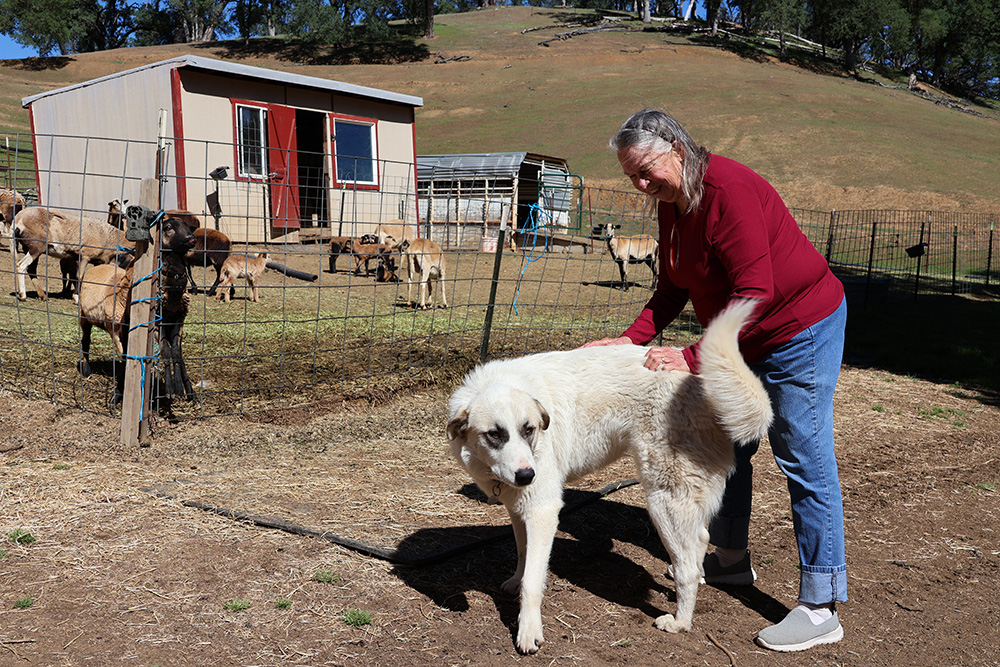
To protect her livestock from mountain lions, Lake County rancher Betty Carrola uses a Great Pyrenees as a guardian dog.
Photo/Manola Secaira


By Manola Secaira
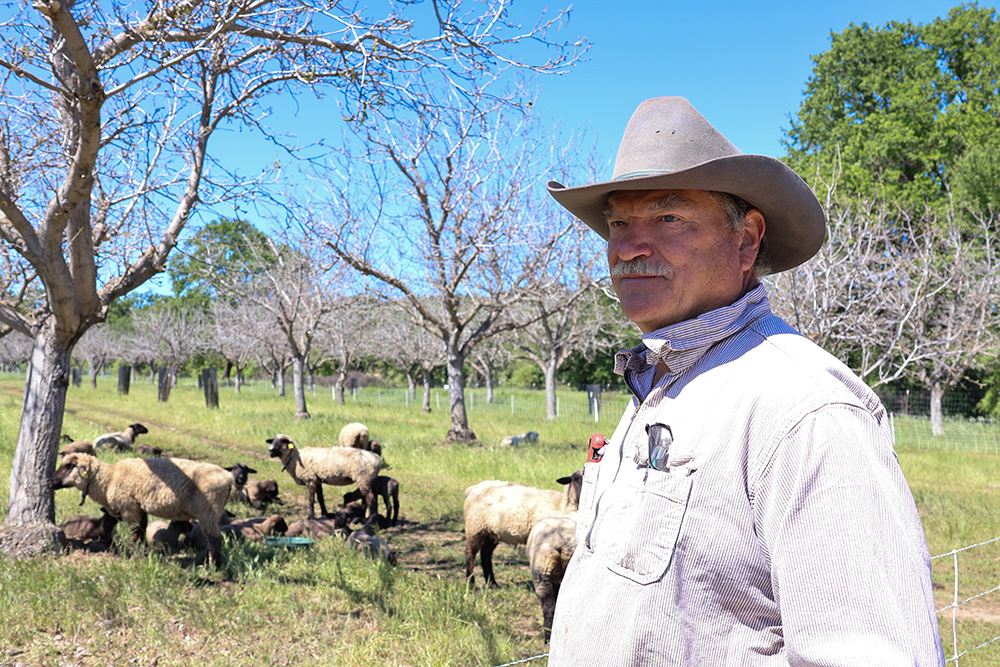
Darrell Suenram lives in mountain lion country. From a barn atop a hill on his family’s 220-acre ranch in Lake County, it’s easy for him to spot neighbors who’ve felt the impacts of that reality. They’re in every direction.
To the right is a neighbor who lost 23 ewes in one night. A little to the left, a different neighbor lost a couple goats. In another direction, a neighbor on the edge of his property also lost goats.
It would be hard to find someone in Suenram’s Lower Lake community who hasn’t at least heard of a mountain lion passing through the area. Many have lost pets and livestock.
State officials estimate there are between 3,645 and 4,750 mountain lions throughout California. Protections for the predator, which has struggled to thrive in some areas, have increased over the years. Residents in areas such as Lower Lake say these changes have made it difficult to respond to the lions when they become a problem.
Suenram raises sheep and cattle and farms walnuts and hay. He said his father-in-law, Phil Adamson, who was born in 1937 and raised on the ranch, never saw or had issues with mountain lions in his youth.
But Suenram has seen that change in recent years. His first encounter happened when he and his family lived in Grass Valley, Nevada County. In 2018, a mountain lion killed a lamb raised by his daughter. He got a Great Pyrenees to guard his sheep after that.
He hasn’t had any mountain lion issues since moving to Lower Lake in 2020, but they’re still an ever-present threat.
Photo/Manola Secaira
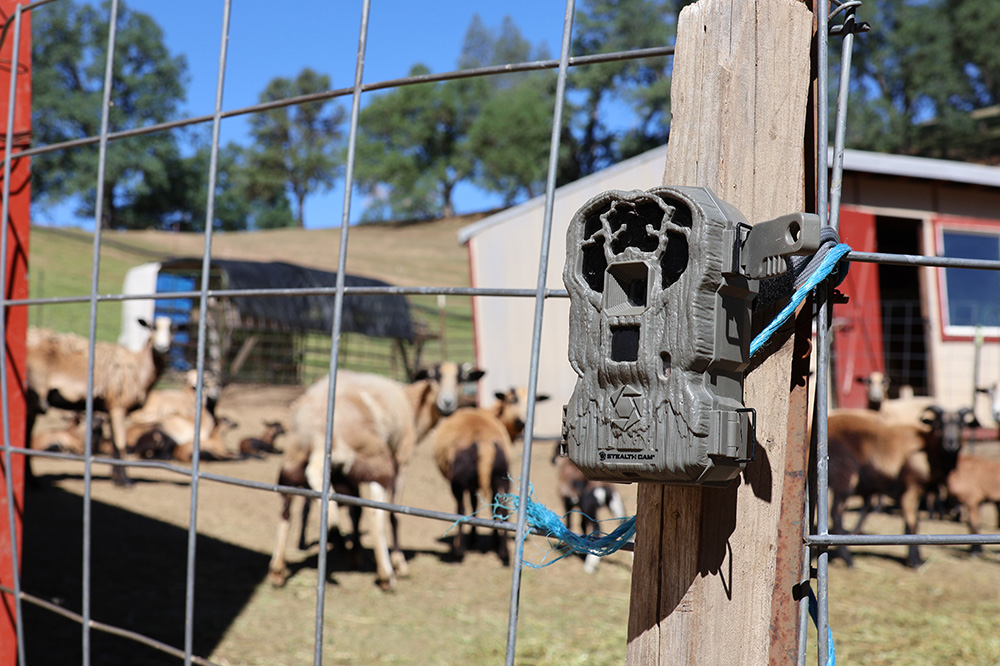
“We’ve seen them fairly regularly on game cameras, including one that was approximately 50 yards from a home on the ranch,” Suenram said, referring to the home where his 93-year-old mother lives. “We had a game camera in our vegetable garden to spy on racoons and opossums that we suspected were eating the cabbage and watermelons. We did not expect to see a mountain lion sauntering through the garden.”
Betty Carrola, his neighbor, runs a 40-acre ranch with about 50 sheep and nine goats. Before 2023, she had around 70 sheep, but she said she’s steadily lost them due to depredation. She said she suspects most of the kills came from mountain lions because she frequently catches them on camera walking through her property.
While her sheep have slowly recovered in number, she said nothing feels the same. She’s made some changes in an effort to protect her flock, including employing deterrence tactics advised by the California Department of Fish and Wildlife. Such actions are often required before the state can take further action in response to a report.
The measures include wire fencing around the pen where she keeps her sheep nightly, guardian dogs, and motion-activated cameras, alarms and lights.
She said she’s much less likely to go on walks around her property at night.
“It’s changed our lives,” Carrola said.
Evolving protections, policies
Mountain lions in California have faced challenges as their environments are developed. Blocked in by roads and other human-made structures, their ability to roam has been limited, leading to inbreeding that then contributes to species decline.
Fernando Najera, director of the University of California, Davis, California Carnivores Program, said these challenges are particularly severe in Southern California. But northern populations face similar issues.
“The habitat fragmentation and the expansion of wildland and urban interfaces—it’s huge everywhere in the state,” he said.
In February, CDFW listed the species’ populations in parts of Southern California and the Central Coast as threatened, broadening protections for mountain lions spanning from the San Francisco Bay Area to the southern border.
In a statement, the department said the listing “provides additional protections to aid in the recovery of the species but does not fundamentally change how the CDFW manages mountain lions across California.”
Photo/Manola Secaira
The protections aren’t new. Californians voted to ban mountain lion hunting and create a habitat conservation fund in 1990. Efforts to study the statewide population intensified in the 2010s. In 2020, the state listed mountain lions in parts of Southern California and the Central Coast as candidates for protected status under the state’s Endangered Species Act. By then, CDFW had also launched its “three strikes” policy, which directs the department to allow a lethal depredation permit only after a landowner has employed deterrents and has had a third reported incident confirmed.
Even lion removal can be complicated.
“People think that if we take that mountain lion from the site, the problem is solved,” Najera said. “And it’s not, because that territory is going to get vacant, and then another animal is going to get there as well.”
Still, many impacted residents say the current system doesn’t work for them. Carrola said she’s filed a wildlife incident report after each depredation she’s come across on her property this year. The reports, which can be filed by people who’ve had livestock killed by predators, are sent to CDFW officials for investigation.
Before the three strikes rule, Carrola said incident reports were more likely to spark action to remove a problem lion. Nowadays, officials will often tell her they can’t confirm the incident, which means no further action can be taken. In other cases, they might confirm a report but still wait for another strike before taking action.
Carrola said waiting means losing more sheep.
“Since this new set of rules has gone in, there’s been a lot more losses,” she said.
Losing animals, business
Vince Fontana, a San Mateo County rancher, said he doesn’t blame mountain lions for acting on their nature. But with regular incidents of livestock killed by the predators on his property, he said it’s not sustainable. He said he also feels his concerns are neglected by state officials.
“It’s a very frustrating situation for anybody in the rural communities, pet owners and the ranchers,” he said. “We’re the ones that are living and working and basically co-existing with these animals.”
San Mateo County Farm Bureau President BJ Burns said he’s heard similar concerns from other impacted locals. Many have talked to him about a need to reboot the state’s strategy. One change could be to create a compensation program similar to what exists for ranchers impacted by gray wolves.
“I strongly feel that the state should reimburse these ranchers and these people that are losing their animals,” Burns said. “We’re losing animals, and it affects the business.”
Ranchers aren’t alone in calling for a change. Pamela Lynch, a San Mateo resident, has had two pet dogs killed by mountain lions. She said neighbors now communicate mountain lion sightings and offer warnings “nearly daily” to each other through online platforms such as Google Groups or Nextdoor.
“I try to forget about it,” she said, referring to an incident in which she witnessed the depredation of a pet. “It’s still very stressful. Every time I let my dogs out, I’ve got to be out there with them, and I’ve got a pitchfork in hand.”
Suenram said he doesn’t believe the problem will go away for his community anytime soon. In the meantime, he said he wants what many other impacted residents want: for the mountain lions to stay away, which would require some consequence for their presence, he said. It could mean having CDFW officials act sooner to address problem lions or allowing them to be hunted in a limited capacity, as is done in Oregon.
“They have no fear of man,” he said of the lions. “If we could hunt them and put that fear, that respect for people, I think they wouldn’t be moving into these urban interface areas so much because they know that there is a good chance that they could get killed.”
Manola Secaira is a staff writer for Ag Alert. She can be reached at msecaira@cfbf.com.

In this issue...
• Big cats complicate ranchers' livelihoods
• California weighs 'truth in labeling' wine industry law
• Water guides discussion at global agriculture forum
• Dry conditions push farms to new irrigation strategies
• Study measures regulatory costs for Napa vineyards
• Researchers study ways to control flatheaded borer
• New CDFW director addresses priorities, predators
• National survey shows most farmers can't afford fertilizer
• What options are available to manage citrus thrips?
• Efficient irrigation through smart and informed irrigation purchases
• Going farm fresh: School districts look to growers as they ditch ultraprocessed foods
• Bountiful Finds: A curated collection of goods made by Farm Bureau members
• Super Snacks: Big California Flavor
• Peaches signal arrival of prime fruit season
• The Scenic Route: Pit stops at California farms and ranches
• From auction ring to dinner table: Coalition ensures no junior livestock exhibitor goes without a sale
• Why calling 811 before you dig is essential for California farmers
• Study: Maximize winter cereal yields with less water





.svg.png)
