


Vineyard workers feel wine industry pain
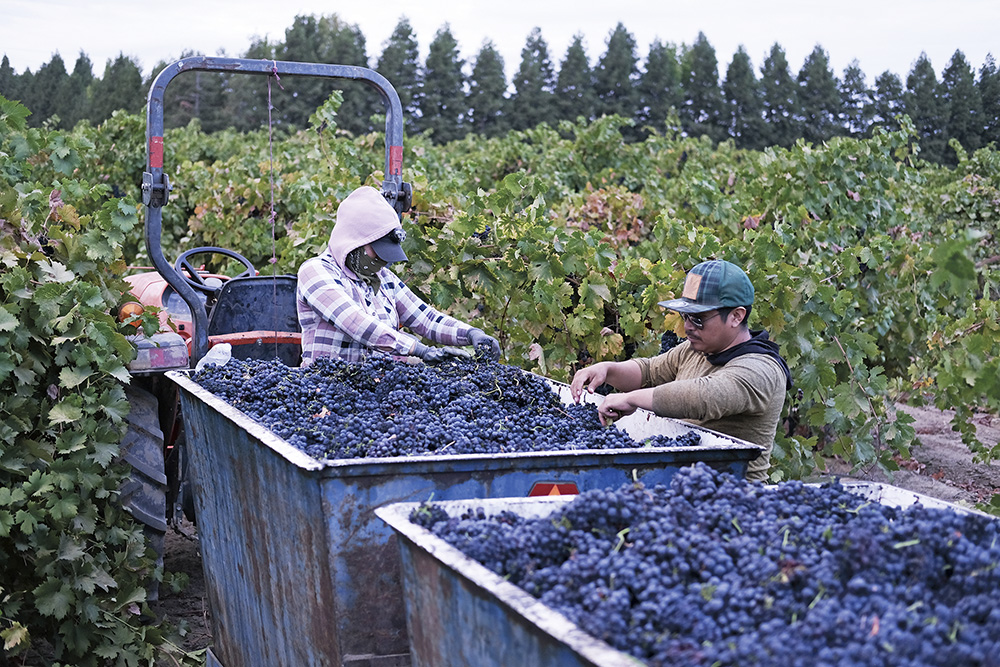
Contract laborers remove debris from old-vine zinfandel grapes this month in Lodi. Because of a downturn in the wine industry, California grape growers have removed vineyards, cut back on hand labor and left fruit unharvested, resulting in a substantial loss of employment for vineyard workers.
Photo/Caleb Hampton


By Caleb Hampton
California farmworkers suffered a wave of job losses during the past few years as work in the state’s winegrape vineyards dried up amid a yearslong market slump.
Since 2023, declining wine consumption left growers with an oversupply of grapes, forcing many to sell their fruit at a loss or watch it rot on the vines. To limit their losses, growers cut back on labor and other costs, and vineyard owners removed an estimated one-quarter of the state’s winegrape acreage.
As a result, the iconic sector likely shed at least several thousand vineyard jobs, industry leaders estimated, with some workers getting laid off and others losing hours.
“It’s pretty ugly,” said Guadalupe Gonzalez, a Napa Valley vineyard crew supervisor at Jaguar Farm Labor Contracting Inc., which is headquartered in Delano.
Gonzalez, who has worked in the region’s vineyards for more than a decade, said she used to work seven days a week during harvest, earning enough to save up for the offseason. But last year, she said, work slowed as grapes went unpicked and more wineries opted to harvest with machines.
This year, “It’s a thousand times worse,” she said.
A few weeks into harvest, Gonzalez was working only every other day, earning less than half what she made a couple years ago. There was “desperation” among her crew members, she said, and her own paycheck barely covered the cost of childcare for her two young children, while rent and other living expenses bore down on her.
“It’s worrying,” she said.
In 2022, California winegrape vineyards supported the equivalent of 49,372 full-time jobs, about 12% of all the farm jobs in the state, according to a report commissioned by the California Association of Winegrape Growers.
Jeff Bitter, president of Allied Grape Growers, which markets winegrapes for about 500 growers in California, said that as a baseline he expected employment loss in vineyards mirrored the 25% reduction in acreage.
“On top of that, with the acres that are in the ground, growers are making efforts to cut costs by any methods possible, and a lot of that is labor,” said Bitter, who grows winegrapes in Madera County. “There’s a huge impact on the farm labor community.”
Vineyard managers said they were mechanizing the labor-intensive work of pruning, when possible, and limiting or mechanizing canopy work.
Aaron Lange, president of Acampo-based vineyard management company LangeTwins Inc., said until a few years ago he saw thousands of workers pulling leaves each year in the Lodi area to allow air and sunlight to penetrate vineyard canopies.
“That occurred every spring like clockwork,” Lange said. “I saw very few crews doing that this year. If leaf pulling is done at all, it’s done with a machine.”
While layoffs at wineries made headlines in recent years, experts said job losses in vineyards were difficult to track because laws requiring that mass layoffs be reported to the state do not apply to seasonal labor.
Philip Martin, professor emeritus of agricultural and resource economics at the University of California, Davis, said it can also be “hard to find employment changes” across an entire crop sector when much of the work is done by contract laborers, as is the case with winegrapes, because the quarterly employment census conducted by the U.S. Bureau of Labor Statistics does not categorize those workers by commodity.
Farm labor contractors specializing in vineyard work said they had downsized significantly.
Steve McIntyre, CEO of Soledad-based Monterey Pacific Inc., which manages thousands of acres of vineyards across several coastal counties, said he was employing about 20% fewer people than a few years ago.
Noe Cisneros, owner of Bakersfield-based Empire Ag Inc., which primarily serves winegrape vineyards in Kern and Tulare counties, said his company went from employing about 900 people to just 150 during the past three years after its largest client, a major winery based in Northern California, pulled out its vineyards in the region, while other clients also removed acreage.
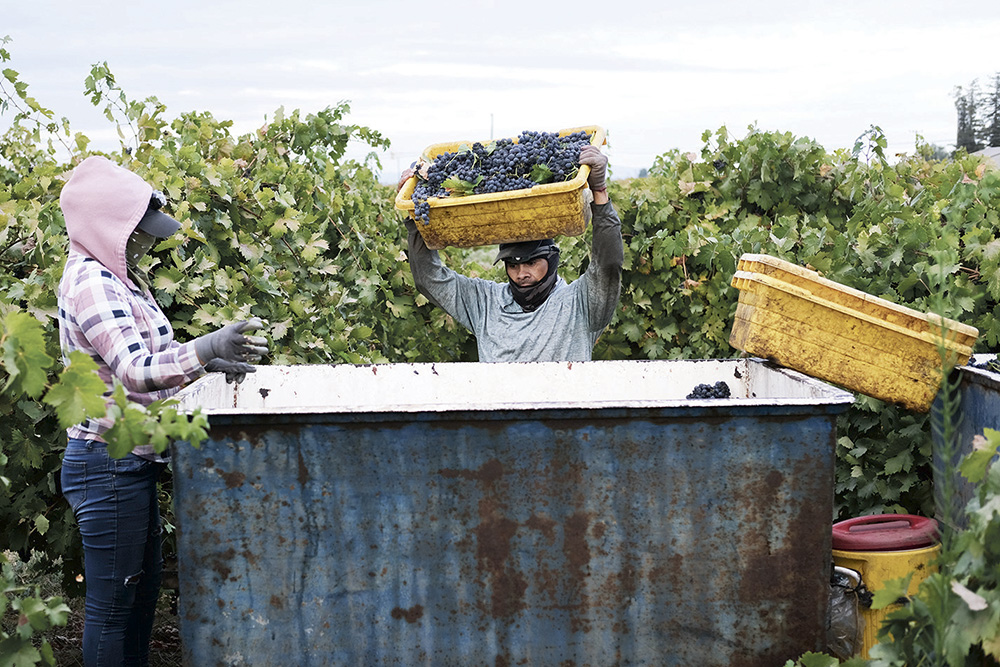
Photo/Caleb Hampton
“We’ve been knocking on doors, trying to find new contracts for our crews to continue working, but it’s become very hard,” Cisneros said. “It’s tough all around.”
Several labor contractors specializing in vineyards shut down altogether, said Kimberly Clark, executive director of the California Farm Labor Contractor Association.
Farmworkers and labor contractors said some vineyard workers may easily pivot to other crops—or already work in them—but that isn’t the case for everyone.
Gonzalez said she sought out other farm work to supplement her declining vineyard income but “couldn’t find anything anywhere.”
Mario Galvan, owner of Lockeford-based Galvan Farming Services Inc., said he was forced to lay off longtime crew leaders as his Lodi-area business shrunk by nearly half within the past few years, while harvest income was down about 40% this year for his remaining workers.
“A lot of families have been doing this for many years,” Galvan said of vineyard work in San Joaquin County. He said older workers, particularly those whose experience was mostly in winegrapes, may have a harder time finding new jobs.
Bitter said growers typically cut back first on contract labor while trying to retain farm employees. But as the crisis “went on and on,” financial distress left some with little choice but to lay people off.
Andrew Forchini, a Sonoma County winegrape grower and vineyard manager, said he went from selling nearly all his fruit two years ago to this year possibly leaving 90% of it unharvested. With few grapes to pick, Forchini said, his three employees were losing crucial income.
In March, Forchini started a land management company, Healdsburg-based AF VINES, partly to create opportunities for his employees to earn money gardening, landscaping and repairing properties.
“My employees have been with me for decades,” Forchini said. “They do everything for us.”
Experts say it remains unclear when the winegrape market will stabilize, but most expect a long-term downward adjustment to match lower demand for wine.
In the meantime, Gonzalez said she was weighing her options. Despite having a passion for vineyard work, she said, the industry’s decline had forced her to consider leaving the field.
“It’s really taking a toll,” she said.
Some quotes in this story were translated from Spanish.
Caleb Hampton is an editor at Ag Alert. He can be reached at champton@cfbf.com.
Reprint with credit to California Farm Bureau. For image use, email agalert@cfbf.com.

In this edition…
• View full issue
• Vineyard workers feel wine industry pain
• El Niño increases chances of winter storms and floods
• Everyone wins when farms invest in their employees
• New DWR director discusses water resiliency plans
• Irrigation can't shield tomatoes from extreme heat
• Owl study assesses rat management in nut orchards
• What is the best strategy to manage Botryosphaeria?
• Wage-and-hour questions from the field
• Vineyard adaptation to heat an economic balancing act
• Advocacy in Action: Dairy, water, wolves and trade
• Are irrigation jets right for your orchard or vineyard?
• Training aims at preventing heat illness in farmworkers





.svg.png)
