


Are irrigation jets right for your orchard or vineyard?
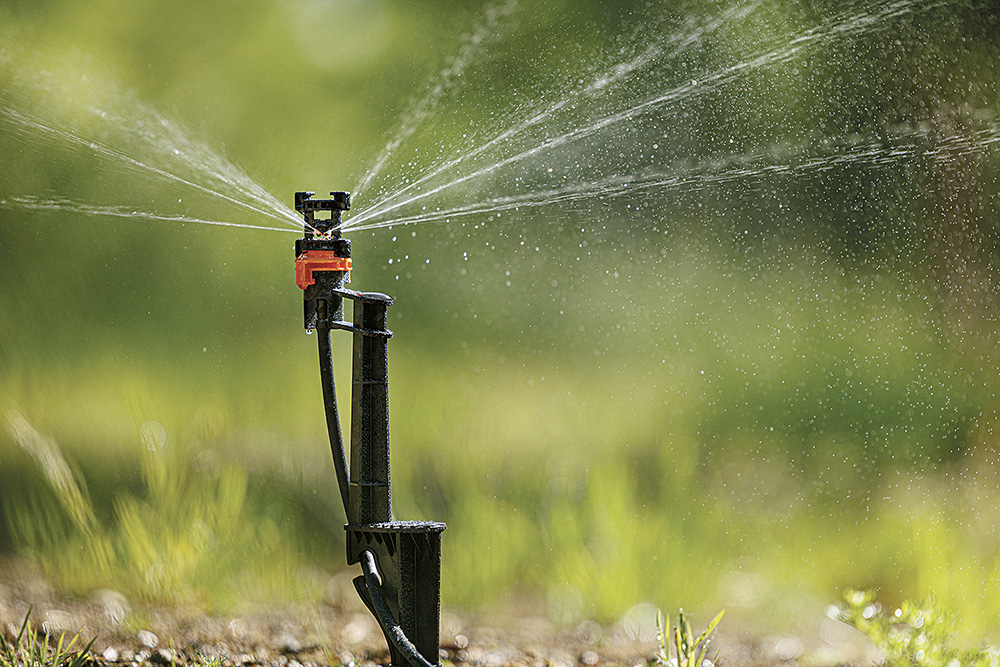
Though drip irrigation has become popular in orchards and vineyards, there are conditions when jet irrigation is a good option.
Photo/Studio 46


By Charles Burt
When irrigating orchards and vineyards, there is no one-size-fits-all answer. Drip systems have become a popular choice, but under the right conditions, irrigation jets can be a good option.
 Jets have been used in orchards and vineyards since the mid-1970s. The technology has come a long way since the early days, when simple jets were attached directly to hoses. Today’s systems can include stakes, more durable materials and better manufacturing controls. Some growers use jets in conjunction with drip lines, while others rely entirely on jets.
When do jets make sense?
Jets can be particularly useful in situations where growers need to wet a larger portion of the soil surface.
For example, they can work well in sandy, rocky or shallow soils that do not hold much water. They can also be a good choice in orchards where trees are planted relatively far apart.
Jets may also offer an advantage when frost protection is a concern. By wetting more of the soil surface, they can provide some additional protection against cold temperatures.
Another consideration is salty irrigation water. The amount of salt delivered is the same whether a grower applies 3 acre-feet of water through drip or through jets. But because jets spread that water over a larger area, the salt is distributed through more soil. That can reduce the concentration of salt in the root zone compared with a tightly concentrated drip pattern.
Jets can also make it easier to apply certain soil amendments. For example, gypsum can be spread across the soil surface and then incorporated into the soil with irrigation water. Done correctly, this can help reduce runoff and add calcium to the soil.
The spray pattern can also be adjusted to help support a cover crop growing between orchard or vineyard rows. Where jets may not be appropriate is when the drive row needs to remain dry and clear, making a large, wetted area undesirable.
Jets are not without their challenges.
One long-standing problem is damage from squirrels and mice, which can chew through the small spaghetti hoses that connect jets to the hose. Growers have addressed this in several ways, including protecting the spaghetti hose with spiral wrapping, placing jets close to the hose connection or burying the spaghetti hose just below the soil surface.
Another concern is wear and tear from abrasive materials in the irrigation water. This can become a particular issue when gypsum is applied incorrectly. Using the right type and amount of gypsum helps, as does choosing jets with durable nozzles and spray plates. The quality of the materials can vary considerably among manufacturers.
There is also the issue of evaporation. Because jets wet more of the soil surface than drip systems typically do, more water can be lost to evaporation.
Years ago, I directed a large California study on evaporation, and our team found that in almonds in the Five Points area, estimated evaporation increased as more of the soil surface was kept wet. The estimates were about 3 inches of evaporation when 20% of the soil surface was wet, 6 inches at 40% and 8 inches at 60%.
But those numbers don’t tell the whole story. How often the system runs matters, too. And the evaporation is partially offset by a reduction in transpiration.
Another important difference between jets and drip is how the system is designed.
There are many pressure-regulating drip emitters on the market. There are far fewer comparable options for jets. That means the overall design of a jet system becomes especially important.
This is particularly true on hilly, rolling and steep ground, where elevation changes can affect how much water individual jets discharge. A system that works perfectly on flat ground may not perform nearly as well on a slope if it is not designed properly.
For this reason, the irrigation dealer or designer matters. Experience designing flat-ground drip systems does not necessarily mean someone has the expertise to design a jet system for uneven terrain.
Manufacturers offer a variety of spray patterns and nozzle sizes. Because companies generally do not disclose the specific plastic materials they use, growers cannot always determine precisely how a particular product will hold up to sunlight and wear.
Instead, growers should ask practical questions. How easy is it to change the nozzle or spray plate? What spray-pattern options are available? How are the grooves in the spray plate made? And how well do the materials hold up to wear?
Perhaps the best test is to look at systems that have already been successful. Growers should ask manufacturers for examples of working installations and, when possible, visit those orchards or vineyards.
Using jets successfully also requires a different approach to irrigation scheduling than using drip. Consider double-line drip, which was originally designed to wet a relatively large area of soil. Over time, however, the two lines can end up close together, creating a much smaller wet area than intended.
Growers also sometimes irrigate only twice a week because of labor or management schedules. Over the course of the week, they may apply the right total amount of water for the crop. But during each irrigation, they can put more water into the limited wet area than the soil can hold. Some of that water moves below the root zone, while the trees may face water stress before the next irrigation. The answer with drip is often shorter, more frequent irrigation runs.
Jets are different.
With a wide spray pattern, running a small amount of water every day can actually increase evaporation because so much of the soil surface remains wet. In many cases, a wide-pattern jet system may be better suited to irrigating a block about twice a week, unless runoff becomes a problem.
Ultimately, the most important lesson applies to drip and jet irrigation: Don’t judge an irrigation system only by what you see above ground. The real question is what is happening in the soil. One of the best ways to find out is to dig some trenches and check how deeply the water is moving, how far it is spreading and whether the tree roots are getting the water they need.
There are good reasons to choose jets, and there are good reasons to choose drip. In many orchards and vineyards, the best answer may fall somewhere in between.
The key is to match the irrigation system—and the way it is operated—to the soil, terrain, trees and conditions in the field.
Charles Burt is irrigation professor emeritus of Cal Poly, San Luis Obispo, and founder of the Irrigation Training and Research Center. He can be reached at charlesmburt@gmail.com.

In this edition…
• View full issue
• Vineyard workers feel wine industry pain
• El Niño increases chances of winter storms and floods
• Everyone wins when farms invest in their employees
• New DWR director discusses water resiliency plans
• Irrigation can't shield tomatoes from extreme heat
• Owl study assesses rat management in nut orchards
• What is the best strategy to manage Botryosphaeria?
• Wage-and-hour questions from the field
• Vineyard adaptation to heat an economic balancing act
• Advocacy in Action: Dairy, water, wolves and trade
• Are irrigation jets right for your orchard or vineyard?
• Training aims at preventing heat illness in farmworkers





.svg.png)
