


New DWR director discusses water resiliency plans
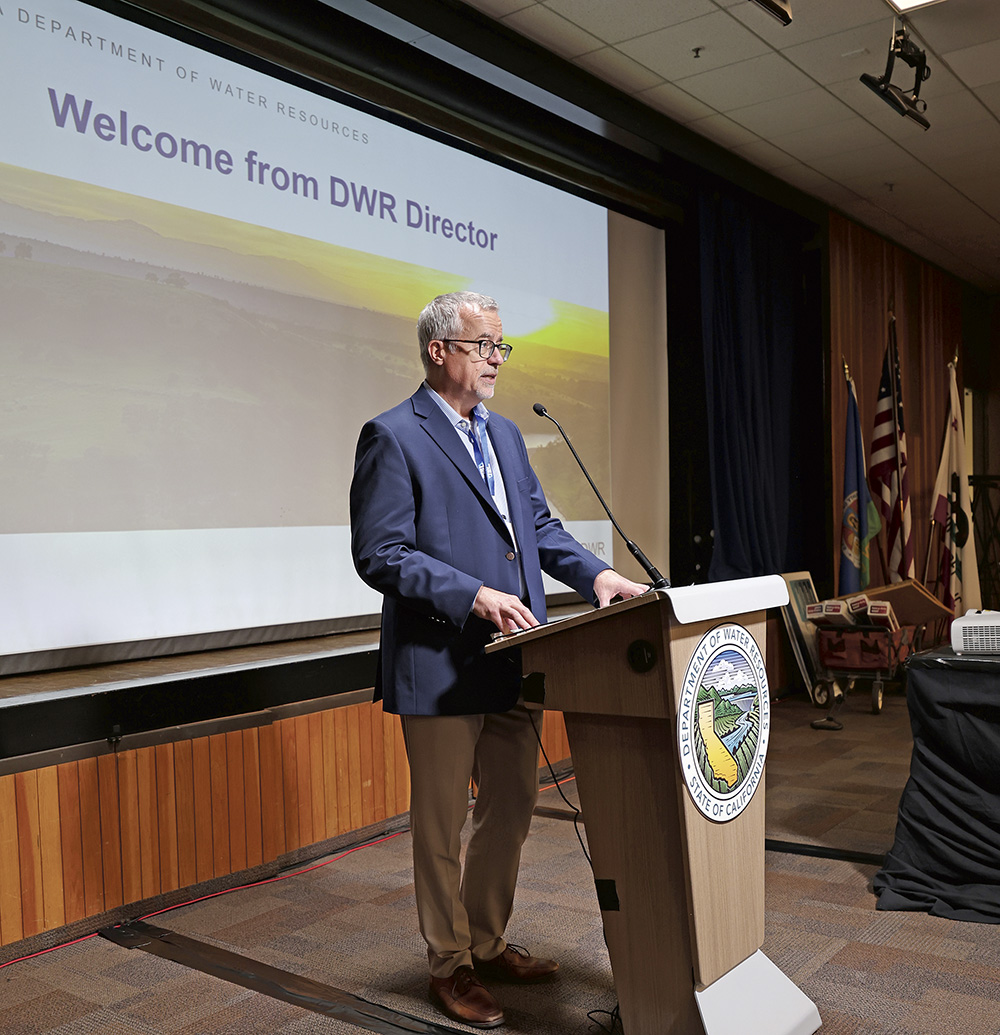
California Department of Water Resources Director Thomas Gibson speaks at the California Water Plan advisory committee meetings in Los Angeles last month.
Photo/Courtesy of California Department of Water Resources


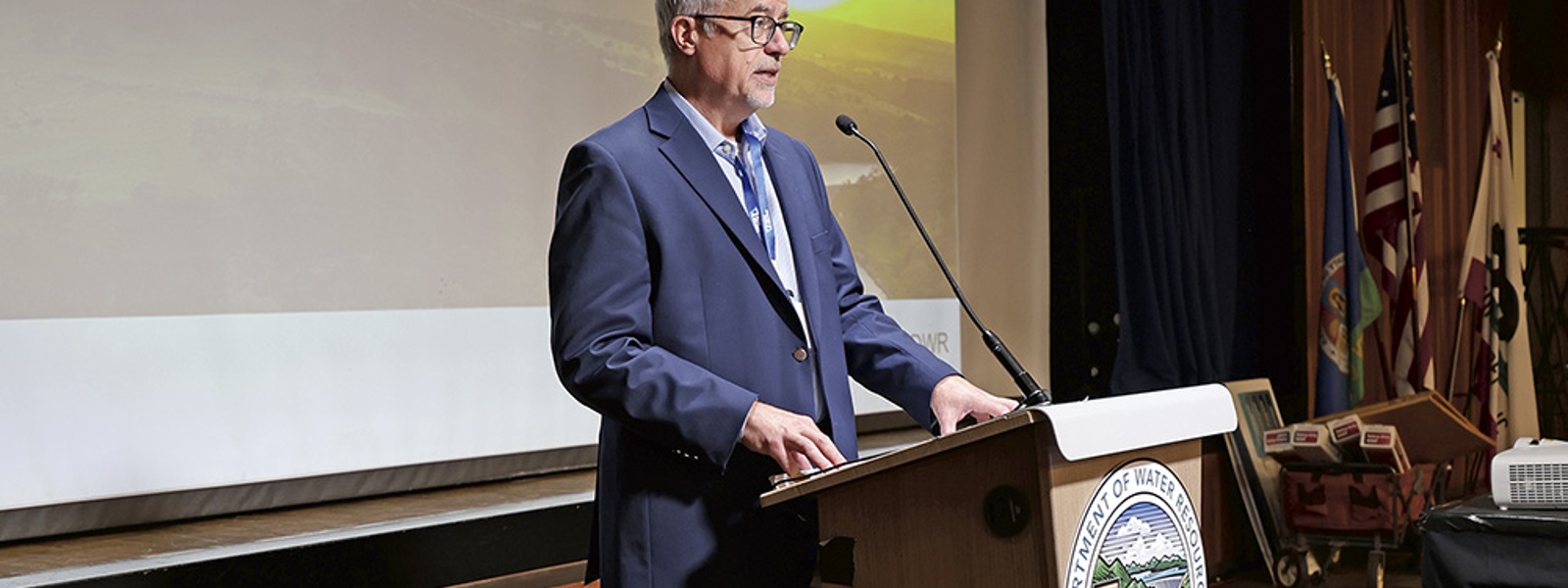
• The California Department of Water Resources swore in its new director, Thomas Gibson, in July. He previously worked in various state agencies addressing water issues, including stints at the state Department of Fish and Wildlife and Natural Resource Agency. Gibson spoke with Ag Alert® about his priorities as he steps into his new role.
This interview has been edited for length and clarity.
How has your past experience informed how you think about California’s water issues?
 I’ve worked in water for most of my career at this point. I was a lawyer in private practice that worked on some water matters for about a decade and then came to work at the state department. At the time, it was called the Department of Fish and Game; now it’s the Department of Fish and Wildlife. I was the general counsel there for a number of years. Then I went to the California National Resources Agency and held a few positions there before joining the Department of Water Resources about five years ago.
I think that helps me in this position, having the background of those different perspectives on water, because in all those cases, I’ve worked primarily on water issues. So, a long time in the water world, but from different perspectives.
In private practice, you’re representing your client’s interest, usually in the litigation context of working on water matters. Then at the Department of Fish and Game, I worked from the perspective of the regulator. But at the same time, we were trying to be productive and pragmatic, working on California’s solutions but from that lens. And then came the Department of Water Resources, where we’re on the water supply side.
It really helps me to have the background of working on these matters from different perspectives, understanding and respecting the different statutory mandates they have, understanding that those mandates really collectively comprise the California policies around how we handle water. So, it helps me to understand what they might need, what our needs are and then, ideally, find a path forward that satisfies everybody.
What are some early priorities for you as you step into this position?
Well, there are a number of projects that are key administration priorities that we need to really maintain momentum on.
One is the Delta Conveyance Project, which is our big climate adaptation project for our water future. There’s also the Healthy Rivers and Landscapes Program; that used to be called the VAs (voluntary agreements). It’s really the water user community, including agriculture, coming together and bringing more resources to bear and different resources to bear, to find a new way to meet the requirements of the state water board’s water quality control plan with less water cost. We’re freeing up, hopefully, water for continued productive use while at the same time meeting the needs of the water board.
The Sites Reservoir Project is another big one. The water board is completing its permit for that hopefully in the fall, and then we’re hoping to get a final award from the water commission for funding for that project, which would be the first major surface water storage project in a generation.
And then more recently, SB 72 (signed into law in 2025), which really modernizes our water plan process. It puts some new requirements on us that we’re working towards for a 2028 water plan release where we’ll really be converting the water plan from an inventory into an actionable document based on regional analysis of water supply needs and water supply opportunities.
I’d say those are really the big ones, but then at the same time we have Sustainable Groundwater Management Act implementation and supporting the locals with that ongoing. We have what looks to be a very strong El Niño coming, which could bring with it flood, drought and opportunities for groundwater recharge that we really need to take advantage of.
How much is agriculture part of your day-to-day thinking in this position?
It’s a huge part of what we do. Our mission is to sustainably manage the water resources of the state of California, and a huge part of that is agriculture and supporting the $60 billion a year farming and ranching economy.
The priority projects I mentioned—every one of those has a key tie into agriculture. It really would be hard to separate the two because so much of what we do is really an important connection to agriculture and maintaining our California agriculture.
Many farmers have faced challenges as they work to implement California’s Sustainable Groundwater Management Act mandates while simultaneously dealing with drought conditions. How are you thinking about this issue of water access for farmers? And what solutions do you see there?
It’s a real challenge for California ag now and into the future of, how much farming can we sustainably maintain? We want to be able to sustain as much as we can, but at the same time, getting the groundwater use in the sustainable yield under SGMA—it’s a long-term problem that’s just now sort of coming into focus.
Through groundwater recharge efforts, through the water plan and through projects like the HRL (Healthy Rivers and Landscapes), we’re looking for ways to maximize the water supply everywhere we can. Then, modernizing our infrastructure so that, as much as possible, we can move the water to where it’s most needed. So those are all key activities that we’re working on to try to maintain as much ongoing agriculture as possible while at the same time getting to within sustainable yields.
And then our ever-vacillating hydrology is a challenge, and we go through these weather extremes. We need to be more and more able to capture the water when we have the wet times so that we can balance out the really dry times.
How does California’s hydroclimate whiplash impact how you approach this work?
If you go back a long time, we’ve managed for a fair amount of that through creating the State Water Project and the Central Valley Project, the system of dams and reservoirs where we can store a lot of that water and then move it where needed when we’re able.
With climate change in the hydrology, reducing the snowpack and more atmospheric rivers, we need to be able to really take advantage of those opportunities. Hopefully, with the Sites Reservoir and with the efforts to create those groundwater recharge basins, we’ll be better able to capture the water in wet years and then be able to rely on that in the dry years.
California agriculture is used to that because it’s been our history. It’s getting worse, but we’ve always had that kind of variability. So, I think they understand that, and they’re as good as anybody and probably better than anybody else at how to manage around those uncertainties.
Reprint with credit to California Farm Bureau. For image use, email agalert@cfbf.com.

In this edition…
• View full issue
• Vineyard workers feel wine industry pain
• El Niño increases chances of winter storms and floods
• Everyone wins when farms invest in their employees
• New DWR director discusses water resiliency plans
• Irrigation can't shield tomatoes from extreme heat
• Owl study assesses rat management in nut orchards
• What is the best strategy to manage Botryosphaeria?
• Wage-and-hour questions from the field
• Vineyard adaptation to heat an economic balancing act
• Advocacy in Action: Dairy, water, wolves and trade
• Are irrigation jets right for your orchard or vineyard?
• Training aims at preventing heat illness in farmworkers





.svg.png)
