


El Niño increases chances of winter storms and floods
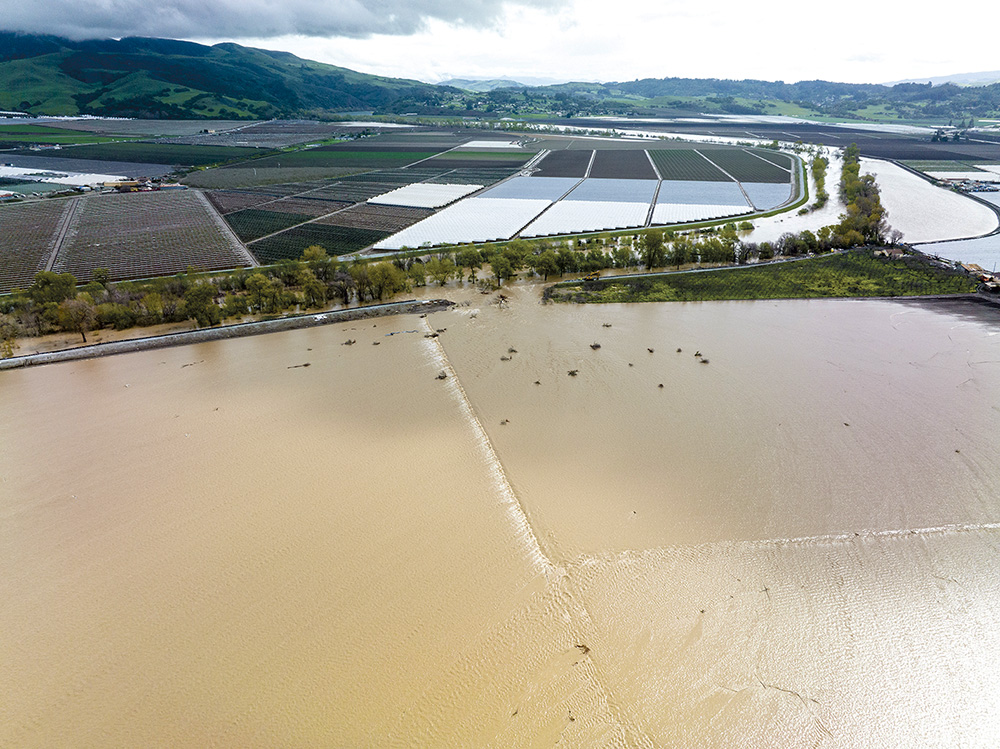
This aerial view shows submerged farm fields caused by floodwaters from the Pajaro River in Monterey County after a levee breach in March 2023.
Photo/Odin Abbott/California Department of Water Resources


By Manola Secaira
California’s water year will be shaped by the arrival of El Niño, a climate pattern that raises the likelihood of intense precipitation and flooding in the coming months.
Experts call the upcoming system a super El Niño. A National Weather Service report in August said there’s a 69% chance its strength would exceed that of previous El Niño events dating back to 1950.
While a stronger-than-usual El Niño might seem to promise more rain—and therefore ample water for farms—experts caution that it doesn’t necessarily mean a boost in snowpack, which helps replenish reservoirs and sustain water supplies through the growing season.
 Paul Ullrich, a regional climate modeling professor at the University of California, Davis, describes El Niño as an event that occurs every two to seven years, driven by shifts in wind patterns and ocean temperatures that can influence weather around the world.
“Essentially, from a water management standpoint, we’re expecting to probably end up pretty well off through the summer season in terms of captured water, but we’re worried about potentially low snowpack for ag,” Ullrich said.
He said El Niño increases the probability of above-average winter precipitation, especially in Southern California. But with climate change driving warmer winter temperatures in California in recent years—a trend experts expect will continue in the future—he said there’s no guarantee that additional precipitation will fall as snow and build the state’s snowpack.
“It is much harder for us in California to make those kinds of predictions,” Ullrich said, adding it’s possible the state will end up getting average or below-average rainfall.
He said 2016 offers a good example of how an El Niño event can fail to deliver the expected precipitation in California. That year, forecasters anticipated that a developing super El Niño would bring intense rainfall to the state. While the event brought heavy precipitation to other regions, its effects were weaker farther south, including in California.
“What we found is that the way that the weather pattern set up resulted in the Pacific Northwest getting drenched and California being left dry,” he said. “It was very opposed to what people were expecting for that particular season.”
California’s snowpack has historically acted as a natural reservoir, contributing around 30% of the state’s overall water supply. But a changing climate and declining snowpack levels by summer have challenged that role.
Karla Nemeth, executive director of the Association of California Water Agencies, said California needs to adapt by investing in more reliable sources of water to ensure water users aren’t left scrambling for supplies when warmer months arrive.
“This is probably a year that is going to demonstrate the value of storage in California that doesn’t rely on the slow drip of snowmelt generating inflow over the course of a long, hot summer after we get a great snowpack,” Nemeth said.
She noted the state has worked to invest more in sustainable groundwater infrastructure so more winter precipitation can be stored even if it doesn’t stick around as snow. In addition to building infrastructure, she said evolving forecasting technology has been key to capturing more rain and managing floods.
When warm rain falls on existing snowpack during back-to-back storms, the snow can diminish quickly, Nemeth said. Therefore, tracking how those storms and their varying temperatures affect the remaining snowpack is essential for planning water supplies for the rest of the year, she added.
State climatologist Michael Anderson said California has also worked to improve its response to extreme weather during the winter, especially after the 2023 floods. One change has been making it easier for impacted areas at risk of flooding to take preventive action, including diverting water from river channels to recharge aquifers.
“A lot of what we did in 2023 (was) kind of in an emergency response mode,” he said. “There’s been a lot of work since then to try and actually move it into a more organized space, done under changes to the water code and work with a control board on how it’s regulated so that you’re not relying on a governor’s emergency order to be able to do it.”
Jason Smith, who grows winegrapes and serves as president of Monterey County Farm Bureau, said the 2023 floods were made worse by environmental regulations that prevented community members from clearing vegetation from waterways such as the Salinas River. He said he would like to see such regulatory restrictions changed.
In the meantime, he said farmers have limited options when preparing for flood conditions. Some basic steps include clearing ditches and culverts and planting cover crops to help prevent sediment from washing away, Smith said.
Monterey County farmer Jynel Gularte saw the impacts of 2023’s atmospheric rivers, which submerged more than 200 acres of her farm, broke her levee in multiple places and destroyed a house. She said the financial damage has been difficult to recover from in the years since.
“As you can imagine, it takes a lot of capital to work your ground, to rebuild your levee,” she said. “We had blocks already planted that never came to fruition, so that was a complete loss for us.”
Gularte said she wants the state to make changes that would better prepare people for future floods, including allowing vegetation that clogs parts of the Salinas River to be cleared so the river can better absorb rainfall during extreme weather.
The 2023 floods did bring Gularte some limited benefits. Her farm relies entirely on groundwater, which was partially recharged by the storms that hit during the first few months of that year. The rainfall also allowed her to use less water for irrigation later in the year.
“On our other ranches that didn’t get flooded, we were able to use the natural rainfall to our advantage and schedule our farming practices around that,” Gularte said.
But she said the benefits of the rainfall did not offset the damage caused by flooding. The 2023 floods left some of her acreage unavailable for planting.
She said she can make some changes to prepare for the incoming El Niño weather, such as waiting to plant in flood-prone areas as late as possible and, if there’s a forecast of intense rain, moving equipment so it doesn’t get washed away by a flood.
“I’m anxious about it,” Gularte said. “I don’t like hearing that it’s going to be a super El Niño because there’s no way we can have another flood like 2023 … That would be absolutely tragic.”
Manola Secaira is a staff writer for Ag Alert. She can be reached at msecaira@cfbf.com.
Reprint with credit to California Farm Bureau. For image use, email agalert@cfbf.com.


In this edition…
• View full issue
• Vineyard workers feel wine industry pain
• El Niño increases chances of winter storms and floods
• Everyone wins when farms invest in their employees
• New DWR director discusses water resiliency plans
• Irrigation can't shield tomatoes from extreme heat
• Owl study assesses rat management in nut orchards
• What is the best strategy to manage Botryosphaeria?
• Wage-and-hour questions from the field
• Vineyard adaptation to heat an economic balancing act
• Advocacy in Action: Dairy, water, wolves and trade
• Are irrigation jets right for your orchard or vineyard?
• Training aims at preventing heat illness in farmworkers





.svg.png)
