


Owl study assesses rat management in nut orchards
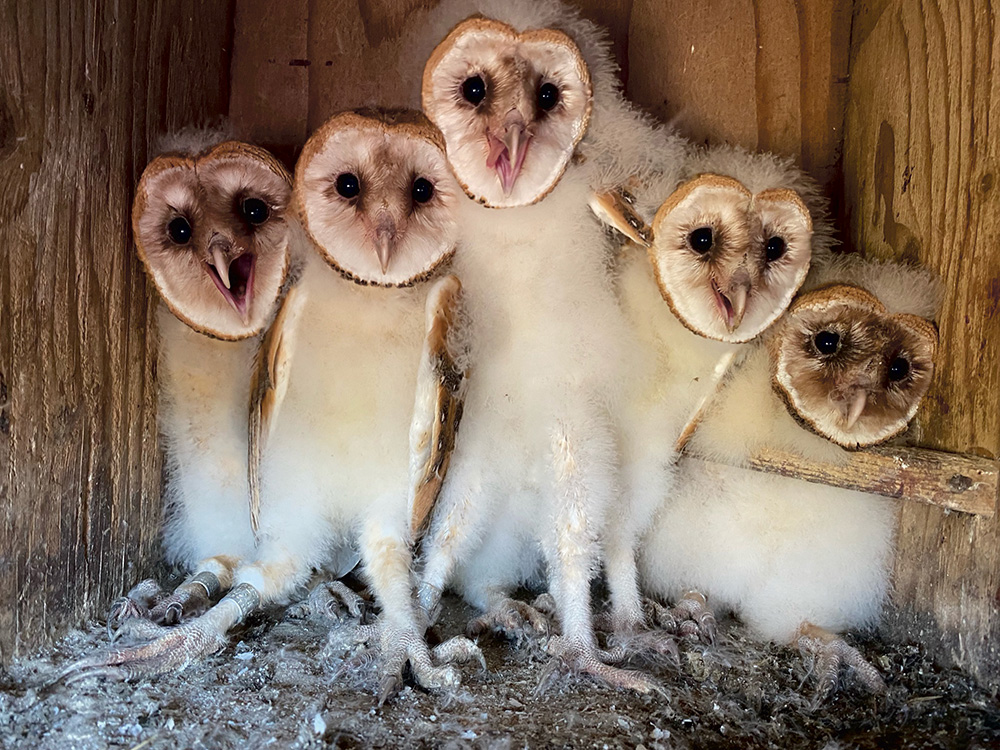
Nestlings spend about two months in the owl box before they’re ready to try their wings. As many as a half dozen owlets typically fill a box, and they eat up to four to five rodents daily.
Photo/Laura Montenegro Echavez


By Vicky Boyd
For more than a decade, university wildlife researchers have studied how installing barn owl nesting boxes and accompanying owl predation help manage small rodents in vineyards. Now they hope to take a similar approach during a three-year study that examines the effects of barn owl predation alone or combined with trapping to potentially manage roof rats in nut orchards.
“We’ve documented that barn owls do indeed reduce the number of voles, gophers and mice, and we’ve learned a lot in the vineyard systems,” said Matthew Johnson, a Cal Poly, Humboldt, wildlife professor who led much of the research. “Now we’re really excited to try some similar approaches in orchards.”
Although many growers have erected owl boxes to control small rodents in vineyards, he said little scientific data existed until recently about barn owl predation and how cultural practices influenced it.
There’s been even less research into the feathered predator’s impacts on orchard rodents.
Funded by a $923,954 grant from the California Department of Pesticide Management, Johnson and fellow researchers will focus on roof rats in almond and pistachio orchards. Joining him is University of California Cooperative Extension wildlife management specialist Roger Baldwin, who conducted research previously into managing roof rats in citrus orchards.
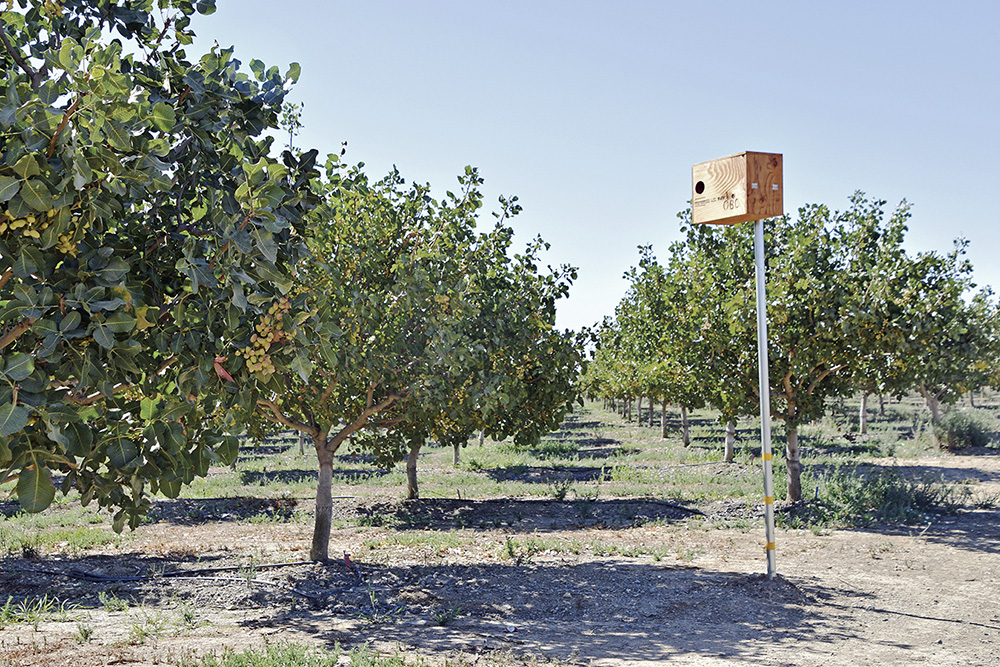
Photo/Vicky Boyd
In that project, Baldwin said his research team found that citrus trees’ dense canopies and evergreen foliage hindered barn owl’s foraging on rats. But the researchers had good success using elevated bait stations with a small amount of toxicant to knock down rat populations. Then they followed up with trapping to maintain the low numbers.
While nut orchards also provide an arboreal environment, Baldwin said they’re deciduous and drop leaves seasonally, unlike citrus. He theorized this may push rat activity onto the orchard floor in the fall, making them more vulnerable to owl predation.
“But there’s so much we don’t know,” Baldwin said.
During his years of vineyard studies, Johnson found barn owls hunt primarily using acoustics or sounds, allowing them to locate prey under mowed cover crops and other natural protection.
Previous work by Johnson and Baldwin noted that a single barn owl family can kill 3,000 to 4,000 rodents annually, frequently reducing rodent populations. In vineyards, field mice, voles and gophers are the dominant prey.
More recent work by Johnson, Baldwin and Cal Poly, Humboldt, doctoral student Karen Gallardo Cruz found that barn owls also create a fear factor, with rodents showing 16% to 38% increased fear of predators.
For their upcoming project, Johnson said they’re seeking cooperating nut producers willing to volunteer at least 40-acre blocks. The orchards would need what he described as the “Goldilocks” of rat issues.
They would need enough rats so researchers could observe potential population reductions with the different treatments. But the blocks couldn’t have so many rodents that the producers would feel a need to use a chemical toxicant to prevent significant economic damage.
He said they hope to have 12 participating blocks. Of those, four will be untreated controls, four will have only owl boxes, and four will have both owl boxes and traps. To learn how to participate, contact Johnson at matthew.johnson@humboldt.edu.
The researchers will begin this fall and spend the first year collecting baseline data on resident rat populations. To do this, they’ll use tracking tunnels and ink pads, among other methods.
Johnson said they’ve already placed an order with a nonprofit organization that builds barn owl boxes and erects them. The nesting sites will be installed before the second year and monitored through the third year.
Using activity cameras and other types of surveillance, the researchers will determine owl predation levels, nesting success and progeny produced. They’ll also identify the types of prey brought back to the nest boxes.
Known scientifically as Rattus rattus, roof rats are agile climbers and frequently build nests in trees, attics or other elevated locations. They’re not a new problem either, having caused isolated infestations in rural and suburban locations for years, Baldwin said.
It’s only been the past two or three seasons that nut producers in some regions have experienced population explosions and related economic damage. The problem isn’t widespread throughout the Central Valley but is a scattered issue.
“The problem is there are pockets where it’s really bad, and in other locations, it’s kind of hit and miss,” Baldwin said.
Not only do roof rats cause economic damage by directly consuming nuts, but they also can injure trees by girdling branches, he said. One of the most common and costly types of damage is destroyed irrigation lines.
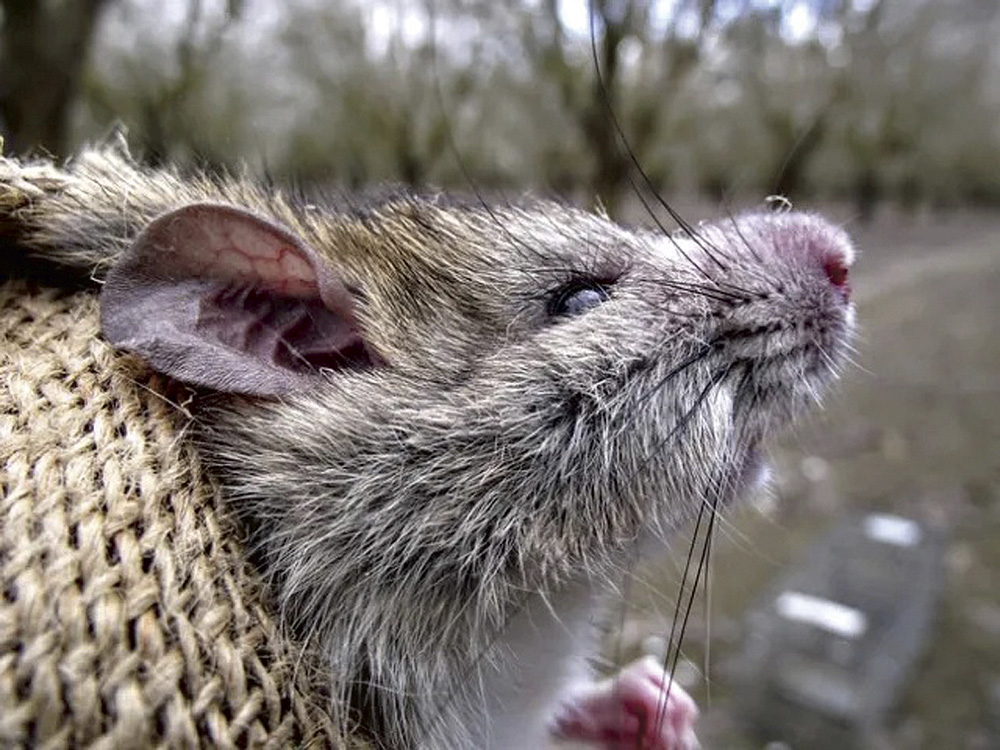
Photo/Courtesy of the University of California
The California Department of Food and Agriculture in March estimated rat damage to almonds ranged from $118 million to $297.7 million, while losses in pistachios were between $48.1 million and $275.5 million. The estimate, which covers about 112,000 acres of almonds and 116,000 acres of pistachios in Fresno, Kings and Merced counties, does not include pest control expenses.
Baldwin said he and Johnson suspect much of the rat problem is tied to the increase in abandoned almond orchards, which provide food and habitat.
“You go two to three years without any management, and you start to see a buildup of rats on the property, and they spread out to adjacent properties,” he said. The problem may multiply when trees are taken out and the rats seek new habitat.
Baldwin also pointed to other possible causes, including further restrictions on chemical rodenticides and in-burrow fumigants that many growers have relied upon.
Vicky Boyd is a reporter in Modesto. She can be reached at agalert@cfbf.com.
Reprint with credit to California Farm Bureau. For image use, email agalert@cfbf.com.


In this edition…
• View full issue
• Vineyard workers feel wine industry pain
• El Niño increases chances of winter storms and floods
• Everyone wins when farms invest in their employees
• New DWR director discusses water resiliency plans
• Irrigation can't shield tomatoes from extreme heat
• Owl study assesses rat management in nut orchards
• What is the best strategy to manage Botryosphaeria?
• Wage-and-hour questions from the field
• Vineyard adaptation to heat an economic balancing act
• Advocacy in Action: Dairy, water, wolves and trade
• Are irrigation jets right for your orchard or vineyard?
• Training aims at preventing heat illness in farmworkers





.svg.png)
