


Tomato variety key to controlling fusarium stem rot
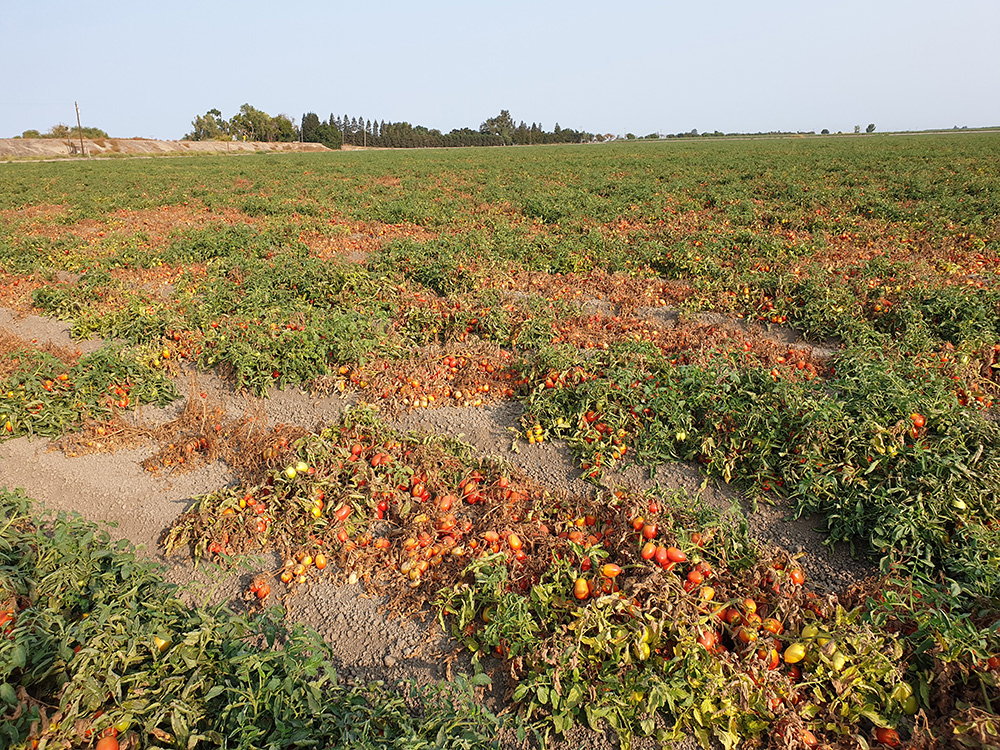
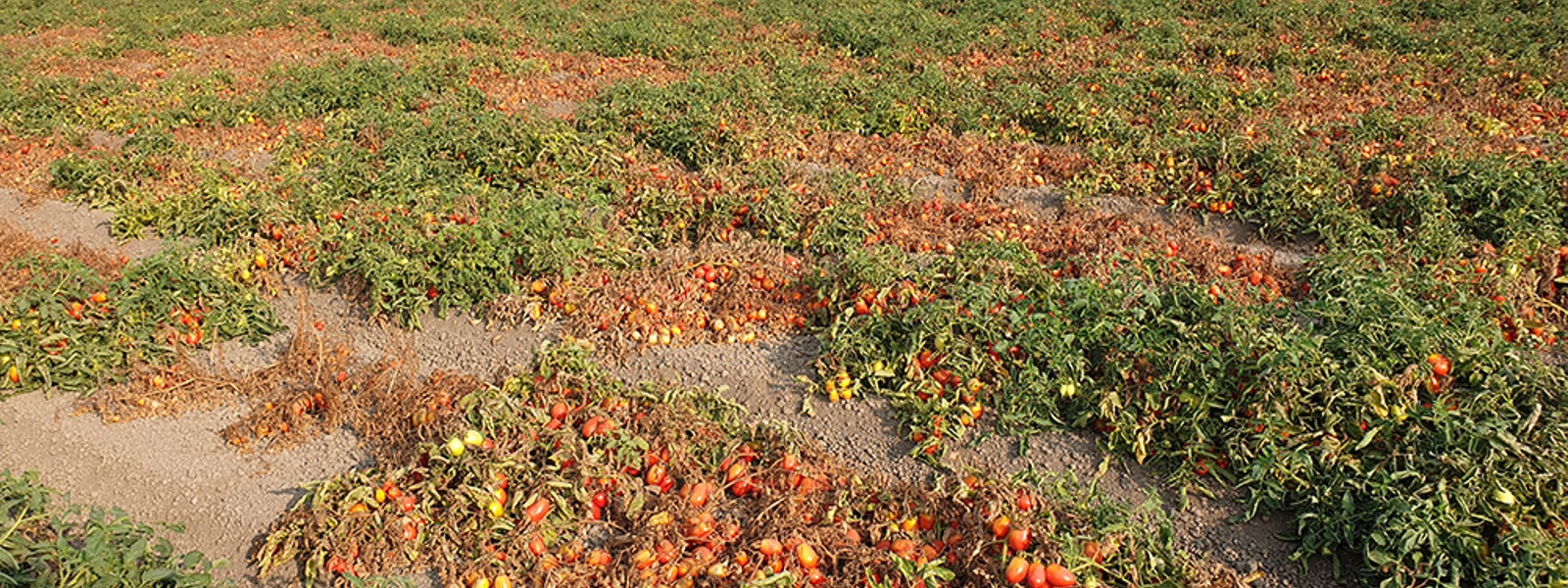
Fusarium stem rot and decline, commonly known as FRD, affects the water- and nutrient-carrying vascular portions of processing tomato plant stems and canopies. Eventually, vines begin to decline, collapsing and exposing the fruit to the sun, leading to potential sunburn.
Photo/Brenna Aegerter


By Vicky Boyd
As experts learn more about a relatively new fungal disease of processing tomatoes, they say variety selection is key to reducing potential yield losses. Crop rotation and equipment sanitation also are important in managing fusarium stem rot and decline, though to lesser extents.
“I think the variety and sanitation would be my top priorities,” said Brenna Aegerter, University of California Cooperative Extension vegetable crops farm adviser who serves San Joaquin County.
Rotating to a nonhost crop can help reduce the pathogen in the soil, but she said it’s not too popular because many of the alternatives are unprofitable.
Fusarium stem rot and decline, often referred to as FRD, is found in scattered fields from Kern County to the northern Sacramento Valley. But the bulk of the infections are centered in the northern San Joaquin and southern Sacramento Valley processing tomato-production areas.
Patricia Lazicki, UC vegetable crops farm adviser for the southern Sacramento Valley, said FRD is the issue that generates the most calls from growers. In 2025, it comprised about 30% of her diagnoses. In the northern San Joaquin Valley, the disease is scattered but still common, Aegerter said.
For the past seven years, Aegerter has been part of a UC team researching FRD. From the beginning, she conducted trials to screen for varietal disease resistance. Woodland-based Ag Seeds Unlimited joined the collaborative effort in 2021, and Lazicki started in 2023 when she was hired by UCCE. The California Tomato Research Institute is supporting their work.
Each year, Ag Seeds grows the transplants, and plants replicated trials in farmers’ commercial fields infested with soil-borne pathogens, said Ross Lopez, an Ag Seeds salesperson also involved with product development.
Rarely does a field have a single pathogen, so he said the company typically screens for multiple diseases. This year, Ag Seeds planted 11 trials, each featuring the same 29 popular varieties.
During the season, the seed dealer and UC rate them for disease symptoms and vine decline. If the cause is questionable, they may pull samples to send to Cassandra Swett’s pathogen diagnostic laboratory at UC Davis.
A commercial processing tomato harvester picks the plots, transferring the fruit to a modified gondola cart with a weight cell to measure yields before conveying them to commercial trailers. Through the years, the trials have evolved.
“They used to be just strip trials of varieties side by side, with no yield information. It was just visual ratings,” Lopez said.
They’ve found that no variety has true FRD resistance, although some varieties appear more tolerant, Aegerter said. Even then, some varieties may not yield well under high disease pressure. But varieties that have both FRD tolerance and the extended field-holding trait frequently produced the highest yields in the trials.
UC and Ag Seeds publish their results annually in early winter so growers, pest control advisers and sales people can use them to make planting decisions for the upcoming season. In addition, Lopez said it was important to relay the data to seed breeders as they develop new varieties.
To reduce the amount of inoculum in the soil, UC experts recommend rotating to nonhost plants for one or more seasons. UC Davis doctoral student Myles Collinson conducted laboratory and field trials over three years to determine the pathogens’ host range.
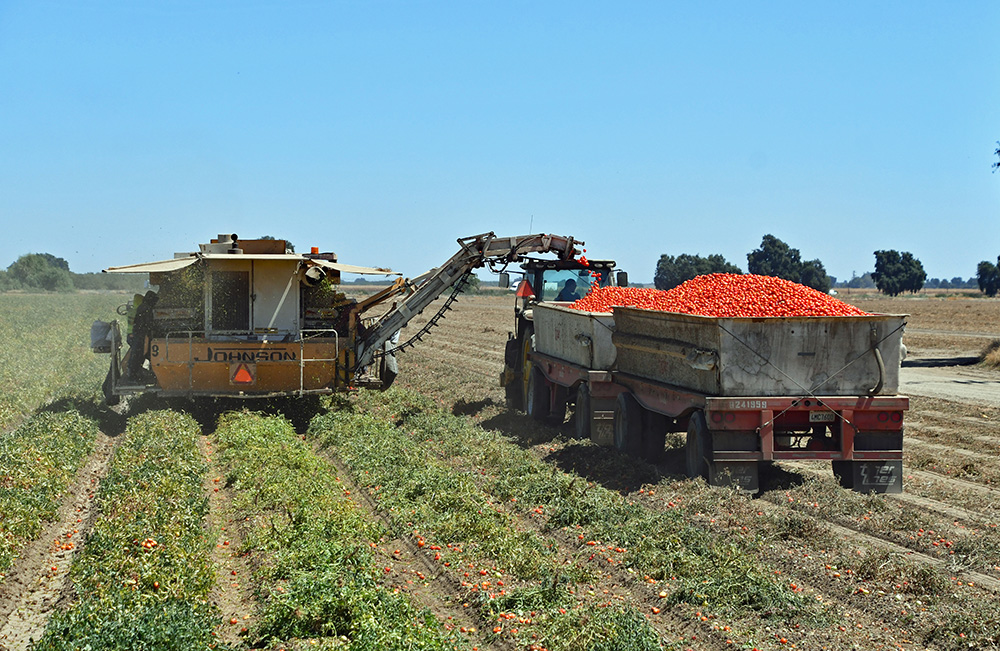
Photo/Vicky Boyd
Of the commonly grown crops, potatoes, peppers, cilantro, carrots and some sunflower varieties yielded severe symptoms. Garlic, onions, alfalfa, corn, cotton, melons, wheat and barley, on the other hand, were nonhosts.
Sanitizing equipment before moving from one field to another is another management tool to help reduce pathogen spread, Aegerter and Lazicki said. While removing all dirt and plant debris on machinery may not be feasible, they said minimizing the amount of plant debris using high-pressure air or water goes a long way.
Equipment sanitation also is helpful to reduce the spread of broomrape, a yield-robbing processing tomato parasite found in the southern Sacramento Valley.
As part of a federally funded specialty crop research project in 2025, Lazicki examined the efficacy of K-Pam soil fumigant at 25 gallons per acre, 2.5 tons per acre of poultry manure and Trichoderma beneficial microbes used alone or together. She planted a tolerant variety and compared the treatments to untreated controls in a grower’s heavily infested field.
Incorporating poultry manure following K-Pam fumigation increased yields by 14.3 tons per acre compared to the untreated control and by 9.3 tons per acre compared to K-Pam alone, Lazicki said.
Using the 2025 processing tomato price of $109 per ton, she said the K-Pam plus manure treatment yielded a $1,021 per-acre net profit over the untreated check. K-Pam plus manure produced a $776 per-acre return compared to K-Pam alone.
“Fumigation and manure were both helpful even though it was a pretty tolerant variety,” she said.
Retired UCCE farm adviser Gene Miyao collected the first plants with suspected FRD in 2017. But it took Swett, an associate UCCE specialist in plant pathology, several years to determine that a pair of related fusarium fungi was causing the issue. Although the two belong to the same large genus as the fusarium wilt causal organism, they aren’t closely related, so varieties with fusarium wilt race 3 resistance are still susceptible to FRD.
Initially, FRD-infected plants take on a yellowish or chlorotic cast, while leaves may be small and possibly curled, Aegerter said. Lazicki said she frequently sees leaves that look bleached, but the veins are dark green.
As the disease progresses, vines begin to decline, eventually collapsing and exposing fruit to the sun and potential sunburn. Damaged fruit also is more prone to other invaders such as mold.
If cutting into the below-ground stem portion and crown tissue of infected plants, they may be necrotic, or dead, and “pretty ugly,” Aegerter said.
Because foliar symptoms can be confused with tomato spotted wilt virus, southern blight or even potassium deficiency, Aegerter said it’s wise to have a laboratory confirm the field diagnosis.
Vicky Boyd is a reporter in Modesto. She can be reached at agalert@cfbf.com.
In this edition…
- 'Rough' peach crop caps a bitter season
- Processed tomato growers hope for market recovery
- Young farmer reflects on her agricultural leadership
- State's farmers seek fairness in trade talks with Canada
- From the Fields: Rod Chamberlain, Riverside County mango and vegetable farmer
- From the Fields: Joe Valente, San Joaquin County winegrape grower
- From the Fields: Trevor Airola, Calaveras County rancher
- From the Fields: Ken Mitchell, Sacramento County squab producer
- Latest campaign positions walnuts as fresh produce
- Feds release Colorado River framework for next 10 years
- Tomato variety key to controlling fusarium stem rot
- Ruling: State can withhold quarantined dairy locations
- Study: Napa wine compliance costs near 18% of production
- Farm Bureau eyes screwworm, food labeling, wildfires, landlines and endangered species
- Planning for retirement: A guide for young farmers
- View full issue





.svg.png)
