


Latest campaign positions walnuts as fresh produce


By Tim Hearden
To strengthen its market position, California’s walnut industry is running a campaign this summer to encourage consumers and retailers to think beyond the baking aisle and place walnuts in the fresh produce section, where they can be marketed as a healthy snack or a versatile topping for salads and other dishes.
The promotion, launched in May to coincide with peak produce sales, combines in-store displays near fruits and vegetables with a media campaign featuring influencer endorsements, streaming TV commercials, digital advertising and product sampling at wellness-focused events.
The effort is an extension of the California Walnut Board and Commission’s 2025 “Feel Good” campaign to position walnuts as a lifestyle brand for millennials and Gen-Z consumers who increasingly turn to natural foods for better health.
The industry wants to move walnuts beyond simply an ingredient in “grandmother’s banana nut cake,” said Robert Verloop, the board and commission’s executive director and CEO.
“The younger generation is much more educated about food as medicine, and they understand that nuts play an important part of not only breakfast, lunch and dinner but also snacking,” Verloop said. “Having a handful of nuts at 10 in the morning or 3 in the afternoon provides a metabolic boost.”
The industry is also encouraging consumers to store walnuts in the refrigerator, mirroring how they treat fresh produce.
Gordon Heinrich, a Modesto grower and processor who chairs the walnut commission’s marketing, promotions and business development committee, said he’s seen the produce-aisle promotions in most of the supermarkets he’s entered.
“The produce department is just a natural place for walnuts to be,” Heinrich said, noting how walnuts complement many of the foods shoppers already find there. The nut is also a staple on charcuterie boards and pair well with dried fruits, cheeses and other fresh ingredients, he added.
He said the produce section is an ideal place to highlight walnuts’ health benefits and encourage purchases. At the same time, he said walnuts should be merchandised in multiple locations throughout the supermarket to make them more visible and convenient for shoppers.
The push is the latest phase of a two-pronged strategy the industry has pursued for years highlighting the value of walnuts as a healthy snack and as a versatile food ingredient.
In 2011, the American Heart Association recognized walnuts as a heart-healthy food, allowing retailers to display the organization’s Heart-Check mark alongside walnut products. Walnuts are a rich source of alpha-linolenic acid, a plant-based omega-3 fatty acid that has been shown to reduce the risk of coronary heart disease.
That recognition, coupled with a growing body of nutrition research linking regular walnut consumption to benefits ranging from brain health to male fertility, led the industry to promote walnuts as a nutritious snack. More recently, however, the rapid growth of the plant-based meat sector and renewed interest in home cooking during the COVID-19 pandemic shifted the industry’s focus toward positioning walnuts as a versatile cooking ingredient.
In 2020, the walnut board and commission released a product guide for bakeries and pastry shops to encourage the use of walnuts in everyday baked goods, including breads, pastries, cakes, cookies and pie crusts. The industry also promoted walnuts as a versatile ingredient for gluten-free and low-carbohydrate recipes.
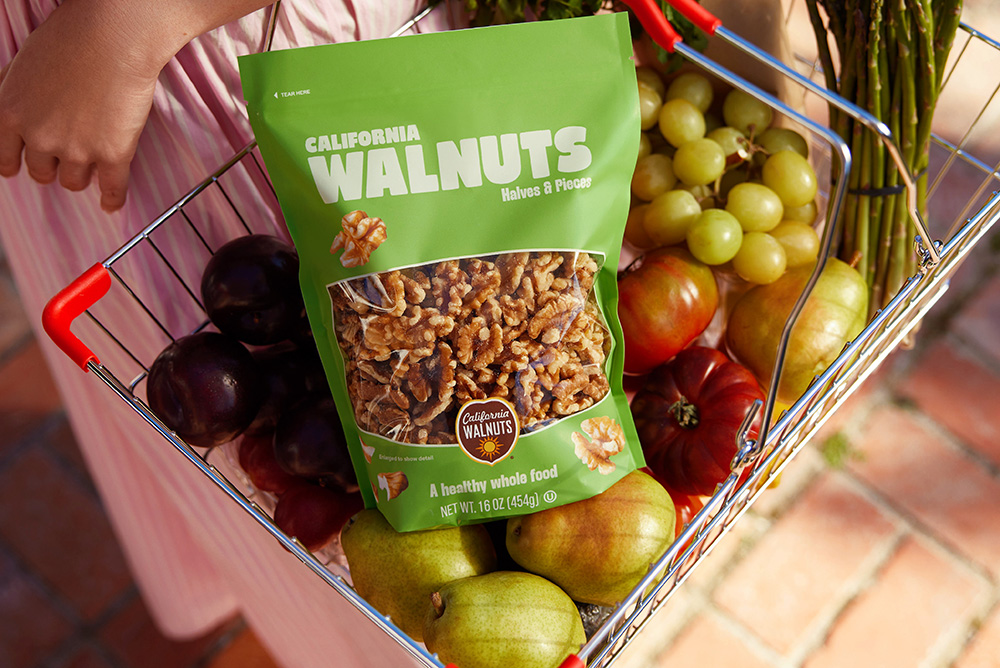
Photo/Courtesy of the California Walnut Board and Commission
Having come from the produce industry four years ago, Verloop led a reexamination of that strategy and noted that placing walnuts solely on the baking aisle became a barrier to consumption.
“Obviously, it provides texture and flavor, but in the baking aisle … they put it next to sugar, flour and indulgent items like chocolate,” Verloop said. “It doesn’t have the same connotation as a healthy, nutritious nut.”
Verloop, who was born in Holland, noted that tree nuts are part of the culture in Europe and “were always on the table,” as they are in the Middle East and India.
“It’s seen as a snacking item and less as an ingredient,” he added.
Further, while the industry sells between 55 million and 60 million pounds of walnuts in various forms annually in retail, it has been selling only about 7 million pounds a year to food service, which is more likely to use the nuts as an ingredient, Verloop said.
Even in retail, the baking aisle gets less traffic than most other parts of the store, noted Jack Mariani, a producer in Winters who chairs the walnut board’s marketing, promotions and business development committee.
“Our recent efforts to move walnuts into the produce section is long overdue and seems to be a great improvement and (is) bringing our fresh and healthy product to consumers in the area where they do their most healthy shopping,” Mariani said.
“As more stores convert our production into the produce area, we will continue to see improved sales of California walnuts both domestically and internationally,” he added.
A sales boost is needed after last year’s crop, forecast at 710,000 tons by the U.S. Department of Agriculture but came in at close to 810,000 tons, the second largest in history, Verloop said.
Producers have been on a pricing roller-coaster, with walnuts peaking near $1.88 a pound in 2013-14, crashing at roughly 25 cents a pound amid a global glut in 2022-23 and rebounding to an average of about 93 cents a pound in 2024-25, according to the most recent USDA data.
This year’s crop should be smaller than last year’s, Verloop said.
But Red Bluff grower Tyler Christensen said he still has “a pretty decent-sized crop” and that he’s excited about the quality.
As a grower, Christensen said he appreciates the industry’s produce-aisle push.
“We’re just always looking to expand our markets so more people will compete to buy our product back to a sustainable level,” he said.
Verloop said he’s optimistic the industry will see increased consumption.
“We’re very bullish on where the market can go and where it can grow,” he said.
Tim Hearden is a reporter in Redding. He can be reached at agalert@cfbf.com.
In this edition…
- 'Rough' peach crop caps a bitter season
- Processed tomato growers hope for market recovery
- Young farmer reflects on her agricultural leadership
- State's farmers seek fairness in trade talks with Canada
- From the Fields: Rod Chamberlain, Riverside County mango and vegetable farmer
- From the Fields: Joe Valente, San Joaquin County winegrape grower
- From the Fields: Trevor Airola, Calaveras County rancher
- From the Fields: Ken Mitchell, Sacramento County squab producer
- Latest campaign positions walnuts as fresh produce
- Feds release Colorado River framework for next 10 years
- Tomato variety key to controlling fusarium stem rot
- Ruling: State can withhold quarantined dairy locations
- Study: Napa wine compliance costs near 18% of production
- Farm Bureau eyes screwworm, food labeling, wildfires, landlines and endangered species
- Planning for retirement: A guide for young farmers
- View full issue





.svg.png)
