


State's farmers seek fairness in trade talks with Canada
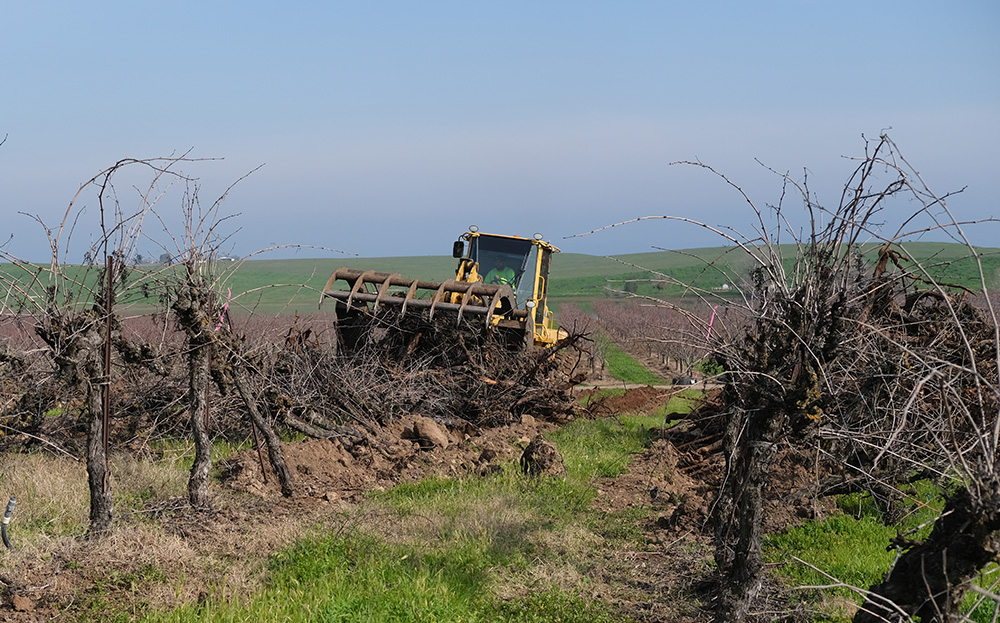
A winegrape vineyard in San Joaquin County is removed earlier this year due to a yearslong downturn in wine sales. Several Canadian provinces have banned the sale of alcohol from the U.S.
Photo/Caleb Hampton


By Caleb Hampton
Agricultural groups in California are paying close attention this month to the trade relationship between the U.S. and Canada.
The North American neighbor has long been the top export market for agricultural products from California and the U.S. as a whole. But a trade conflict that began shortly after President Donald Trump returned to office last year has put that relationship on fragile footing.
“There has been a lot of volatility,” said James Sayre, an international trade researcher and assistant professor of Cooperative Extension at the University of California, Davis.
The dispute reached another inflection point last month when the Trump administration announced plans to impose new 50% tariffs on some Canadian goods. Meanwhile, the two nations and Mexico began negotiations on the renewal of the United States-Mexico-Canada Agreement, which replaced the North American Free Trade Agreement during Trump’s first term as president.
“The purpose of USMCA was to secure guaranteed access for producers in all three countries into the other ones’ markets,” Sayre said.
Bilateral agricultural trade between the U.S. and Canada last year was valued at $9.2 billion, according to federal data.
On July 1, which marked the first review deadline since the trade pact began in 2020, the Trump administration opted not to approve a 16-year extension of the USMCA. The trade agreement remains in effect, but the decision by the U.S. not to automatically extend it triggered an annual review and negotiation process.
Amid that backdrop, stakeholders from both sides of the border met last week at a closed-door meeting in Sacramento to discuss their priorities. Those in attendance included California Department of Food and Agriculture Secretary Karen Ross, Canadian Consul General Rana Sarkar and representatives of various agricultural commodity groups.
“Trade is extremely important to California agriculture,” said Matthew Viohl, director of federal policy advocacy at the California Farm Bureau, which hosted the meeting. “We want to be leaders on this, and we’ll continue to take this conversation to D.C. and emphasize our goals.”
Among the topics discussed, Viohl said, were bans on U.S. alcohol sales imposed by several Canadian provinces.
The provincial bans came in response last year to Trump’s tariffs on Canadian products and his promises to annex Canada and make it a U.S. state, which caused California wine sales to Canada to plummet from $404 million in 2024 to $90 million last year.
Trump cited Canada’s “discrimination” against U.S. alcohol last month in his proclamation announcing new tariffs on Canadian goods, which were scheduled to take effect Aug. 19 if Canada does not meet certain conditions.
The collapse of the Canadian market worsened an already bleak outlook for California winegrape growers and wine producers.
“That’s a really strong headwind on top of the other headwinds they’re already facing,” Sayre said.
In recent years, a global downturn in wine consumption left the state with a persistent oversupply of grapes. In each of the past three years, some of California’s winegrape crop went unpicked due to lack of demand. Last year, a record amount of around 820,000 tons of winegrapes—about a quarter of the crop—went unpicked, according to industry estimates.
Sarkar, the Canadian official, said the country’s government could not speak to the bans on California wine because “decisions on the sale of alcoholic beverages in Canada are made at the provincial level.”
He added, “Canada remains committed to constructive engagement with the U.S. and to restoring predictability in our trading relationship, which we see as benefiting businesses on both sides of the border.”
California exporters of fresh fruits and vegetables also reported losing Canadian trade partners due to boycotts last year of U.S. goods.
However, federal data showed overall exports of fresh California produce to Canada remained relatively stable.
While Canadian consumers might be able to shift wine consumption to domestically produced wines or imports from Europe, South America or Australia, Sayre said, it isn’t as easy for Canada to source perishable goods from other continents.
“Wine doesn’t degrade if you ship it on a boat for a long time,” he said. “But with something like strawberries, it’s going to be hard to divert that sort of trade from California.”
Sayre said California commodities such as almonds have more secure access to the Canadian market because the state effectively holds a monopoly on production. With about 80% of the world’s almonds grown in the Central Valley, “I don’t even know where else you’d go (for almonds) in this hemisphere,” he added.
As negotiations around the renewal of the USMCA continue, Viohl, the Farm Bureau policy advocate, said free trade agreements with Canada had generally benefitted California’s agriculture sector—even if they weren’t perfect.
“USMCA has been productive for all three countries,” he said. “That doesn’t mean there aren’t ways that we would like to see it improved.”
Viohl said that because California farmers and ranchers are subject to some of the most stringent environmental and labor regulations, which increase their operating costs, the state’s producers want to ensure international trade partners adhere to the minimum production standards outlined in trade agreements.
“We just want to make sure that other countries are holding up their obligations, too,” he said. “What we really stress when it comes to trade is stability and fairness.”
Officials from the U.S., Mexico and Canada are scheduled to hold another round of talks related to the renewal of the USMCA in September.
Caleb Hampton is an editor at Ag Alert. He can be reached at champton@cfbf.com.

In this edition…
- 'Rough' peach crop caps a bitter season
- Processed tomato growers hope for market recovery
- Young farmer reflects on her agricultural leadership
- State's farmers seek fairness in trade talks with Canada
- From the Fields: Rod Chamberlain, Riverside County mango and vegetable farmer
- From the Fields: Joe Valente, San Joaquin County winegrape grower
- From the Fields: Trevor Airola, Calaveras County rancher
- From the Fields: Ken Mitchell, Sacramento County squab producer
- Latest campaign positions walnuts as fresh produce
- Feds release Colorado River framework for next 10 years
- Tomato variety key to controlling fusarium stem rot
- Ruling: State can withhold quarantined dairy locations
- Study: Napa wine compliance costs near 18% of production
- Farm Bureau eyes screwworm, food labeling, wildfires, landlines and endangered species
- Planning for retirement: A guide for young farmers
- View full issue





.svg.png)
