


Study: Napa wine compliance costs near 18% of production
Graphic/Cal Poly, San Luis Obispo


Regulatory compliance costs add nearly $24 to every case of wine produced and sold by a small Napa County winery, accounting for about 17.5% of production costs, according to a new study examining the cumulative impact of federal, state and local regulations on the wine industry.
The report, released in July by Cal Poly, San Luis Obispo, is the second installment of a broader study commissioned by the Napa County Farm Bureau.
Part 1, released earlier this year, found regulatory compliance costs accounted for about 8% of production costs for a small Napa County vineyard and nearly 12.5% for a large vineyard.
The new report, authored by Cal Poly agribusiness professors Lynn Hamilton and Michael McCullough, shifts the focus from vineyards to wineries, documenting regulatory costs for an 8,500-case Napa County winery across production and direct-to-consumer sales.
“This study is the first of its kind to document regulatory costs of a Napa County winery as well as any type of alcoholic beverage production,” the authors wrote.
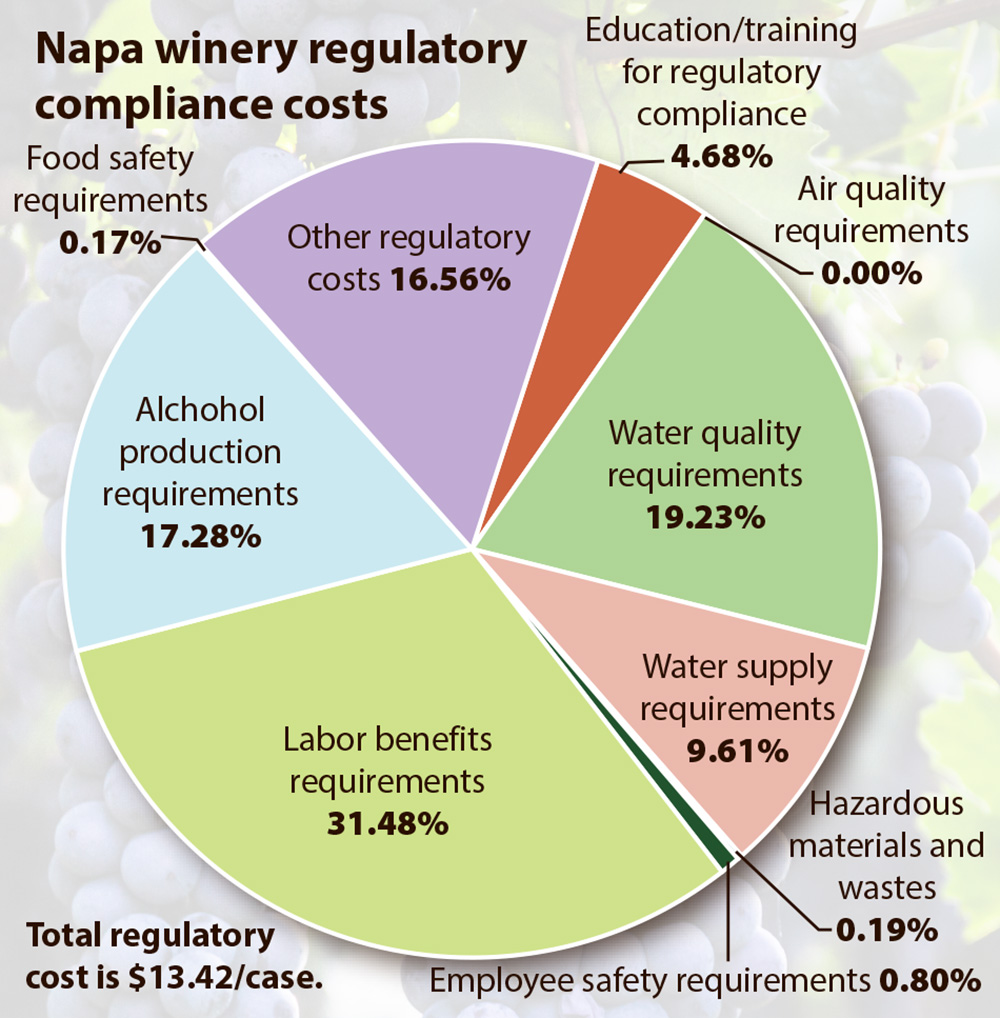
Researchers found the winery spent $115,874 annually complying with regulations tied to producing wine, or $13.44 per case. Based on weighted average production costs of $135.25 per case, those requirements represented 9.94% of production costs.
Adding regulations governing direct-to-consumer sales increased total compliance costs to $203,832 annually, or $23.65 per case.
“Including these with production regulatory costs brings the total to $23.65 per case, or 17.5% of production costs,” the report said.
The study comes as California wineries face declining consumer demand after decades of industry growth.
“Additional regulatory costs, combined with the current decline in consumer demand raise questions regarding the long-term viability of California wine production,” Hamilton and McCullough reported.
The researchers interviewed one Napa County winery in 2025 and reviewed federal, state and local regulations affecting wine production. While they cautioned against broadly applying the findings because the study is based on a single operation, they said it establishes a baseline for understanding regulatory costs in the industry.
Labor regulations represented the winery’s largest production-related compliance expense at $36,403 annually, or $4.22 per case. Those costs included workers’ compensation insurance, paid sick leave and administration of California’s CalSavers retirement savings program.
“The largest regulatory category for the cooperating winery is labor,” the report said.
Water regulations ranked second. Water quality compliance cost the winery $22,236 annually, while water supply requirements added another $11,117.
The winery spent $17,500 each year on consulting services for required water testing and reporting. It also paid to upgrade and certify water infrastructure to comply with state requirements.
Alcohol production regulations were the third-largest category, costing nearly $20,000 annually through state licensing fees, excise taxes and mandatory federal reporting.
“Outside of cannabis production and processing in California, wine production is the most heavily regulated agricultural product, requiring both state and federal licenses, excise taxes and reporting,” the authors wrote.
Other compliance costs included hazardous materials permits, food safety requirements, recycling regulations, county permitting fees, pressure vessel inspections, Pierce’s Disease assessments and California business taxes.
The study also examined regulations governing direct-to-consumer wine sales, which added $87,958 annually, or $10.20 per case.
Much of that expense came from software used to manage sales tax and regulatory compliance, registration and reporting requirements for shipping wine into multiple states, website accessibility compliance under the Americans with Disabilities Act and out-of-state excise taxes.
The researchers noted wineries selling only within California would likely incur lower compliance costs than wineries shipping nationwide.
Some regulatory categories generated little or no expense for the winery studied. Air quality compliance costs were zero because the operation was not subject to federal Title V emissions requirements and used propane and electric forklifts that did not require emissions reporting.
The report also points to additional costs expected in coming years.
New groundwater sustainability fees approved by Napa County after the study period began taking effect in 2026. The authors also cited California’s packaging regulations, possible expansion of similar laws in other states, updates to Napa County’s General Plan and annual increases in California’s minimum wage as factors likely to increase compliance costs.
“This case study is the first of its kind with regards to the cumulative regulatory costs of producing and selling wine,” the report said.
The authors emphasized that wineries differ in size, staffing and marketing strategies, all of which can affect regulatory costs.
“While the analysis represents only one producer in Napa County, it provides a foundation on which to understand the implications of the current regulatory structure and its impacts on the wine industry,” they wrote.
The researchers said Napa Valley’s wine industry faces growing pressure from market conditions and regulation.
“Whether Napa Valley continues to be the pinnacle of the U.S. wine industry depends on wineries’ ability to withstand not only the current softening of consumer demand, but the rising costs imposed by local, state and federal regulators,” the report said.

In this edition…
- 'Rough' peach crop caps a bitter season
- Processed tomato growers hope for market recovery
- Young farmer reflects on her agricultural leadership
- State's farmers seek fairness in trade talks with Canada
- From the Fields: Rod Chamberlain, Riverside County mango and vegetable farmer
- From the Fields: Joe Valente, San Joaquin County winegrape grower
- From the Fields: Trevor Airola, Calaveras County rancher
- From the Fields: Ken Mitchell, Sacramento County squab producer
- Latest campaign positions walnuts as fresh produce
- Feds release Colorado River framework for next 10 years
- Tomato variety key to controlling fusarium stem rot
- Ruling: State can withhold quarantined dairy locations
- Study: Napa wine compliance costs near 18% of production
- Farm Bureau eyes screwworm, food labeling, wildfires, landlines and endangered species
- Planning for retirement: A guide for young farmers
- View full issue





.svg.png)
