


Expected almond crop yield slightly smaller this year
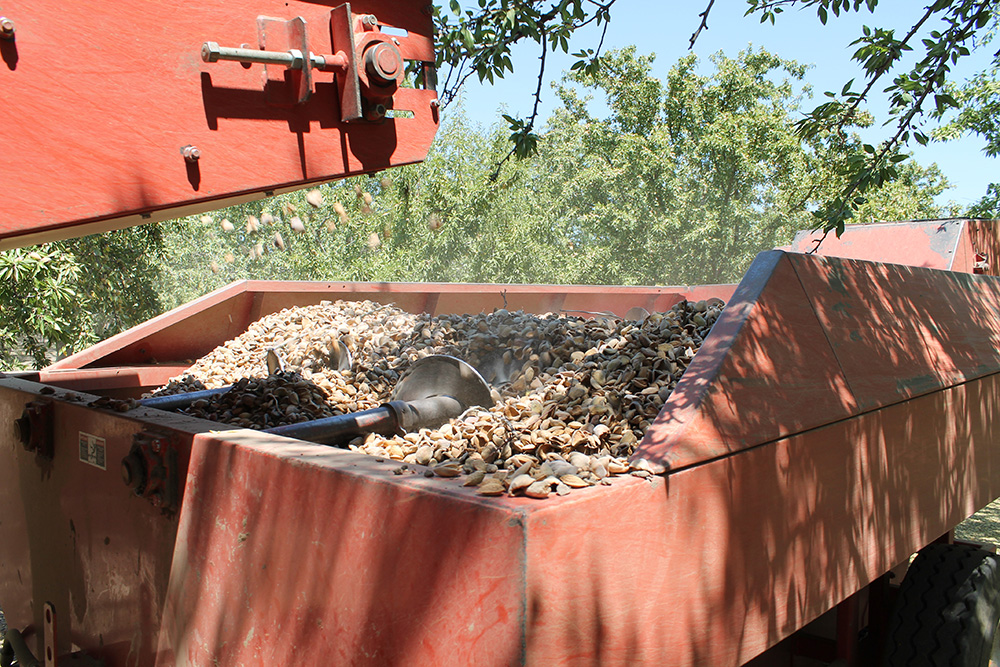
Photo/Ching Lee


By Manola Secaira
California’s 2026 almond harvest is expected to be somewhat smaller than last year’s crop, after early-season heat affected yields. But with harvest typically wrapping up in October, some growers say the full impact of the heat—and the size of this year’s crop—remains to be seen.
This year marks the first without the U.S. Department of Agriculture’s “objective measurement” forecasting the season’s yield. After last year’s forecast projected hundreds of millions of pounds over the actual harvest, the Almond Board of California voted to stop funding it.
This leaves the USDA’s “subjective” crop forecast, which was released in May and is based on grower phone surveys, as the only official estimate.
The department predicted yields at 2.7 billion pounds, down 1% from last year. Bearing acreage is expected to fall by 1% to 1.39 million acres.
Mel Machado, chief agricultural officer for Blue Diamond Growers, said the USDA estimate was similar to what private forecasts predicted.
He also said warmer-than-normal March temperatures drove earlier kernel development, which led to an earlier harvest—similar to the heat’s impacts on other crops. He said some growers reported harvesting almonds 10 to 14 days earlier than usual.
Rain during almond bloom also impeded pollination, Machado noted.
“This year’s bloom was kind of messy,” he said. “We had some weather during the bloom that eliminated bee activity for several days … when most of the varieties were blooming.”
Machado said some reports suggest early spring heat can possibly result in smaller kernels, so he’s keeping an eye out for those impacts. But he said better post-bloom weather appears to have improved nut retention.
Stanislaus County grower Donny Hicks, who works as a regional grower relations manager for Los Banos-based almond grower and processor RPAC, said an early harvest prompted by the spring heat could be beneficial for growers. He noted that California’s almond harvest typically ends by late October, when the increasing likelihood of rain begins to threaten the quality of almonds that remain in orchards.
While rain this time of year dries out quickly, he said concern grows as October approaches because cooler conditions mean fewer opportunities for the almonds to dry. For this reason, growers would ideally have the harvest completed by mid-October, he added.
Hicks said he’s hopeful this year’s harvest will be done a couple weeks early. He said some hullers in his area began receiving product in July, marking the first time some had done so.
“We’re in a good position right now,” he said. “Prices have firmed up, and it does look like it’s going to be pretty bullish ... all depending on what this crop does.”
Machado said last year’s orchard conditions can influence the current year’s yield, noting that a significant number of orchards have received minimal or reduced care due to rising costs and low prices.
“Profitability has been a challenge for the last several years, and orchards have not been in the best condition, so even coming into bloom, some of them have struggled,” he said.
Regarding growers’ higher production costs, Hicks said rising gas and fertilizer prices have added extra financial stress for many almond growers. That means spending more on fuel for equipment during harvest. Because he uses custom harvesters to do his work, he said he expects they will adjust their rates due to higher fuel prices.
Hicks said almond growers would have been happy to harvest 2,000 pounds per acre and earn $2 a pound two decades ago. But with the rise of input costs, “now you hope for 3,000 pounds an acre and hopefully $3 a pound.”
Due to the U.S. economy, Machado said domestic almond sales have declined, while the export market has been “carrying the day.”
“Consumers need to decide how much money they’re going to put in their gas tank versus the food that they buy, and they’re making those tactical decisions on the fly,” he said.
That consumers seek almonds for their nutritional benefits can help support demand, he said, though he noted the product is “not cheap.”
Yolo County grower Brian Paddock has begun harvesting some of the almonds in his 15-acre orchard. He sells raw, organic almonds directly to customers through his website.
He said connecting with customers throughout the country seeking his particular niche almond product has helped sales despite what may be happening in the larger almond industry.
As a result, managing his website has become an important part of his work. He said he doesn’t necessarily love the task, but it is a necessary adjustment to maintain consistent sales.
“I have become less of a farmer and more of a search engine optimization technician,” Paddock said. “That’s the other aspect of farming that I have to deal with.”
Hicks said one big shift in almond production comes from declining acreage. He’s seen older orchards gradually come out of production and some San Joaquin Valley growers deciding to plant almonds farther north in the valley in response to tighter water use restrictions under the Sustainable Groundwater Management Act.
Reports on SGMA show that between 500,000 to 900,000 acres of crops across the valley would potentially need to be taken out of production to comply with the state law.
Even so, Hick said “the future, along with (almond) prices firming up … looks pretty bright for all the growers right now.”
Manola Secaira is a staff writer for Ag Alert. She can be reached at msecaira@cfbf.com.
In this edition…
• Expected almond crop yield slightly smaller this year
• Cyclospora fallout hits California farmers
• Memory loss on the farm is more than a health issue
• State regulator: 'We should fight to keep our farms'
• California startup advances in Ag Innovation Challenge
• Almond hulls being tested for use as food ingredient
• Wolf reports show continued livestock losses, more packs
• Nonprofit program aims to bring more rice to delta
• Mothballing offers middle ground in wine downturn
• Dial 811 first to protect your land, workers and neighbors
• Could coastal citrus mites destroy your crop in weeks?
• Zinc, boron, manganese and their role in nut production
• More funds devoted to stop sharpshooter
• Advocacy in Action: Labor, fire equipment, climate funds, Gualala River, endangered species, dairy order, lily bulbs
• Meeting to address risk in uncertain times





.svg.png)
