


California startup advances in Ag Innovation Challenge
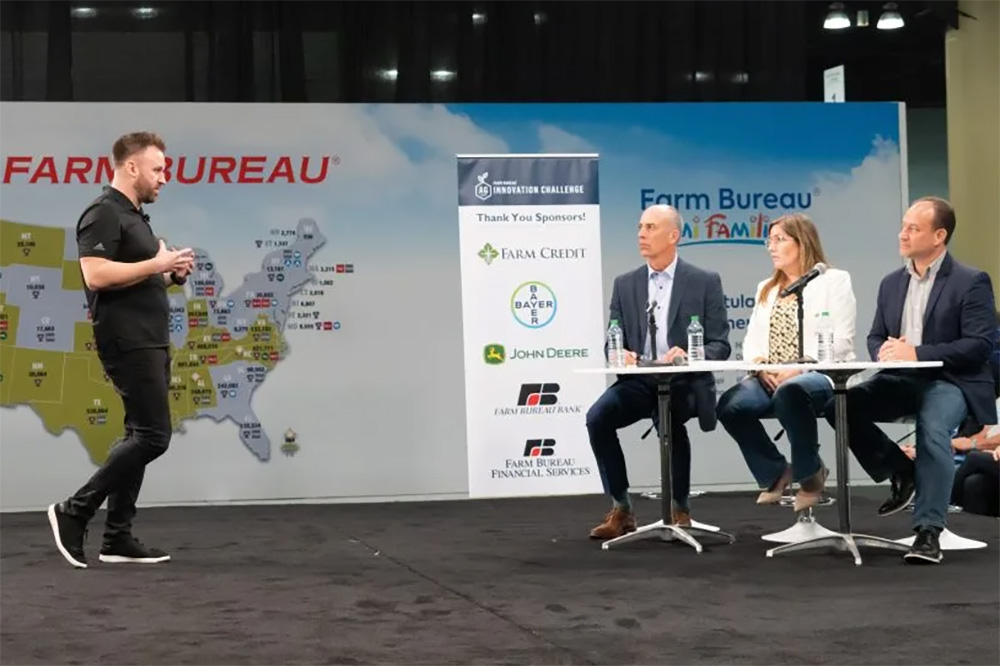
Michael LoBiondo/American Farm Bureau Federation file photo


A California startup looking to turn agricultural byproducts into better, less expensive cattle feed is among 10 semifinalists in the American Farm Bureau Federation’s 2027 Ag Innovation Challenge.
Gilly, based in Modesto, is developing a fungal-based prebiotic feed additive intended to help cattle digest more fiber, with the goal of allowing cows to get more energy from forage and agricultural byproducts already used in dairy rations.
The company is the only California-based semifinalist in this year’s competition, now in its 13th year. The contest, conducted in partnership with Farm Credit, is intended to identify entrepreneurs developing technologies and services that address challenges facing farmers, ranchers and rural communities.
“Farmers and ranchers count on innovation to produce the safe and sustainable food, fuel and fiber our country relies on,” AFBF President Zippy Duvall said. “Farm Bureau takes great pride in offering outstanding entrepreneurs an opportunity to showcase their technology and services that will help sow the seeds of a better, brighter future for all of agriculture.”
Gilly’s technology is focused on a familiar issue for dairy farmers: getting more nutritional value from feed while controlling costs.
Gilly said its additive is designed to work with an existing dairy ration rather than replace other feed ingredients. Less than 0.5% of a cow’s dry matter intake would come from the additive, according to the company.
The product is intended to support anaerobic fungi naturally present in the rumen. Gilly said these fungi help break down plant material, potentially making more of the nutrients in fibrous feed available to the animal.
The company said it is particularly interested in agricultural byproducts, including almond hulls and grape pomace. California’s almond and winegrape sectors generate significant quantities of those materials, some of which already find their way into livestock feed.
Gilly’s technology uses a fungus traditionally used to produce oncom, a fermented food from Indonesia. The company said the organism does not produce mycotoxins and forms the basis of its feed additive.
In laboratory testing, the additive increased 48-hour in-vitro neutral detergent fiber digestibility by as much as 16 percentage points, Gilly reported. The company said its testing indicates potential improvements in feed efficiency of 3% to 5%.
Those results still need to be evaluated under commercial dairy conditions.
Gilly said it has completed commercial heifer feeding trials at Trinkler Dairy in Ceres, where it established palatability of the product. The company is now participating in an in-vivo milk-production study with Pennsylvania State University’s dairy sciences program. Gilly said that study is scheduled to conclude in spring 2027.
The company estimates the additive would cost between 5 and 15 cents per cow per day. Based on its current testing and economic modeling, Gilly estimates the potential return could range from 20 to 70 cents per cow per day in additional milk or meat value.
Those figures are projections from the company rather than results from a completed commercial-scale milk-production trial.
Gilly was founded by Bo Xu, who holds a Ph.D. in plant and microbial biology from the University of California, Berkeley. The company’s animal-science work is led by Conor McCabe, who holds a Ph.D. in animal biology from UC Davis.
The startup is now preparing for the next stage of the AFBF contest. It faces nine other startups—from Texas, New York, Kentucky, Georgia, Nebraska, Minnesota and Oklahoma—that span a wide range of agricultural challenges, including grain handling and robotics to livestock and farm analytics.
The 10 semifinalists will pitch their businesses virtually this fall, with four teams advancing to the final round at AFBF’s annual convention in Charlotte, North Carolina. The final pitch competition will be held Jan. 10 in front of a live audience of Farm Bureau members and industry representatives.
Each finalist will receive $10,000. The winner will receive a total of $100,000, while the runner-up will receive $25,000.
In this edition…
• Expected almond crop yield slightly smaller this year
• Cyclospora fallout hits California farmers
• Memory loss on the farm is more than a health issue
• State regulator: 'We should fight to keep our farms'
• California startup advances in Ag Innovation Challenge
• Almond hulls being tested for use as food ingredient
• Wolf reports show continued livestock losses, more packs
• Nonprofit program aims to bring more rice to delta
• Mothballing offers middle ground in wine downturn
• Dial 811 first to protect your land, workers and neighbors
• Could coastal citrus mites destroy your crop in weeks?
• Zinc, boron, manganese and their role in nut production
• More funds devoted to stop sharpshooter
• Advocacy in Action: Labor, fire equipment, climate funds, Gualala River, endangered species, dairy order, lily bulbs
• Meeting to address risk in uncertain times





.svg.png)
