


Smart sprayers slash farm labor and herbicide costs
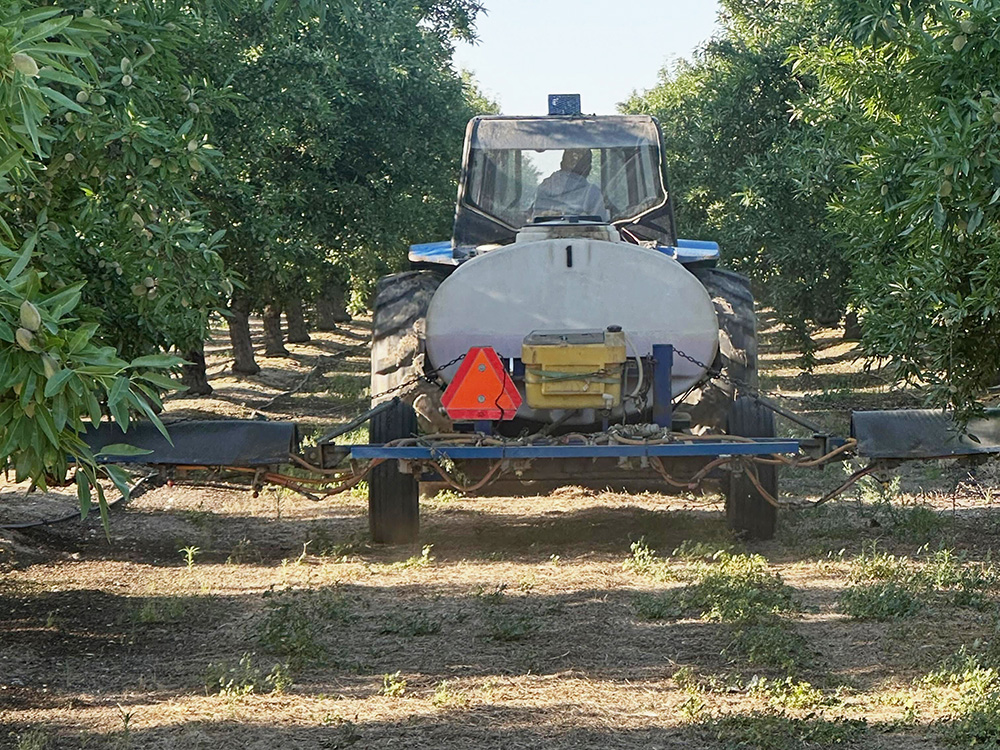
R&R Farms in Kern County uses the WeedSeeker 2 from PTx Trimble to apply herbicides only to green plants and not to dead material or soil. An increasing number of farms are using high-tech sprayers to save on labor and chemical costs. Brothers Justin and Joe Ritchie, who grow 1,300 acres of almonds and pistachios at R&R Farms, paid for the unit in herbicide savings in one season.
Photo/Courtesy of R&R Farms


By Vicky Boyd
An increasing number of specialty crop farmers in California are minimizing labor and chemical costs through the adoption of high-tech herbicide sprayers used for weed control.
 “When I talk to growers, it’s getting good reviews,” Walt Duflock, vice president of innovation at the Western Growers Association, said of the emerging technology used to power various smart sprayer machines. “I think spraying does have a moment in the next couple of years to come.”
Family-owned TopFlavor Farms has enlisted an herbicide sprayer called the SharpShooter from Hayward-based Verdant Robotics, which uses artificial intelligence and machine learning to differentiate between weeds and vegetable crops and apply chemical only to the weeds.
Sensors along the spray boom image each plant at a rate of 30 frames per second while an on-board computer searches an image library of crops and weeds to identify whether a plant is friend or foe. If it’s a weed, the computer instructs the adjacent nozzle to stream a minute amount of herbicide onto the target.
Curtis Garner, co-founder and chief commercial officer at Verdant Robotics, said the SharpShooter is more than 90% accurate, and depending on the herbicide and weed pressure in a field, it allows growers to use about 95% less chemical.
 Third-generation grower Daniel Alameda, whose family owns TopFlavor, said the smart sprayer significantly reduced labor costs at the vegetable operation’s fields in the Southwest and the Salinas Valley.
TopFlavor has used the smart sprayer successfully on myriad crops, ranging from leafy greens and artisan-mix lettuces to broccoli and green onions, Alameda said.
During the seven-month-long 2025 Salinas Valley season, he said TopFlavor saved $500,000 in labor costs compared to the previous season—roughly the cost of the machine. The financial benefits prompted the farm to purchase a second SharpShooter.
Although the smart sprayer hasn’t eliminated hand labor, Alameda said the hybrid approach—with some weeding done by hand and some done by the smart sprayer—has made the weeding crews more efficient.
TopFlavor Farms direct seeds a large portion of its crops. After mechanical thinning, it runs the SharpShooter through on the first pass to target weeds growing close to young plants. On the second weeding pass, it employs a hand crew. With significantly fewer weeds, the laborers are quicker and more efficient.
“What the SharpShooter does is it simplifies the situation,” Alameda said. “It weeds very close to a plant, so it’s easier for a person to weed a field later.”
Other machines have employed similar technology.
Brothers Justin and Joe Ritchie, who farm about 1,300 acres of pistachios and almonds in Kern County, have adopted a different type of smart sprayer that differentiates between the green of growing plants and the brown of soil or dead plants. The WeedSeeker 2, as the sprayer from PTx Trimble is branded, applies herbicide only to green plants.
“With the size of our operation, it’s paid for itself the first season just in chemical savings,” Justin Ritchie said. “For a small grower with 40 to 80 acres, it would take more time for them to see a payback.”
This is the Ritchie brothers’ second season running the WeedSeeker 2 at R&R Farms near McFarland. Early in the spring, they make a preemergent herbicide application along a berm to create a continuous weed barrier. Where they’ve seen substantial chemical savings is on subsequent passes that target spotty weeds that have broken through the preemerge treatment or sprouted in the dry middles.
“It was a no-brainer,” Justin Ritchie said. “We’re very happy with it.”
Kris Goodman, president of Precision Ag Solutions in Dos Palos, said that as chemical prices increased, he saw more interest from growers in the Weed-It smart sprayer the company sells.
During the past five years, Goodman said he’s sold about 120 units. Manufactured in the Netherlands, the Weed-It comes as part of a turn-key sprayer built by Precision Ag Solutions or a retrofit kit.
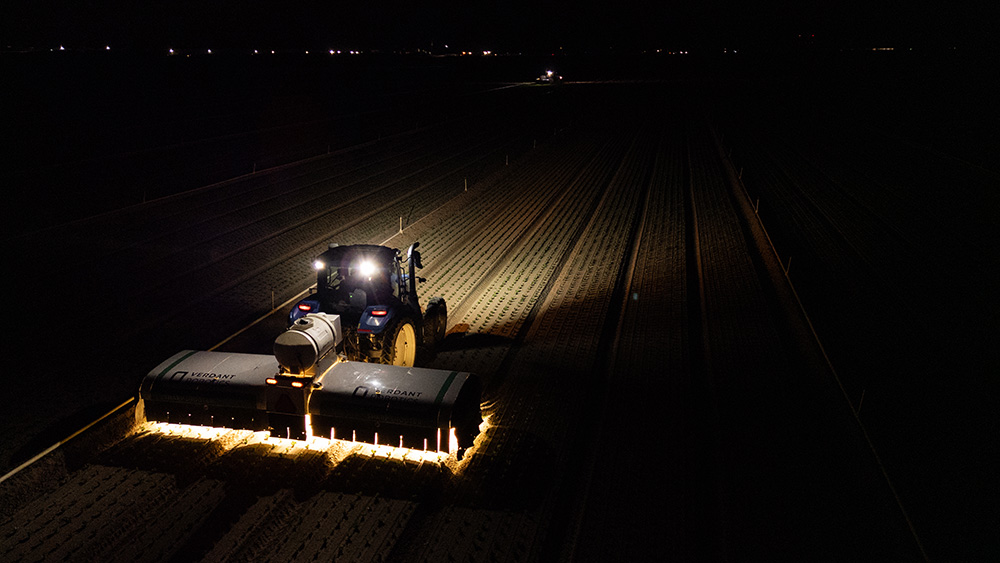
Photo/Courtesy of Verdant Robotics
The spray boom emits fluorescent light aimed downward. Spanning four nozzles, each boom sensor measures the amount of near-infrared, or NIR, light reflected by plant chlorophyl. Soil or dead plants don’t reflect NIR light. When it detects NIR light, the sensor briefly opens the spray nozzle to apply herbicide. Weed-It units also come with rate controllers, which ensure uniform applications regardless of sprayer speed.
The bulk of Precision Ag Solutions’ customers are almond and pistachio growers. Goodman said he also has seen interest from stone fruit and grape growers. In pistachios, producers using Weed-It have seen a 60% to 80% reduction in herbicide use, he said. In almonds, they’ve averaged 30% to 60% less herbicide.
Duflock, the Western Growers executive, said smart sprayer machines have continued to evolve as growers gained more experience with the technology.
Many companies first launched the smart-spray technology as part of self-propelled machines, and based on grower input, they have since pivoted to selling tow-behind sprayers that incorporate the same technology but need to be used with a tractor.
Alameda said TopFlavor went with the tow-behind SharpShooter after previously using a self-propelled autonomous mechanical weeder. With the self-propelled weeder, he said employees ended up spending more time repairing the drive portion of the machine than they did the actual weeding components.
Vicky Boyd is a reporter in Modesto. She can be reached at agalert@cfbf.com.
In this edition…
• Researchers study potential of agave crop
• Investigadores estudian el potencial del cultivo de agave
• California grazing sector threatened as goat herder wage soars to $240K
• California's pest prevention system needs an update
• Mechanical harvest research bolsters table olive prospects
• Overnight guests add key revenue stream for farms
• Advocacy in Action: Grazing, wild horses and the Endangered Species Act
• Smart sprayers slash farm labor and herbicide costs
• How will early blooms and light crop affect navel orangeworms?
• Finding her second act: Former dancer builds new life with U-pick raspberry farm
• Bountiful Finds: A curated collection of goods made by Farm Bureau members
• Now in season: You can grill just about anything
• The scenic route: Pit stops at California farms and ranches
• Grape expectations: Sweet flavor with healthy twist
• A life in motion: Avocado farmer helped revolutionize the modern skateboard
• Imagine this: Students tell stories about agriculture
• AI in agriculture: Balancing innovation and new risk
• Workforce training program seeks input from employers







.svg.png)
