


Mechanical harvest research bolsters table olive prospects
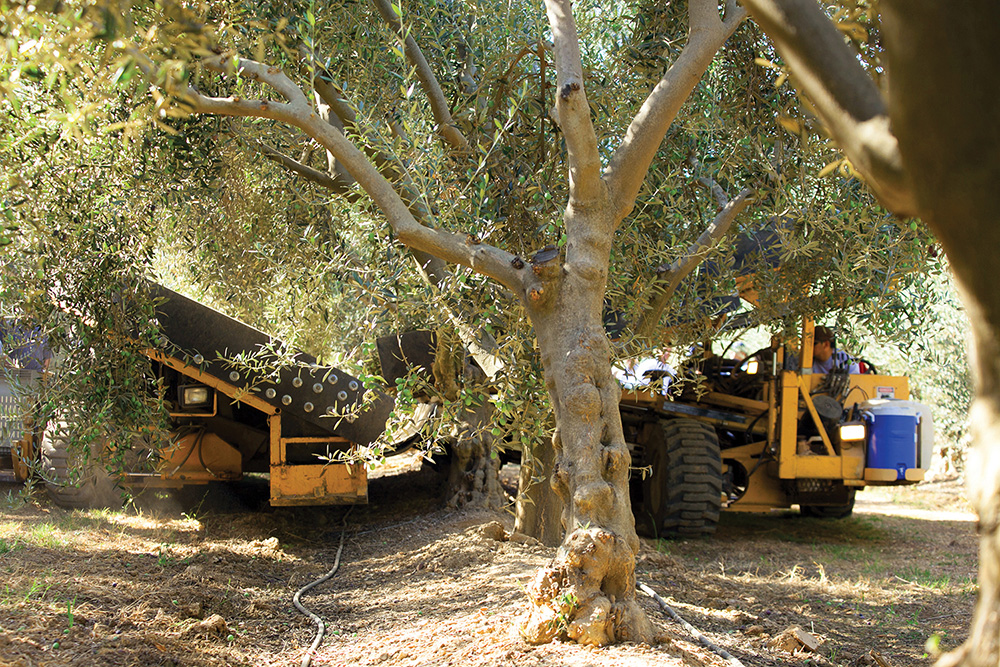
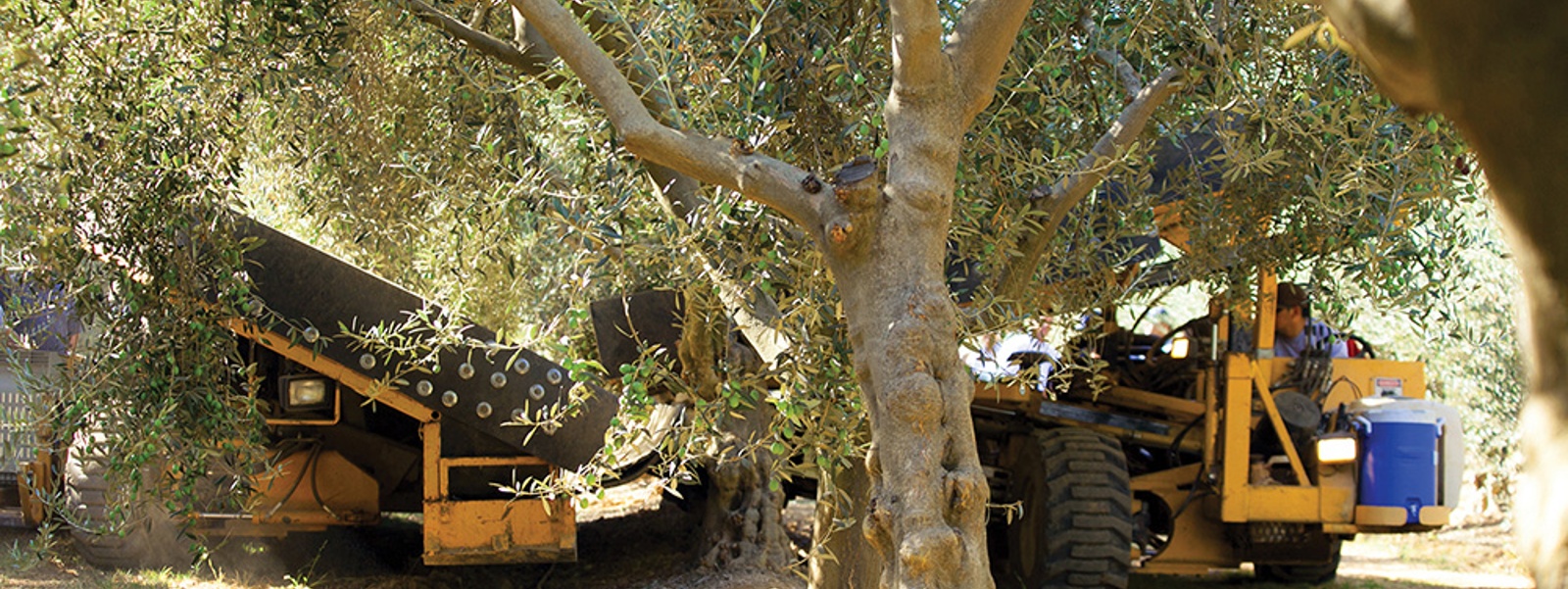
Tables olives are mechanically harvested at Burreson Farm Orchards in Orland. Researchers are experimenting with an ethylene-like spray that makes it easier to harvest olives with a trunk shaker.
Photo/Courtesy Musco Family Olive Co.


By Cecilia Parsons
California table olive producers have endured a challenging decade. Once an important crop in the Golden State—particularly in Butte, Glenn, Tehama, San Joaquin and Tulare counties—high picking costs, relentless foreign competition and a shift to more promising crops have shrunk the sector.
Today, more than 60% of the state’s olive acreage is dedicated to oil production rather than canning.
 Research being conducted by a team of University of California researchers, including farm adviser Becky Wheeler-Dykes, is aimed at improving mechanical harvest efficiency for table olives to save on labor costs. The research is funded by the California Olive Committee and its research committee.
For the past three years, Wheeler-Dykes has been testing the use of the synthetic ethylene precursor Accede, which loosens fruit attachment, requiring less force from shakers to remove the fruit and allowing more olives to be harvested at once. Wheeler-Dykes continues years of COC-funded olive harvest research at UC Davis. The current work is now in its fourth year.
For the 2026 harvest season, Wheeler-Dykes will pair Accede use with varying settings on mechanical harvest equipment. Trunk shakers with catch frames—equipment commonly used to harvest pistachios and prunes—will be used at the test sites to document harvest efficiency and assess how much force is needed for removal.
Different revolutions per minute, or RPM, shake patterns and weight setups on the shaker will be tested to evaluate how these variables may contribute to improved harvest efficiency.
Trunk shaking with a catch frame has been an option for table olive growers who have planted orchards adapted to mechanical harvesting, but Wheeler-Dykes said removal percentage without Accede was only in the 55% to 65% range. Combining Accede with optimizing mechanical harvester settings, she said researchers hope to achieve much better removal with lower fruit removal force.
According to the International Society of Horticultural Science, ethylene works by stimulating the abscission zone, a band of cells at the stem-fruit connection. Ethylene triggers cell wall-degrading enzymes that break down cell structures and allow the olives to come off with much less force.
At the Nickels Soil Lab annual field day in May, Wheeler-Dykes explained how Accede, a synthetic version of a naturally occurring precursor to ethylene, is applied and its effect on harvest efficiency. Timing the application of Accede is important. Trees must be receptive and able to metabolize the application. When timing is right, the active ingredient in Accede is converted to ethylene, which easily penetrates and loosens green olives.
Her trials with table olives have involved using Accede applied seven to 10 days prior to anticipated harvest. Monitoring fruit maturity is helpful, as any application prior to fruit readiness wastes the application. The trials involved three different concentrations of the product: 400 parts per million, 800 parts per million and 1,500 parts per million, all applied at 100 gallons per acre with an air-blast sprayer.
The treatment is aimed at lowering the fruit removal force, allowing a higher percentage of olives to come off the tree at harvest. A lower fruit removal force is important because it makes it easier for the fruit to be separated from the tree, reducing shake time and shake intensity, and reducing potential for tree damage. Timing and concentration of application is important to prevent leaf loss, though Wheeler Dykes said no phytotoxicity has been found with the rates tested.
Accede, a Valent product, is not yet registered for use on olives, but it is registered for use in apple and cherry harvest. Wheeler-Dykes said the UC team has been collecting the required efficacy and crop safety data for registration and expressed hope that Accede will become registered by next year.
The federal Interregional Research Project No. 4, or IR-4 program, is assisting in the registration by providing additional funding and support for the research. This assistance also supports label expansion for specialty crops by waiving costly Environmental Protection Agency registration fees when data supports it.
Wheeler-Dykes said she expects the higher harvest efficiency that can be achieved with Accede and mechanical harvest will benefit table olive growers with orchards that can be adapted to mechanical harvest.
Many factors determine whether an orchard can be mechanically harvested, including trunk size, which is largely determined by tree age and management. Throughout California’s table olive-growing regions, there are productive orchards that are more than 100 years old.
“They are beautiful trees, but much too large to shake,” Wheeler-Dykes said.
She said the best candidates for an efficient mechanical harvest are orchards younger than 30 years, most of which were planted in the “modern acreage” style, with tighter spacing. These orchards were designed from day one to be mechanically harvested, so tree architecture and size have been carefully managed to enable equipment to move through the field. Some older orchards could also potentially be retrofitted for mechanical harvesting with strategic pruning and trunk manipulation, she said.
At the Nickels Soil Lab olive orchard, Wheeler-Dykes pointed to some older olive trees that she said were severely pruned by removing some limbs to fit a shaker head around the trunk but bounced back well and have been mechanically harvested for the past three years.
The mechanical harvest protocol Wheeler-Dykes outlined starts with skirting tree canopies during early June. This practice prevents low branches from touching the shaker deck, which reduces the energy transfer to the fruit and limits harvest efficiency. She noted that research shows skirting does not significantly affect yield but does substantially improve fruit removal with mechanical harvesters.
Dennis Burreson, vice president of field operations at Musco Family Olive Co. in Tracy and vice chair of the California Olive Committee, has been a witness to the changes and needs of the table olive industry.
Musco is family owned and one of two major commercial ripe olive canners remaining in the state.
Burreson said the industry realized decades ago the need to transform the California table olive industry, which has been decimated by high labor costs for harvesting. He estimated that about 15% of existing table olive orchards could be adapted to mechanical harvest.
Musco’s Million Trees project initiated four years ago prompted 3,000 to 4,000 new acres to be planted, he said. Musco purchased the trees and provided them to growers at no cost.
The new orchards were designed to accommodate mechanical harvest and will be in production in the near future. Burreson said olive trees typically enter production at 5 to 6 years of age. Using Accede will allow the trees to be mechanically harvested by their sixth year. In young trees, using Accede to reduce fruit removal force will help protect them from shaker damage at initial harvest, he said.
Cecilia Parsons is a reporter in Tulare County. She can be reached at agalert@cfbf.com.
In this edition…
• Researchers study potential of agave crop
• Investigadores estudian el potencial del cultivo de agave
• California grazing sector threatened as goat herder wage soars to $240K
• California's pest prevention system needs an update
• Mechanical harvest research bolsters table olive prospects
• Overnight guests add key revenue stream for farms
• Advocacy in Action: Grazing, wild horses and the Endangered Species Act
• Smart sprayers slash farm labor and herbicide costs
• How will early blooms and light crop affect navel orangeworms?
• Finding her second act: Former dancer builds new life with U-pick raspberry farm
• Bountiful Finds: A curated collection of goods made by Farm Bureau members
• Now in season: You can grill just about anything
• The scenic route: Pit stops at California farms and ranches
• Grape expectations: Sweet flavor with healthy twist
• A life in motion: Avocado farmer helped revolutionize the modern skateboard
• Imagine this: Students tell stories about agriculture
• AI in agriculture: Balancing innovation and new risk
• Workforce training program seeks input from employers






.svg.png)
