


Overnight guests add key revenue stream for farms
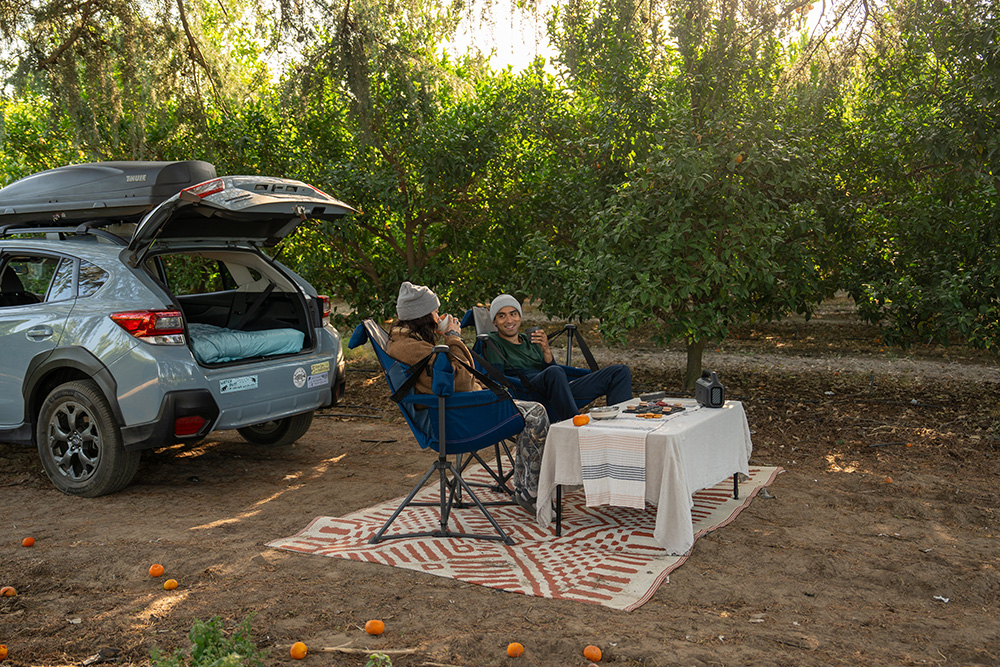
A couple enjoys a meal while car camping at Sunny Cal Farms in Fresno County. The farm, which grows organic table grapes, recently began welcoming overnight guests to diversify its income.
Photo/Courtesy of Hipcamp


By Tim Hearden
More California farms and ranches are incorporating small-scale overnight camping into their operations, and both their goals and stages of development cross a wide spectrum.
For Nelson Family Vineyards in Mendocino County, three campsites are part of an agritourism program that includes weddings, concerts, a choose-and-cut Christmas tree lot and an annual fun run—all of which augment the family’s diversified farming operation.
By welcoming guests to stay on the land, the family directly boosts retail sales. Some campers buy the farm’s wine, and nondrinkers support the business by purchasing other products the farm sells, co-owner Greg Nelson said.
“I think it gives a really positive image to folks that live in the cement forest of the big city,” he said. “They get to get out and see what it’s like out on a farm.”
Sunny Cal Farms in Fresno County, which grows organic table grapes, has recently started welcoming overnight guests at its single, undeveloped camping area.
“You realize you start with what you have and build it,” co-owner C.J. Buxman said. “It’s really a boondocking site. Guests can bring their RVs or camp with tents, but it’s really a ‘bring everything in and camp on an organic farm.’ Basically, there’s nothing there.”
The two farms are among an increasing number of California agricultural operations hosting overnight campers to diversify their incomes amid rising land ownership costs, water uncertainty and fluctuating crop prices, according to the University of California Agriculture and Natural Resources.
The trend has been boosted by legislation approved last year that created a new state category for small nature-based campsites so that they no longer need a commercial occupancy permit. Assembly Bill 518, the Low-Impact Camping Areas Act, was supported by the California Farm Bureau and outdoor enthusiast groups.
“It is a positive that agricultural producers may have more options to diversify their income in a way that is compatible with their farming business and that invites the public to appreciate the beauty of California’s agricultural lands,” said Rachael Callahan, statewide agritourism coordinator for the UC Sustainable Agriculture Research and Education Program. “It is promising that policymakers are thoughtfully engaging with how to create new opportunities for farmers and ranchers, and remove barriers, to ultimately strengthen farm viability.”
Counties must opt in on the AB 518 provision and can regulate the sites through their own land-use and safety ordinances.
Guido Frosini, owner of True Grass Farms in Tomales, is among a handful of Marin County farmers working with local officials to draft an ordinance.
Frosini said he envisions a farm stay as part of his family’s beef and lamb operation, with a strong working-land and stewardship angle.
“I believe in the importance of accessory camping, which is how Marin County is talking about it,” Frosini said. “It is essential and necessary for the viability of agricultural operations going forward to provide an opportunity for the consumer to learn about a product on site and to enjoy a product on site.”
As land prices have increased while the prices for agricultural products have remained flat, agritourism can enable a farm to make ends meet, Frosini said.
“It’s not like it used to be,” he said. “With that, we have to adapt.”
According to Hipcamp, an online camping marketplace that sponsored AB 518, two-thirds of its nearly 1,500 listed hosts in California describe their land as a farm, ranch or similar working land. On average, California hosts earn $14,500 per year through their camping offerings, with guests generating about $58 million in spending statewide during the past year, the company estimated.
Nearly half of Hipcamp’s hosts said in a survey they were prompted to begin hosting by financial considerations, and 59% sell goods or services directly to guests.
With campsites at state and national parks tending to fill up rapidly every summer, “there was a real need for more opportunities for camping,” said Cassandra Prenn-Vasilakis, Hipcamp’s senior manager of government and community relations. The demand has grown steadily since Hipcamp started partnering with private landowners in 2015, and there’s “no signs of letting up soon,” Prenn-Vasilakis added.
“It’s a really wonderful way of reaching new customers and new audiences,” she said. “That’s the thing that gets me really excited about camping-based agritourism. …I think every opportunity we have to connect people with agricultural land and help them understand their value is just a wonderful opportunity.”
Nelson Family Vineyards south of Ukiah is listed by Hipcamp and Harvest Hosts, an annual membership program that allows self-contained RVers to park overnight for free at more than 9,700 small businesses throughout North America, including farms, according to the company.
Greg Nelson’s father bought the ranch in 1951 and passed it on to his children and grandchildren. Today, the working farm leases rangeland for cattle and features a 5-mile hiking trail along a ridge overlooking Ukiah.
The farm established its three campsites during the COVID-19 pandemic to accommodate people who were traveling by RV and looking for more remote destinations, Nelson said. Sometimes travelers to Oregon or the California redwoods stop for the night on their way home to the San Francisco Bay Area, he said.
The farm has an apartment that visitors can rent and often hosts concerts.
“We get a lot of campers for concerts,” Nelson said. “We could have 12 or 15 RVs come to a concert.”
Nelson said the response from visitors has been positive, with some praising the area’s clear night skies and appreciating the stargazing opportunities. Although some have complained about the sound of irrigation pumps, “we warn them that it’s an active farming operation,” he said.
He also said he has been impressed by how respectful visitors have been, leaving virtually no trash behind—only a child’s coat and a handkerchief—and that many people enjoy walking their dogs on the property.
“It’s been nice for us,” he said.
There will be a session on AB 518 and next steps for counties at the California Agritourism Summit Sept. 23-25 in Paso Robles. At the event, keynote speakers, panel discussions and breakout sessions will give participants practical tools and inspiration, according to the UC, which is organizing the event. For information and to register, visit https://na.eventscloud.com/website/83086/.
Tim Hearden is a reporter in Redding. He can be reached at agalert@cfbf.com.
In this edition…
• Researchers study potential of agave crop
• Investigadores estudian el potencial del cultivo de agave
• California grazing sector threatened as goat herder wage soars to $240K
• California's pest prevention system needs an update
• Mechanical harvest research bolsters table olive prospects
• Overnight guests add key revenue stream for farms
• Advocacy in Action: Grazing, wild horses and the Endangered Species Act
• Smart sprayers slash farm labor and herbicide costs
• How will early blooms and light crop affect navel orangeworms?
• Finding her second act: Former dancer builds new life with U-pick raspberry farm
• Bountiful Finds: A curated collection of goods made by Farm Bureau members
• Now in season: You can grill just about anything
• The scenic route: Pit stops at California farms and ranches
• Grape expectations: Sweet flavor with healthy twist
• A life in motion: Avocado farmer helped revolutionize the modern skateboard
• Imagine this: Students tell stories about agriculture
• AI in agriculture: Balancing innovation and new risk
• Workforce training program seeks input from employers






.svg.png)
