


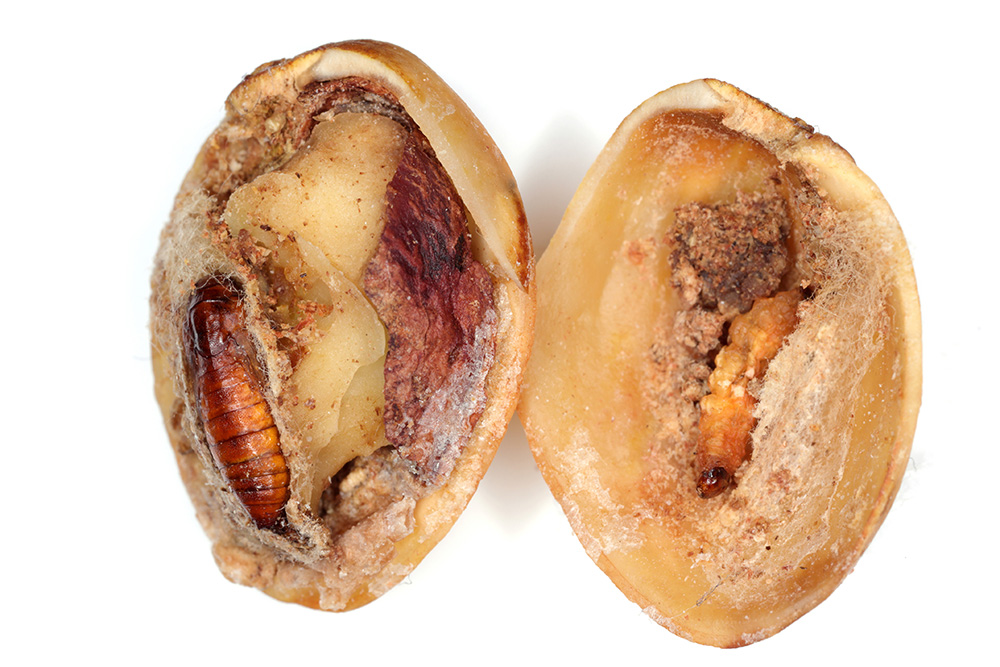
How will early blooms and light crop affect navel orangeworms?
Photo/Licensed image


By Justin Nay
Integral Ag Services, Durham
Due to an unseasonably warm March that led to an early pistachio bloom, the crop is small this year. Pistachios are alternate bearing, and 2026 is expected to be a light-crop year. The combination of a small crop and an “off” year could create challenges for growers.

If prices are low, some growers may not shake, and this could present problems with the navel orangeworm, or NOW. A single shake could pose additional challenges because the nuts remain on the trees longer, increasing their exposure to the pest.
Off years generally have fewer early splits, but they still occur. Even with a light crop, some trees will produce enough nuts to develop early splits, providing entry points for NOW. The pest is very good at finding the splits, so it’s important to prevent populations from building in July when growers delay harvest for a single shake.
The level of NOW activity in the orchard and the number of early splits will determine the spray applications, which could begin as early as mid-July.
Intrepid, Altacor and pyrethroids tend to be the most heavily relied upon products. If applied at the right time and rate, with high gallons of water per acre, they deliver good results.
Growers who harvest will generally invest in chemical treatments. However, when large numbers of moths are cycling through mummies on the orchard floor, sanitation may be a more cost-effective option. Using a sweeper instead of a blower and shredding more slowly can help destroy mummy nuts that serve as NOW breeding sites.
Growers who decide not to shake because their crop is too small will need extra winter sanitation to prevent large NOW populations the following year, which will be an “on” year in the alternate-bearing cycle and could result in more early splits. Pruning crews and other orchard activities can knock many mummies from the trees, and Mother Nature frequently removes them as well.
In this edition…
• Researchers study potential of agave crop
• Investigadores estudian el potencial del cultivo de agave
• California grazing sector threatened as goat herder wage soars to $240K
• California's pest prevention system needs an update
• Mechanical harvest research bolsters table olive prospects
• Overnight guests add key revenue stream for farms
• Advocacy in Action: Grazing, wild horses and the Endangered Species Act
• Smart sprayers slash farm labor and herbicide costs
• How will early blooms and light crop affect navel orangeworms?
• Finding her second act: Former dancer builds new life with U-pick raspberry farm
• Bountiful Finds: A curated collection of goods made by Farm Bureau members
• Now in season: You can grill just about anything
• The scenic route: Pit stops at California farms and ranches
• Grape expectations: Sweet flavor with healthy twist
• A life in motion: Avocado farmer helped revolutionize the modern skateboard
• Imagine this: Students tell stories about agriculture
• AI in agriculture: Balancing innovation and new risk
• Workforce training program seeks input from employers





.svg.png)
