


The mechanics of postharvest nutrition for orchards



By Mike Almasri
The most common question I get from growers is which fertilizer application matters most for trees. My answer is the postharvest application. It is the one application focused not on feeding this year’s crop but on building the reserves the tree will need next spring.
Every fall, we preach the same sermon in almond, pistachio, walnut and stone fruit: Apply postharvest nutrients, keep water on, and do it while the leaves are still green. We argue about what and how much. We never talk about why.
Bloom and the first leaves next spring are built from what the tree stored the previous fall. From bud break until the leaves are fully developed, the tree relies on those stored nutrients and sugars. The soil contributes little during this early stage before the canopy is fully functioning. The tree can replenish nutrients from the soil as the season progresses, but it cannot replenish its sugar supply until the leaves are developed enough to produce sugar through photosynthesis.
From bud break to harvest, the tree has one job—the crop—and its reserves are at their lowest while the crop is developing. After harvest, the leaves continue producing sugars, which the tree stores as starch and sugars. Whatever the tree manages to store between harvest and leaf drop is all it will have to support growth the following spring.
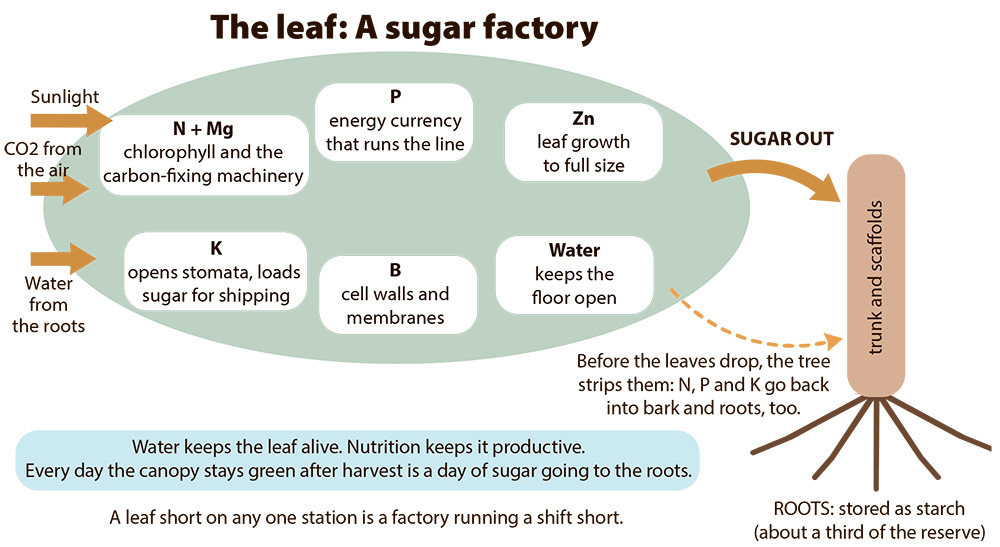
So what is the postharvest program actually doing? It is not simply building fertilizer reserves in the soil; it is keeping the leaves productive. A leaf is a sugar factory, and every nutrient we apply has a job on the production line. Nitrogen supports the proteins and enzymes needed for photosynthesis, while magnesium is a central component of chlorophyll, the pigment that captures sunlight. When a leaf is short on nitrogen, its ability to produce sugar declines.
Phosphorus is the energy currency that keeps the production line running. Potassium helps regulate the stomata and move sugars into the phloem for transport throughout the tree. Zinc supports leaf growth and development, helping leaves reach their full size and productive capacity. Boron helps maintain cell wall structure and, in almonds, plays a role in transporting sugars to flower buds. Fall foliar applications of boron have been shown to improve nut set the following spring. A leaf short on any one of these nutrients is like a factory running a shift short.
Water keeps the leaf alive; nutrition keeps it productive. Nutrition supports sugar production. Sugar builds storage reserves. Those reserves support bloom, and bloom produces the crop.
Much of what the tree stores is sent belowground. When a University of California, Davis, team dug up mature Nonpareil trees at Shafter in December, they found that roots accounted for 13% of the tree’s dry weight but held 36% of its carbohydrates and 44% of its nitrogen. Trees in the same orchard that had their water cut off through harvest—a hard cutoff repeated for three consecutive seasons—lost their leaves early and had 26% less carbohydrate overall, including 35% less in their roots. Their nitrogen levels, however, did not change. Before dropping their leaves, trees can pull nutrients back into storage. But early leaf drop meant these trees lost an important opportunity to replenish their carbohydrate reserves.
How much damage that causes depends on how much time the tree has to recover after harvest. An early peach harvest in June leaves about four months for the tree to rebuild its reserves. In a four-year study at Parlier, withholding postharvest water did not reduce yields on deep sandy loam, although it did limit trunk growth and increase the number of double kernels. Almonds, typically harvested in August, have until leaf drop in November to recover. Pistachios, harvested in late September, and walnuts, harvested later, have even less time. The later the harvest, the more costly every missed irrigation and delayed nutrient application can be.
Here’s the takeaway: Keep the dry-down period as short as conditions allow, and resume irrigation as soon as the shakers leave. That protects the leaves and gives them more time to keep working. Make sure the tree has the nutrients it needs while the canopy is still green rather than applying them according to the calendar. That’s what keeps the leaves productive. The reserves the tree carries into bloom are built during those weeks.
Mike Almasri is a certified crop adviser for Simplot and Western Region Certified Crop Adviser board member. He can be reached at Mike.Almasri@simplot.com.
In this edition…
• View full issue
• Adaptability fuels pomegranate potential
• Farmers seek new tools to ward off copper wire theft
• Building strong relationships strengthens agriculture
• Lima bean breeders explore regional differences in trial
• Automated irrigation systems can help reduce costs
• Rice commission CEO centers conservation efforts
• The FELS Hotline: Do not wait until you are in a jam
• Are there orchard sanitation steps to skip to save money?
• The mechanics of postharvest nutrition for orchards
• Why Nationwide understands farm business, coverage