


Farmers seek new tools to ward off copper wire theft
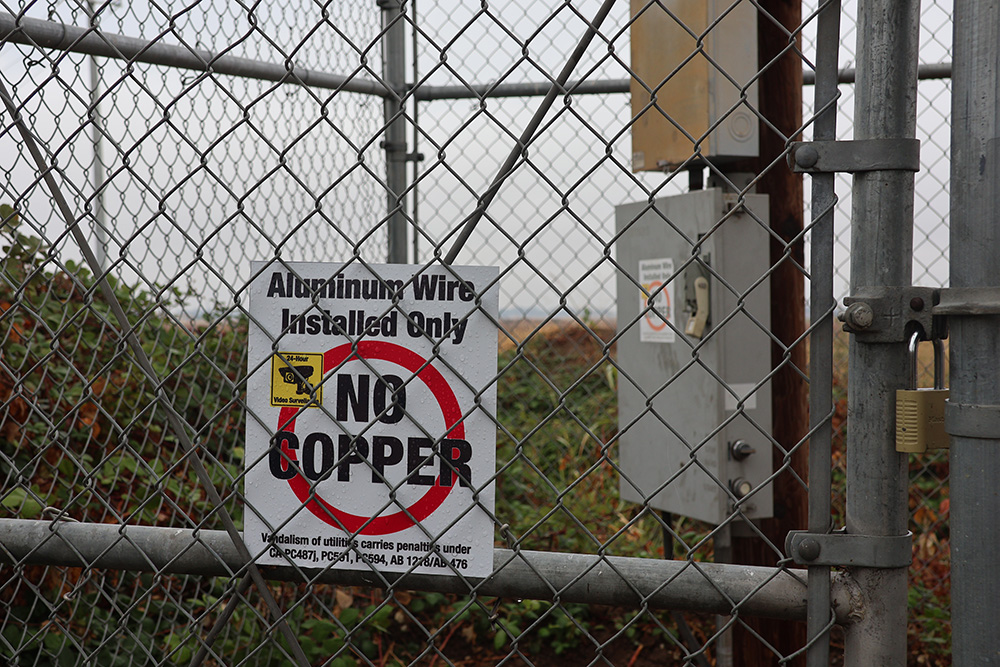
Sacramento County farmer Ray Yeung replaced what was once copper wiring at his water pump with aluminum after his previous wiring was stolen.
Photo/Manola Secaira


By Manola Secaira
With California experiencing a rise in copper wire thefts, farmers are looking for new ways to protect their property.
Copper wire is often a component of water pumps used for irrigation, and such thefts can threaten crops and create costly damage for farms.
 Sacramento County farmer Ray Yeung was hit five times this year, with one theft as recently as last week and another occurring in July, a critical growing period. He paid for the repairs himself in all cases rather than file an insurance claim for fear his premium would go up. He said addressing the repairs was particularly stressful during the summer.
“Your crop needs water, so you’re kind of screwed,” Yeung said. “You might have a million dollars’ worth of crop out there that you could lose because these guys stole 50 bucks worth of wire. That’s a big deal.”
Though farms continue to be targeted, copper wire thefts remain hard to entirely prevent. Agricultural operations have been forced to look for solutions elsewhere, even though prevention remains limited in rural areas.
Brett Gray, general manager of the water utility Natomas Mutual Water Co., said copper wire theft has become so routine that it’s part of his “business as usual.” His company has around 30 water pump stations serving about three dozen farmers in the Sacramento Basin.
“We typically are getting five or six sites hit per year right now,” Gray said. “It’s continually a problem. It’s continually a cost.”
Gray said his company spends about $30,000 annually in repairs related to copper wire thefts. The company has also spent money to increase security, including on nightly patrols, cameras and razor wire for fences.
More recently, it has explored replacing copper wiring with aluminum at some of its sites. Gray said aluminum is much cheaper than copper, making it less attractive to thieves, although it can be harder for an electrician to work with, and it isn’t the right fit for every site.
The company has added signs to indicate aluminum is being used instead of copper in hopes of warding off thieves. It hasn’t always worked, Gray said, noting that even with the signs, thieves have cut wires.
“So, damage occurs, and you’ve got to fix it and replace it. But they didn’t steal it, so they got nothing,” Gray said. “Hopefully with time, they’ll avoid some of these facilities, and we can decrease the issues.”
Some technological developments have become available to farmers. Last year, agricultural automation company Farmblox released COP-R-LOCK, a security system specifically made to prevent copper wire thefts.
Melissa Steidlmayer, senior vice president of sales for Farmblox, said COP-R-LOCK uses sensors to detect activity in an area. When a sensor is triggered, it sets off an on-site siren. It also sends a wireless signal to a solar-powered base station that then sends the alert to the grower.
“The whole goal of COP-R-LOCK is to deter thieves before they can steal the copper or cause expensive damage that puts a pump out of service,” she said.
Bobby Rader, Porterville’s police chief and rural crime expert, worked with Farmblox to craft COP-R-LOCK after coming up with a similar concept himself. He had spent much of his career focused on agricultural crime and has overseen thousands of copper wire theft investigations.
For much of that time, Rader said he couldn’t find a security system designed to meet the needs of rural farmers targeted by copper wire thieves. Available tools, such as game cameras, did not offer sufficient protection on their own.
An effective solution, he said, would need to work in remote areas without an internet connection and provide real-time alerts to growers even when they’re miles away from the property.
COP-R-LOCK is a potential solution, Rader said. It uses long-range wireless communication and cellular connectivity, making it better equipped to serve rural areas. He noted that since Farmblox began selling COP-R-LOCK, there have been tamperings but no stolen copper wires at sites where it has been installed.
Copper wire theft isn’t limited to farms. In a bulletin last year, California’s Attorney General Rob Bonta reported a surge in such thefts across the state affecting agricultural and urban areas. In cities, copper wire stolen from telecommunications infrastructure can lead to utility outages. A press release from Bonta’s office said the telecom industry reported more than 1,800 copper wire thefts in California between June and December of 2024.
“While the value of copper remains high, we can expect it will continue to be a target of theft and vandalism, unless we step in now and do something about it,” Bonta said in a statement last year.
California has passed laws in recent years to address the problem. This year, lawmakers passed a bill strengthening penalties for repeat and organized copper wire theft.
Rader said while legislation is helpful, he thinks innovation to thwart wire theft is needed, with COP-R-LOCK being one example. Creating and refining tools to prevent theft on farms could help lessen the financial burden, he added.
“We need the private sector to build better tools that not only help the farmer mitigate risk but help law enforcement get engaged much, much faster, and it helps give the criminal pause,” Rader said.
Farmer Yeung has taken steps to secure his property. After speaking to Gray at Natomas Mutual Water Co., he swapped out some of his copper wiring with aluminum. He also installed COP-R-LOCK at one site and plans to equip his other farms with the system.
“This is the first time that I felt that we were able to do something to solve the problem,” Yeung said, adding he hopes his new measures will be enough to deter future wire thefts.
Manola Secaira is a staff writer for Ag Alert. She can be reached at msecaira@cfbf.com. Reprint with credit to California Farm Bureau. For image use, email agalert@cfbf.com.
https://qrco.de/bf8VjQ


In this edition…
• View full issue
• Adaptability fuels pomegranate potential
• Farmers seek new tools to ward off copper wire theft
• Building strong relationships strengthens agriculture
• Lima bean breeders explore regional differences in trial
• Automated irrigation systems can help reduce costs
• Rice commission CEO centers conservation efforts
• The FELS Hotline: Do not wait until you are in a jam
• Are there orchard sanitation steps to skip to save money?
• The mechanics of postharvest nutrition for orchards
• Why Nationwide understands farm business, coverage