


Adaptability fuels pomegranate potential
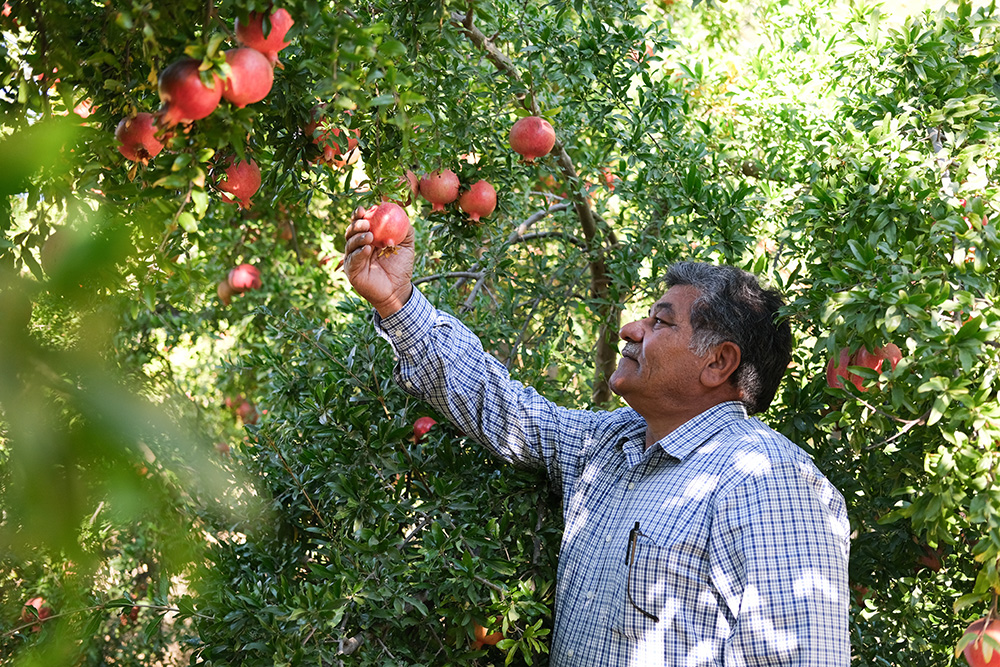
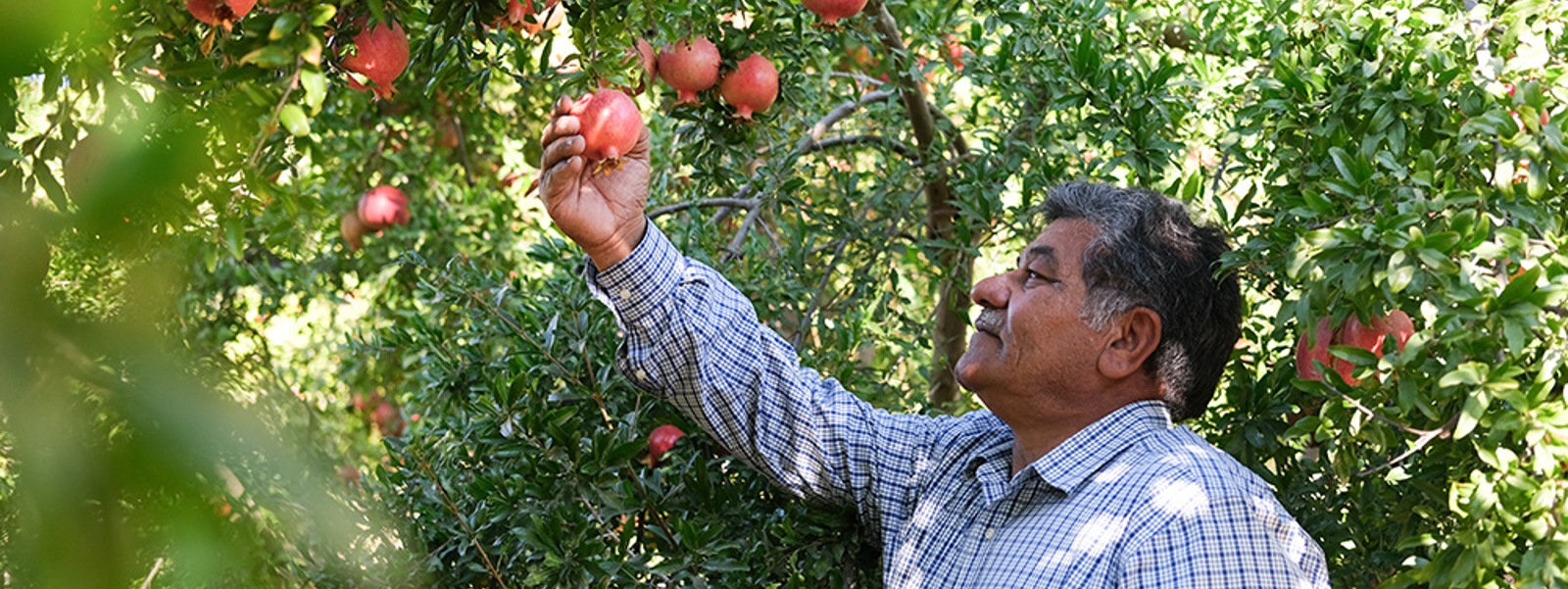
Farmer Raj Sharma checks the ripeness of a pomegranate last month in Solano County. Pomegranates are harvested from September through November in the Central Valley. Farmers say the plant’s tolerance of poor soils and adaptability to different orchard systems make it attractive to grow.
Photo/Caleb Hampton


By Caleb Hampton
California’s history as a major pomegranate producer is relatively short. But according to farmers and researchers, the crop possesses traits that could give it a promising future in the state.
 Compared to most fruits and nuts grown in the Central Valley, pomegranates are better able to tolerate water scarcity and soil salinization, both of which are expected to worsen in the region.
“They’re very hardy plants,” said Raj Sharma, a diversified farmer who grows pomegranates in Solano and Sutter counties.
The state’s pomegranate industry was effectively born at the start of the 21st century with the founding of Del Rey-based POM Wonderful in 2002. The Fresno County company, which is owned by farming moguls Lynda and Stewart Resnick, quickly became the largest U.S. pomegranate grower and processor.
By 2012, California’s pomegranate acreage multiplied from less than 3,000 to nearly 30,000, according to the U.S. Department of Agriculture, putting the crop’s footprint among the top several tree fruits in the state. Acreage has since held roughly steady.
Louise Ferguson, professor of Cooperative Extension at the University of California, Davis, said POM Wonderful’s investment in marketing pomegranates to U.S. consumers likely opened the market for other growers, who now account for more than half the state’s acreage. California produces almost all U.S.-grown pomegranates.
Once the market was developed, the pomegranate plant’s adaptability to different orchard systems, hardiness and tolerance of marginal soils helped the fruit carve out a place for itself among millions of acres of more established crops.
Pomegranates grow naturally as shrubs and can be planted close together to form hedges, pruned into trees reaching up to 20 feet in height or trained on trellises.
In Solano County, Sharma planted 30 acres of pomegranates inside a block of Hartley walnuts, which need to be spaced far apart because of how tall the variety grows. He said he chose to plant pomegranates because they can grow close together, fitting two or three between each walnut tree, and they stay low to the ground beneath the walnut canopy.
In Sutter County, Sharma planted 20 acres of pomegranates in a dense hedge around the periphery of a peach orchard to shield the stone fruit from unwanted visitors.
In each case, the pomegranates enabled him to “use the space more economically,” he said, while also diversifying his business.
Farmers have also planted pomegranates to make the most of low-quality soils. The trees grow well in rocky, gravelly and sandy soils, thrive in soils with a wide pH range and without many nutrients, and tolerate drought and relatively high soil salinity, Ferguson said. On top of that, they require little or no nitrogen fertilizer, hand pruning, fruit thinning or ladders for harvest, all of which reduces costs for farmers, she added.
“Pomegranates get planted in really poor soils because they’re highly adaptable,” Ferguson said. “There aren’t many options for poor ground that would have the ease of production.”
In Fresno County, farmer Lance Jackson, who is based in Kingsburg, tried for decades to find a productive crop to grow on a 12-acre block on his farm.
“It’s super sandy soil, almost like beach sand,” said Jackson, who at different times planted peaches, nectarines, cherries and almonds on the plot of ground. “We’ve struggled to get anything to grow there and be profitable.”
A few years ago, he planted pomegranates as a last resort.
“They took off like crazy,” Jackson said. “I’m just astounded.”
Jake Barcellos, a larger pomegranate grower whose diversified farm grows about 500 acres of the fruit for POM Wonderful, said he planted pomegranates near Firebaugh on the west side of Fresno County because the soil was too salty to support almonds.
“It’s not the greatest ground, but pomegranates work pretty well on it,” Barcellos said. “It’s been decent for us.”
The resilience of pomegranates stems from the plant’s early evolution in arid parts of the Middle East, Ferguson said. Historians believe the fruit originated on the Iranian plateau, where it was domesticated about 5,000 years ago.
“It all has to do with how they evolved in high desert climates,” Ferguson said, adding that pomegranates possess “adaptable” roots that can navigate rocky soils and “exploit moisture deep in the ground.”
“It basically came to us adapted to marginal situations,” she said.
 In recent years, drought-tolerant crops such as olives and agave have attracted increased interest in the Central Valley as California’s Sustainable Groundwater Management Act limits water supplies for many farms. The region also faces a soil salinity crisis, with more than a fifth of the valley’s farmland suffering reduced yields due to salt buildup caused by natural conditions and the long-term effects of irrigation.
Ferguson said those factors could make pomegranates “more of a major crop,” but only if market demand were to increase enough to support more production.
In the near term, growers and handlers said they are optimistic about the pomegranate market.
Jennifer Hirano, vice president of marketing at POM Wonderful’s parent company, the Wonderful Co., said the company saw its highest-ever demand for pomegranate juice and packaged arils last year. Sales of arils, the jewel-like seeds, increased 39%, she said, crediting “an increase in consumer awareness and education on the health benefits of pomegranates.”
Hirano said POM Wonderful expanded its pomegranate acreage from 9,000 to 11,000 during the past two years, with plans to further expand in the coming years.
Barcellos, who finished harvest early this month, said he thought more of this year’s crop was likely to be processed for juice and arils than sold fresh due to quality challenges caused by wet weather during bloom and summer heat waves.
Pomegranates are harvested from September through November in California, with some fruit kept in cold storage and sold fresh through January.
Sharma, who sells his fruit to various retailers and wholesalers, as well as directly to consumers at a U-pick, said this year was his best ever for pomegranate sales.
“People are looking for it,” he said, adding that he hopes to plant more pomegranates soon, possibly doubling his acreage. “I think it’s the best crop out there right now.”
Caleb Hampton is an editor at Ag Alert. He can be reached at champton@cfbf.com. Reprint with credit to California Farm Bureau. For image use, email agalert@cfbf.com.


In this edition…
• View full issue
• Adaptability fuels pomegranate potential
• Farmers seek new tools to ward off copper wire theft
• Building strong relationships strengthens agriculture
• Lima bean breeders explore regional differences in trial
• Automated irrigation systems can help reduce costs
• Rice commission CEO centers conservation efforts
• The FELS Hotline: Do not wait until you are in a jam
• Are there orchard sanitation steps to skip to save money?
• The mechanics of postharvest nutrition for orchards
• Why Nationwide understands farm business, coverage