


Warm, dry start of spring sparks fire season concerns
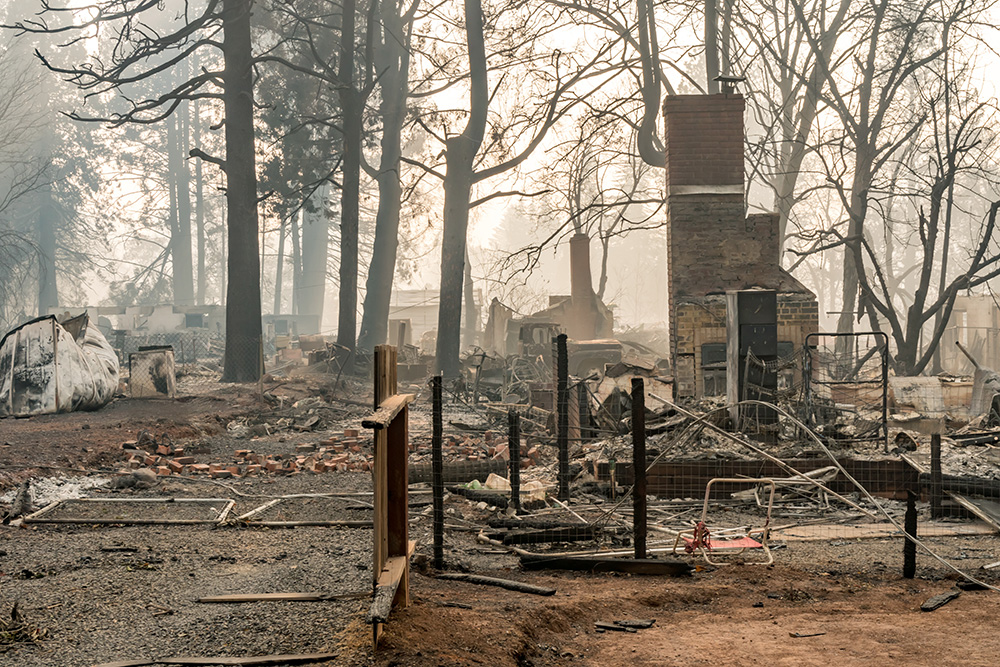
The 2018 Camp Fire devastated the Paradise area, burning more than 150,000 acres and destroying nearly 19,000 buildings.
Photo/Licensed image


By Tim Hearden
More than seven years after the Camp Fire ripped through the Paradise area in Butte County, burning 153,336 acres and killing 85 people, emotion still rings through Laurie Noble’s voice as she talks about preparations for what could be a busy wildfire season.
She and her husband, Jim Noble, owners of the 106-year-old Noble Orchard, lost their home and agricultural buildings in the November 2018 blaze. Since then, they’ve slowly been rebuilding, and this year they’ll finish with a new cold storage and packing facility.
For Laurie Noble, memories of rushing back to her house to grab whatever she could as the fire quickly approached are still vivid.
“Both my husband and I got out,” she said. “I had two cats and next to nothing else. But we were separated, in separate cars. I ended up walking fire trucks through a line of traffic that was double-lane through a residential area.”
The fire came quickly from the east side of Paradise, she recalled. Because it was such a dry year, her husband had been irrigating their orchard, which was mostly spared. The couple lost about 1% of their trees, though all their buildings were affected.
Noble and other farmers and ranchers who’ve had close calls with wildfires emphasize the need for precautions this season, including creating defensible space around structures, eliminating underbrush and other fuel ladders, and developing evacuation plans in case of disaster.
The warnings come after an unusually warm and dry start of spring throughout California, driven by a stubborn high-pressure ridge off the coast, which is likely to remain the dominant weather feature through at least June, according to the National Interagency Fire Center in an April outlook.
Record heat in many areas in mid-March melted most of the snowpack and led to increased dead fuel flammability as the month progressed, the center observed. The daily fire ignition average in Northern California in March was nearly double the average for the month since 2008, with the largest wildfire growing to 164 acres northeast of McArthur in a Tule marsh and becoming the first large fire of the season.
The federal Climate Prediction Center reported elevated chances of above-normal temperatures throughout the West during the next three months, with drier-than-normal conditions most likely in Northern California. The U.S. Seasonal Drought Outlook predicts drought is likely to develop throughout Northern California by June 30.
“I would say within fire circles, we’re all bracing for a long, busy fire season,” said Lenya Quinn-Davidson, director of the University of California Agriculture and Natural Resources Fire Network.
Even though there has been spring rain, Quinn-Davidson said the absence of a snowpack means the fire season will start much earlier because “rain doesn’t do as much to slow fire season as a snowpack would.”
“In fact, late rains can increase the vegetation available to burn when things dry out,” she added.
Sierra Valley rancher Rick Roberti lost his U.S. Bureau of Land Management allotment in the 2021 Dixie Fire and saw some neighboring properties burn. He said conditions at the beginning of April this year were as dry as they normally would be at the start of May.
“I think everyone’s a little nervous,” he said. “So much has burned around us that there’s not a lot left to burn, … but that’s not saying it couldn’t burn again.”
Even in the middle of California’s rainy season, Roberti noted a fire broke out last month in the forest of the Warner Mountains in Modoc County.
Groups such as the California Cattlemen’s Association are urging ranchers to prepare by making sure they’ve gone through the Livestock Pass training and are current pass holders. The Livestock Pass program enables trained commercial producers to enter their properties during disasters to care for or evacuate their animals.
Ranchers should also be aware of what is needed to be eligible for federal disaster assistance programs.
Mariposa County rancher Tony Toso helped advocate for the state Livestock Pass program after the Detwiler Fire broke out near his ranch in 2017. He said he was unnerved in mid-March by seeing a small fire break out near his BLM site before firefighters had it under control within a couple of hours.
“It kind of stung me seeing the smoke,” Toso said, adding that he and other ranchers are expecting a warm summer.
“We’re going to be preparing for what could be … a fire season we’re going to have to reckon with,” he said.
One tool gaining popularity among ranchers is virtual fencing, with which GPS-collared livestock are kept within certain areas without physical barriers. Toso has been using it to manage grazing on his own property, and he said he plans to use it on his BLM allotment this summer.
Toso said he plans to have his cattle eat down vegetation around his home and barns for about a month before taking them to their summer grazing allotment in June. Using his cattle for managed grazing on public lands is “kind of a pilot for us,” he noted.
“I know everyone’s doing it,” Toso said. “We’re trying to do our part.”
For Laurie Noble, public education about wildfire prevention is a key point. During a local fire safe council meeting recently, she noted that July 4 will fall on a Saturday this year, enticing large crowds to celebrate a three-day weekend on public lands.
“I think we need to be extra serious about anybody taking fireworks into the mountains,” she said. “It’s bad enough they take them into the valley. I think we need to talk about it and get out in public with it.”
Tim Hearden is a reporter in Redding. He can be reached at agalert@cfbf.com.

In this edition…
• View full issue
• Groundwater law begins reshaping valley
• Warm, dry start of spring sparks fire season concerns
• Cultivate the future through agricultural education
• Recognize signs of distress and when help is needed
• From the Fields: Jeff Colombini, San Joaquin County cherry and apple grower
• From the Fields: Stuart Mast, Calaveras County vintner
• From the Fields: Loren Poncia, Marin County rancher
• From the Fields: Ron Macedo, Stanislaus County agritourism operator
• Hot temps, new varieties boost strawberry volumes
• Young farmers talk policies during Capitol advocacy visit
• Drought, water restrictions drive innovation in tech
• USDA announces $9 million for cling peach tree removal
• Advocacy in Action: Farm Bureau tracks labor bills, applauds Farm Bill House passage





.svg.png)
