


Groundwater law begins reshaping valley
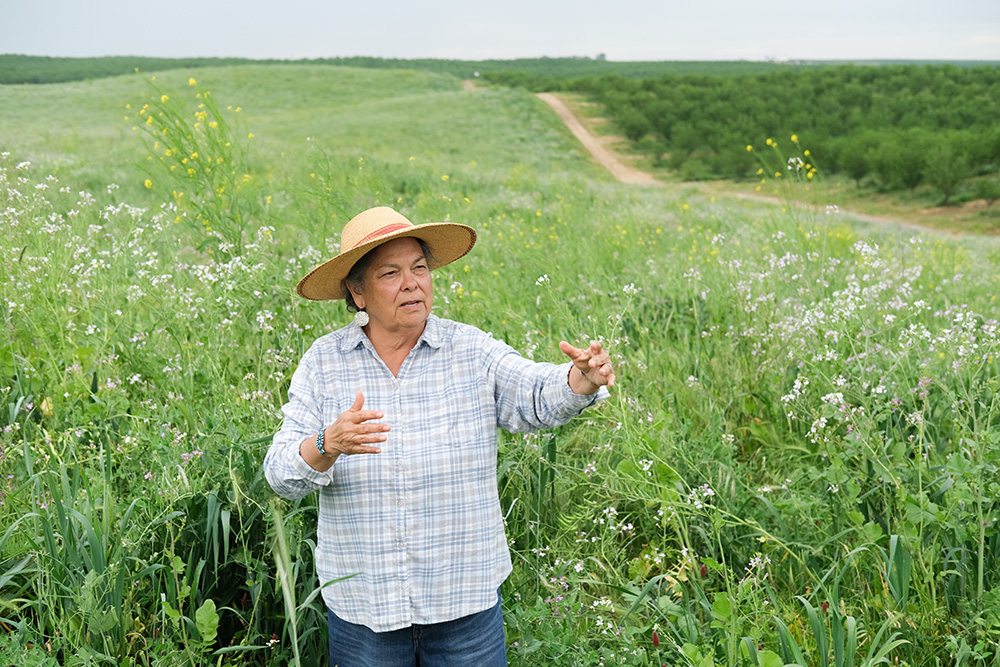
Merced County farmer Rosie Burroughs stands at the site of an almond orchard she removed to conserve water. Burroughs planted non-irrigated cover crops such as mustard and safflower that bring little financial return but help suppress dust, preserve soil health and provide livestock forage.
Photo/Caleb Hampton


By Caleb Hampton
Earlier this spring, an excavator maneuvered through the rolling hills of eastern Merced County, stacking almond trees removed by farmer Rosie Burroughs. During the past couple years, Burroughs scrapped about 170 acres of almond and walnut trees. Another 140 acres are slated for removal, reducing the family’s acreage by about a fifth.
San Joaquin Valley farmers are increasingly fallowing land as California’s Sustainable Groundwater Management Act curtails pumping.
“Every farmer is affected,” Burroughs said.
Groundwater serves as a lifeline for orchards and vineyards in the valley that need water regardless of rain or drought. For some growers, it’s their only water source.
Under SGMA, which is implemented by local agencies, groundwater basins have until 2040 or 2042 to achieve sustainability. But since 2020 or 2022, depending on local conditions, groundwater agencies have been required to prevent “undesirable results” such as land subsidence and household wells running dry.
In the San Joaquin Valley, where the aquifers are especially depleted, preventing those outcomes requires major changes ahead of the law’s final deadline.
Groundwater agencies covering much of the valley adopted pumping limits, or allocations, within the past few years as the state began cracking down on subbasins with inadequate plans.
On the eastern side of the Turlock Subbasin, where Burroughs farms, growers are limited this year to 1.6 acre-feet of groundwater per acre, with hefty fees imposed on excess use. Almonds, the area’s top crop, typically require 3 to 4 acre-feet of water per acre.
“We are truly in the difficult part of SGMA,” said Stacie Ann Silva, principal at Altum Aqua Logic, a Fresno-based water consulting firm that monitors more than 90 groundwater agencies across the state. “As allocations continue to ramp down, landowners are going to have to make harder decisions.”
The pumping reductions required by SGMA could cause as much as 20% of the San Joaquin Valley’s farmland to be taken out of production by 2040, according to a report by the Public Policy Institute of California.
Experts who track groundwater sustainability and land use said that transformation has begun. Last year, orchard removal companies in the San Joaquin Valley could not keep up with demand, particularly in the areas most affected by pumping restrictions, according to a February report by the California chapter of the American Society of Farm Managers and Rural Appraisers.
With pumping limits tightening in some areas and growers bracing for a dry year with less surface water, Silva said she expects fallowed acreage “is going to start to grow exponentially.”
Farming impacts
Alexandra Biering, a water policy expert and director of policy advocacy for the California Farm Bureau, said that while stabilizing the state’s aquifers is critical, doing so will be painful for farmers.
Some growers have made strategic decisions to voluntarily fallow acreage, sacrificing part of their business as they make long-term adjustments to comply with SGMA. But for others, financial stress caused by rising costs, low crop prices and SGMA has accelerated fallowing.
In recent years, as groundwater agencies released their allocation timelines, many parcels slated for steep pumping cuts lost more than half their value as the real estate market priced in a future in which that land lacks enough water to produce lucrative crops.
Real estate underpins many of the loans farmers rely on to develop new orchards and pay farming costs. The drop in land values caused banks to cut off new lending, and in some cases—when lenders became overextended—to call long-term mortgage loans due, plunging farmers into financial ruin.
In the eastern Turlock Subbasin, which relies heavily on groundwater, it is projected that 22,000 acres, about a quarter of the area’s farmland, will need to be fallowed—or repurposed to non-irrigated uses—in the next decade and a half as growers cut their groundwater use by 40%.
Nearly half that amount of land—about 10,000 acres—was taken out of production just in the past year, according to the Eastern Turlock Subbasin Groundwater Sustainability Agency.
Mike Tietze, the agency’s general manager, said foreclosures caused some orchards to be taken out, and other ground was left fallow because growers were denied loans to plant new trees.
“They had to fallow because of economic conditions,” Tietze said.
Burroughs said one of her family members, whose farm neighbors her own, removed an old almond orchard more than two years ago and has been unable to get a loan to plant new trees.
Ripple effects
Economists have warned the water cuts required by SGMA will impact not only farmers but send ripple effects through communities, while ecologists have cautioned that unmanaged fallowing could turn the nation’s top farming region into a dusty patchwork.
“There’s a lot at risk,” said Silva, the water consultant.
Implementation of the law, coupled with anticipated surface water reductions, could result in the San Joaquin Valley losing 42,000 jobs and more than $1 billion a year in worker wages, with the impact being “disproportionately large in the valley’s lowest-income communities,” according to a University of California, Berkeley, study.
The researchers projected the loss of economic activity will cost city and county governments $242 million a year, impacting the budgets of schools, fire departments and other public services.
While there are some state-funded grants to help landowners repurpose farmland, advocates said there are no dedicated relief programs to address SGMA's economic fallout.
“It’s been a constant battle to try to ensure that people understand what it means and what it will inevitably entail,” said Biering, the Farm Bureau policy advocate.
Looking ahead
SGMA’s implementation in the San Joaquin Valley could indicate some of the challenges that await farmers in other parts of the state.
Silva said new guidelines for managing subsidence have prompted “a growing conversation” among groundwater agencies in parts of the Sacramento Valley about adopting pumping limits next year.
She added that proactive growers and water managers in the San Joaquin Valley have found some solutions, however difficult, that could be replicated elsewhere. In multiple subbasins, they got buy-in from landowners and other growers to assess fees that have been used to add surface water supplies, recharge aquifers, compensate fallowing and mitigate ongoing impacts of overdraft.
Burroughs, whose family has farmed in California for more than a century, encouraged farmers to “communicate and work together” to preserve agriculture.
All around her, she said, growers are grappling with the possibility of losing their farms due to SGMA and other challenges.
“When you’ve grown up on a farm and seen what your parents and grandparents have done,” Burroughs said, “and now you’re the generation that the farm closes—because of nothing to do with you or what you put into it—it affects every aspect of your life and well-being.”
Caleb Hampton is an editor at Ag Alert. He can be reached at champton@cfbf.com.

In this edition…
• View full issue
• Groundwater law begins reshaping valley
• Warm, dry start of spring sparks fire season concerns
• Cultivate the future through agricultural education
• Recognize signs of distress and when help is needed
• From the Fields: Jeff Colombini, San Joaquin County cherry and apple grower
• From the Fields: Stuart Mast, Calaveras County vintner
• From the Fields: Loren Poncia, Marin County rancher
• From the Fields: Ron Macedo, Stanislaus County agritourism operator
• Hot temps, new varieties boost strawberry volumes
• Young farmers talk policies during Capitol advocacy visit
• Drought, water restrictions drive innovation in tech
• USDA announces $9 million for cling peach tree removal
• Advocacy in Action: Farm Bureau tracks labor bills, applauds Farm Bill House passage





.svg.png)
