


Growers look to grafted watermelons to battle pests
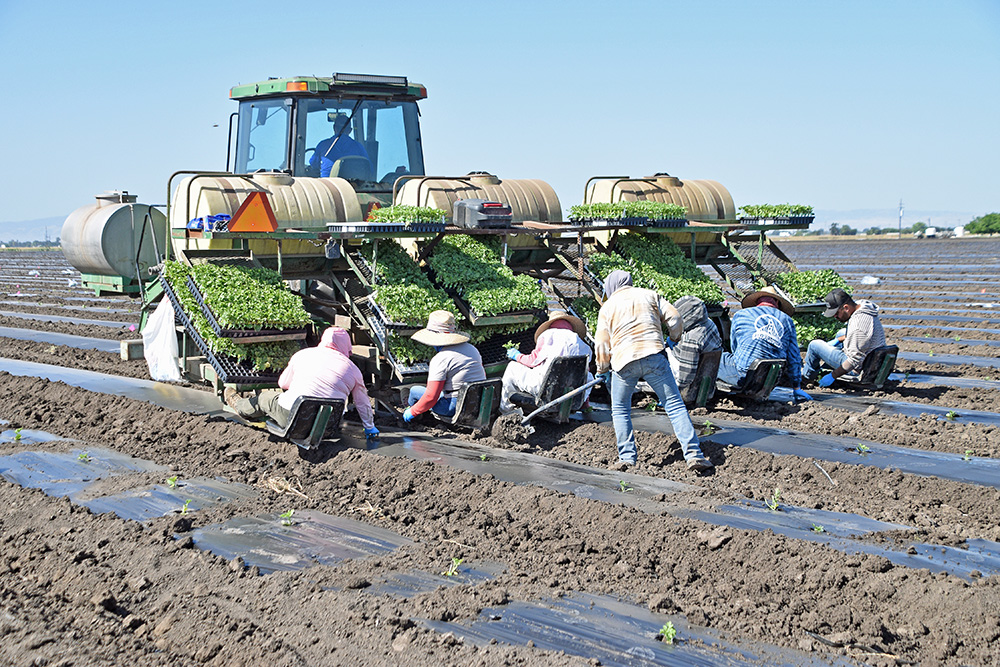
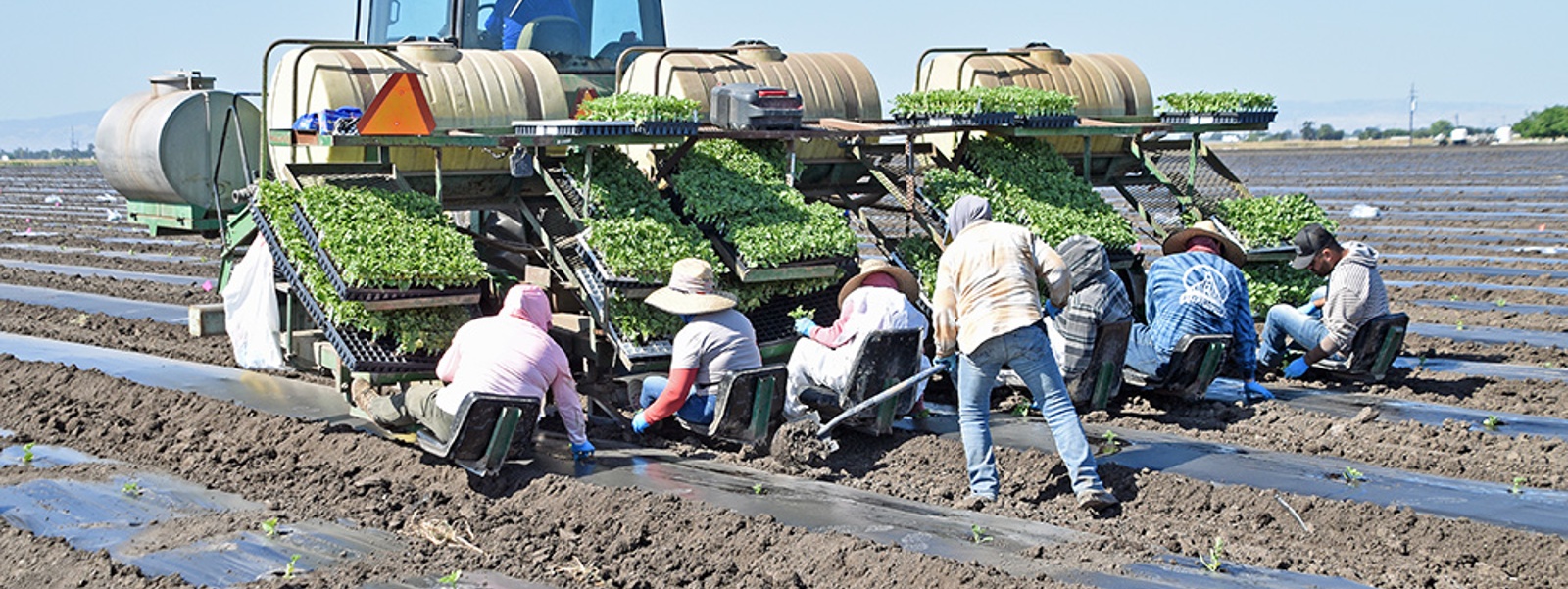
A work crew transplants grafted watermelons into a field in the San Joaquin Valley.
Photo/Vicky Boyd


By Vicky Boyd
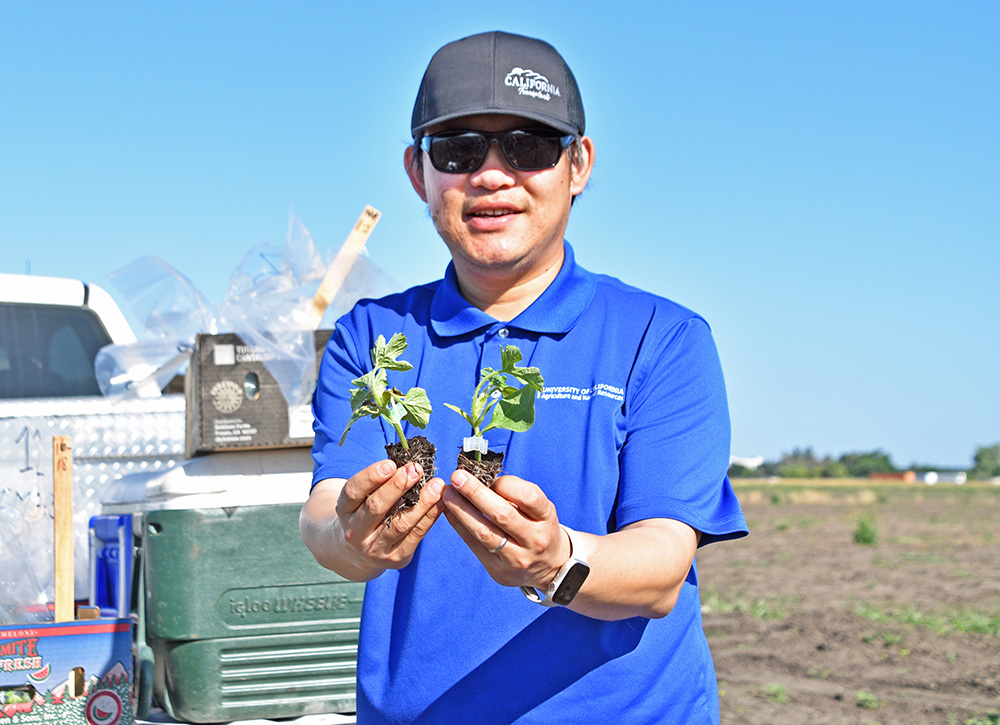
For the past seven years, University of California Cooperative Extension vegetable farm adviser Zheng Wang has studied optimizing seedless watermelon production using scion varieties grafted onto hardy rootstocks.
While field trial results have shown that pairing the right scions and rootstocks can increase yield without affecting quality, particularly in the first couple of harvests, several questions remain.
 “Questions are still unanswered, especially in minis,” said Wang, who serves the northern San Joaquin Valley.
Last year, he irrigated and applied fertilizer in a trial to pint-sized melons as he would a regular melon field. But the vines produced a larger canopy with less fruit until he dialed back the applications.
Also unknown are how grafting affects interactions with pollenizers, delays fruit maturity and affects other watermelon varieties such as yellow-fleshed types, since Wang’s studies have focused on red-fleshed hybrids.
With many of the trials, he said he isn’t comfortable averaging just two years of data.
“We want to say that in five out of seven years, the trials show that the yield is about 15% more,” Wang said. “To us, we want consistency.”
This year, he estimated that about 3,000 of the state’s approximately 10,000 acres of seedless watermelons were grafted. Driving the growth are the increasing costs and reduced availability of fumigation.
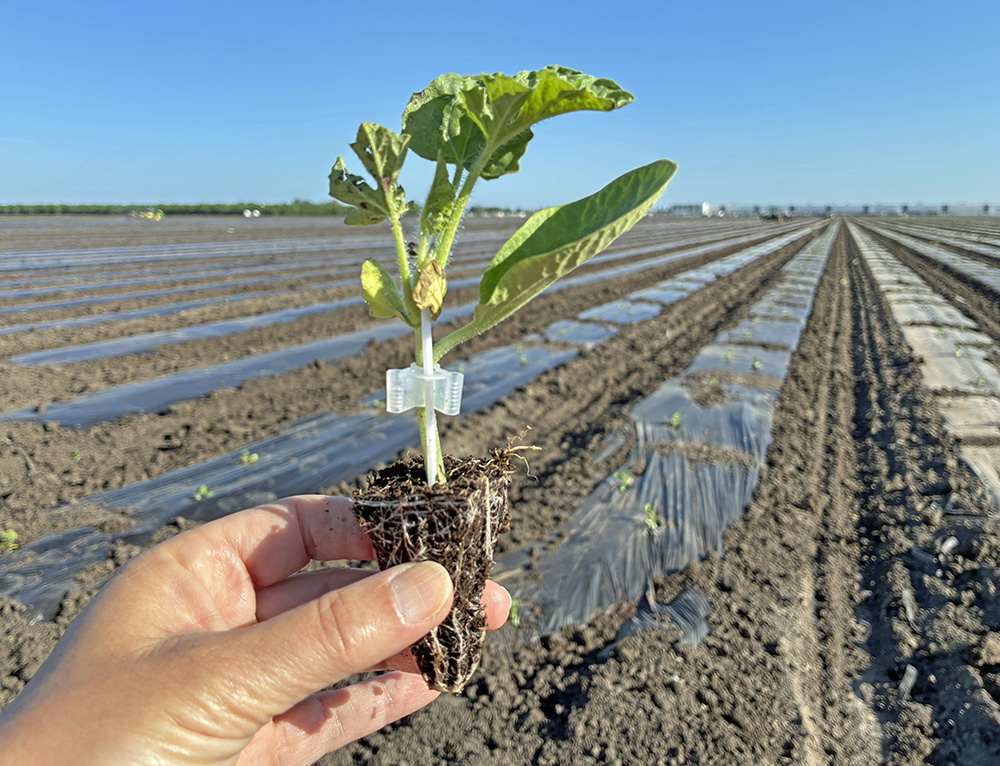
By grafting a desirable fruit-producing scion onto a rootstock that’s resistant to soil-borne pathogens, producers can sustainably manage the pests without a yield or quality loss.
Hande Saganak, who is responsible for grafting at California Masterplant, a wholesale nursery near Tracy, said she’s definitely seen increased grower interest in grafted watermelons.
“It’s been growing really fast,” she said. “It seems we have producers that don’t want to go back to regular plants again. Every year when we think about the orders, it doubles up, but of course, it depends on the supply chain as well.”
Photo/Vicky Boyd
In 2015, Saganak said few California producers had even heard of grafted watermelon plants. But she began giving out samples, and interest eventually took off.
Some of Wang’s initial trials examined optimum in-row plant spacing. He found producers could increase the distance between grafted plants to 4.5 feet from the industry standard of 3 feet for nongrafted plants. That’s because the grafted plants are more vigorous and have larger canopies and vines.
The wider spacing also meant producers using grafted plants could reduce overall plant populations by 30% to 40%. Based on an 80-inch bed width, an industry standard, Wang said producers using grafted watermelons would need about 1,400 plants per acre compared to nearly 2,200 plants per acre for nongrafted melons. Although a grafted watermelon plant costs significantly more than a nongrafted one, the reduced plant populations make the system economically attractive, Wang said.
Based on prior trials, he said the top producing scion-rootstock combinations also yielded up to 40% more fruit with a high probability of larger fruit size than nongrafted plants. In addition to assessing overall yield based on three harvests, the researchers will continue to note fruit quality, including dimension, rind thickness, sugar and firmness. They’ll also use remote sensing to measure canopy density based on the Normalized Difference Vegetation Index.
“We want to know which scions are good on these commonly used rootstocks because people always ask, ‘What rootstock is good?’ But the scion also is important,” Wang said.
Throughout his trials, he found that because grafted plants tended to have more vine regrowth and fruiting after the first harvest, they also tended to accumulate more nitrate in tissue than nongrafted plants. By midseason, the nongrafted plants were beginning to senescence—an age-related deterioration—and had decreasing nitrate tissue content. Producers need to keep the differences in mind as they fertilize a grafted field, Wang said.
This season, he continues to examine the best scion and rootstock combinations. One mid-May-planted trial involves six commercial full-sized red seedless watermelon scion varieties and three commercial rootstocks comprising two interspecific squash hybrids and one citron melon.
Photo/Vicky Boyd
Now in its second year, a late April trial involves a cooperating grower’s preferred mini-melon scion variety grafted on six citron rootstocks and one hybrid squash rootstock. Unlike full-sized hybrids, mini-watermelons typically lack soil-borne fungal disease resistance. Grading standards also are different for the pint-sized melons compared to full-sized fruit.
During 2025, crews harvested the mini-watermelon field three times. The second picking yielded the most fruit, followed by the third and then the first. Total yields ranged from about 42 to 64 tons per acre, depending on the rootstock.
As part of developing a more sustainable watermelon system, Wang also has explored whether applying a beneficial fungi, Trichoderma sp., to nongrafted plants suppressed soil-borne fungal pathogens such as charcoal rot. The biological control agent competes with the pathogen for root space and triggers the plant’s natural immune system while boosting watermelon root growth.
In two years of field trials, Wang found that grafting alone yielded more fruit than Trichoderma applications to nongrafted plants. Applying the biological control to grafted plants produced the highest yields.
The application method also played a role, with a soil drench providing better results than applying the biocontrol through drip irrigation. Producers now routinely request that plant nurseries treat grafted watermelon plugs with a Trichoderma drench before delivery.
Vicky Boyd is a reporter in Modesto. She can be reached at agalert@cfbf.com.


In this edition…
• Mussels plague farms and water districts
• California awards $2 million to curb attacks by wolves
• To protect groundwater, policies need reality check
• Early crop boosts prospects for California pear growers
• From the Fields: Jim Durst, Yolo County farmer
• From the Fields: By Jim Rickert, Shasta County rancher and farmer
• From the Fields: Mark Hall, Kern County table grape grower
• From the Fields: Ian Garrone, Monterey County mushroom farmer
• Growers look to grafted watermelons to battle pests
• It's not too soon to prepare for screwworm response
• Advocacy in Action: New dairy order, grizzly bear reintroduction, H-2A reform and a Supreme Court victory
• Supplies of dairy heifers expected to recover in 2027





.svg.png)
