


California awards $2 million to curb livestock attacks by wolves
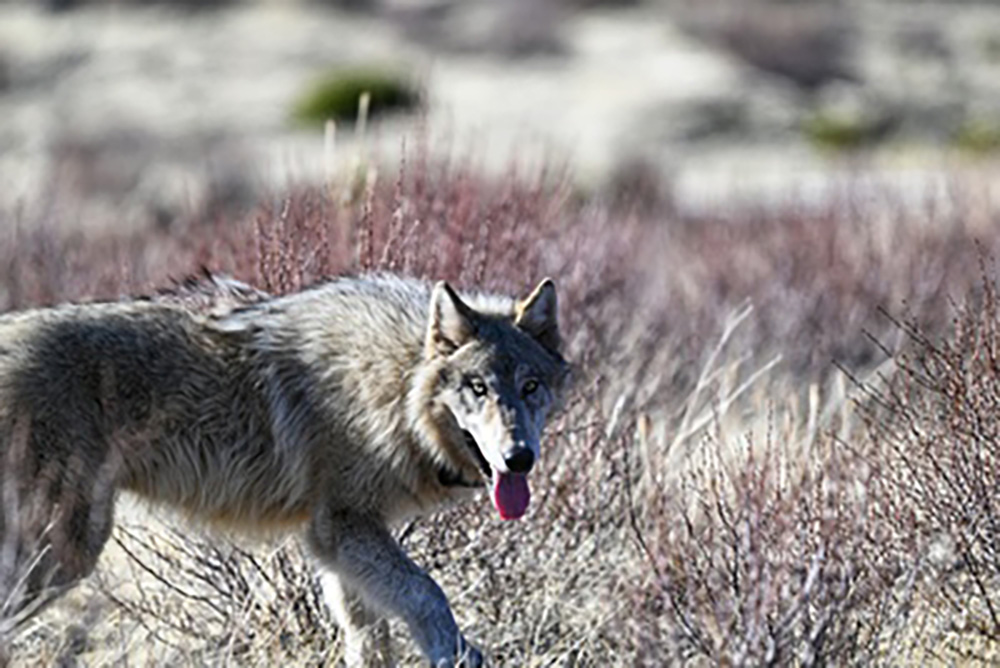
In this January 2025 photo, HAR11M, a male wolf born in the 2024 litter of the Harvey pack is seen with a new tracking collar after being released close to where he was captured.
Photo/Axel Hunnicutt


By Manola Secaira
After months of discussions with agricultural leaders and community members, the California Department of Fish and Wildlife awarded $2 million to organizations supporting efforts to reduce wolf-livestock conflicts.
“We have heard clearly from ranchers how hard the return of wolves has been on their livelihoods—not just financially but in the day-to-day mental and physical toll of managing this animal,” CDFW Director Meghan Hertel said in a statement.
The funding includes $1.1 million to the California Farm Bureau’s California Bountiful Foundation to reimburse producers who have suffered a confirmed or probable wolf attack on livestock. The other organizations receiving funding—Sierra Valley Resource Conservation District, Honey Lake Valley Resource Conservation District and Working Circle—will use the remaining funds to assist in relevant outreach and education.
State officials first piloted a wolf-livestock compensation fund in 2021. Since then, the program has paid more than $3.6 million to impacted producers.
Steven Fenaroli, managing director of public affairs and communications for the California Farm Bureau, said agricultural organizations still desire more funding from the state budget for compensation. That funding could still come through in a budget trailer bill. But for now, Fenaroli said, the $1 million at least “keeps the lights on.”
“Given the protected status of the wolf, we don’t have a lot of options,” Fenaroli said. “So, while this is a Band-Aid to help ranchers when they experience loss, it’s really one of the only things that starts to cover their loss.”
Incidents of wolves preying on livestock have been on the rise as populations of the protected species continue to grow in California. The state currently has 12 confirmed wolf packs. There have been 26 confirmed livestock deaths due to wolves from January to March of this year. The predators were responsible for 196 confirmed livestock kills in 2025.
The presence of gray wolves has changed the lives of producers in impacted counties. Siskiyou County Sheriff Jeramiah LaRue said he regularly gets calls from worried residents about wolves in the region. Frequently, the reports included graphic pictures of mauled livestock.
“It makes me sick,” he said. “It’s just become a common theme around here that we are living with depredations, and they’re going to continue.”
LaRue said living with wolves has been hard on residents. While livestock losses are a major concern, he said the impact goes much deeper for producers who witness the toll firsthand.
“The day-to-day stress of going to bed, waking up, not knowing if the wolves have come into their property, if they have killed animals, then having to go out and look … it’s just that kind of stress,” he said.
He’s spoken to producers who’ve taken to sleeping in their trucks to keep watch, including one 92-year-old rancher who has slept in his pickup truck.
“That doesn’t sit well with me, and it doesn’t sit well with most people,” he said.
While the compensation helps, LaRue said impacted residents want longer-term solutions. He said he’d like to see clear criteria for when the removal of a consistently problematic wolf is necessary if no other methods to deter the animal are working.
“This needs to be a part of the discussion, where the problem animals have to be dealt with,” he said. “It’s not for a lack of trying or because we don’t want wolves around.”
In the meantime, many ranchers still wonder: What can they physically do to ward off a wolf that shows up at their ranch?
Given the wolf’s protected status, residents in impacted counties have few legal options for managing the predators. Producers are limited to nonlethal approaches such as shining bright lights or making loud noises to ward off wolves. But many of them say these tactics are not effective.
“These wolves don’t care about people at all,” said Paul Roen, a Sierra County supervisor and rancher. “We had a person last fall honked the (car) horn at them right outside of Loyalton, and the wolf just looked at her.”
Roen said he and other impacted ranchers want more options. There’s been some recent progress on this front: Impacted counties can now sign on to an agreement with state wildlife officials allowing local law enforcement to use additional hazing tools.
Among the counties that signed on to the agreement is Sierra County. The county’s sheriff, Mike Fisher, views the agreement as progress, but he said the real goal is to eventually get the nonlethal hazing tools into the hands of ranchers.
“They’re the ones that are having the daily interaction with the wolves; it’s not the deputies that are there,” he said.
He noted ranchers often call him to report a wolf on their property. But by the time he arrives, the wolf is gone.
“Until we can get the ranchers the ability to haze as well, it’s not going to be nearly as productive,” Fisher said.
Discussions to expand or adjust options for ranchers will continue. Farm Bureau’s Fenaroli said compensation for direct loss addresses only one of three prongs in the state’s Wolf-Livestock Compensation Grant Program. The other prongs—support for nonlethal deterrents and indirect loss compensation—have still gone unaddressed due to CDFW’s limited resources.
“It’s a balancing act, just knowing that we have limited resources,” he said.
Meanwhile, Fenaroli said he’s focused on using the money that is available most effectively. But long term, he said ranchers will need more to truly see relief.
“Anything short of fully funding, it is the state doing ranchers a disservice,” he said.
Manola Secaira is a staff writer for Ag Alert. She can be reached at msecaira@cfbf.com.


In this edition…
• Mussels plague farms and water districts
• California awards $2 million to curb attacks by wolves
• To protect groundwater, policies need reality check
• Early crop boosts prospects for California pear growers
• From the Fields: Jim Durst, Yolo County farmer
• From the Fields: By Jim Rickert, Shasta County rancher and farmer
• From the Fields: Mark Hall, Kern County table grape grower
• From the Fields: Ian Garrone, Monterey County mushroom farmer
• Growers look to grafted watermelons to battle pests
• It's not too soon to prepare for screwworm response
• Advocacy in Action: New dairy order, grizzly bear reintroduction, H-2A reform and a Supreme Court victory
• Supplies of dairy heifers expected to recover in 2027





.svg.png)
