


Governor hopefuls vow to cut regulations

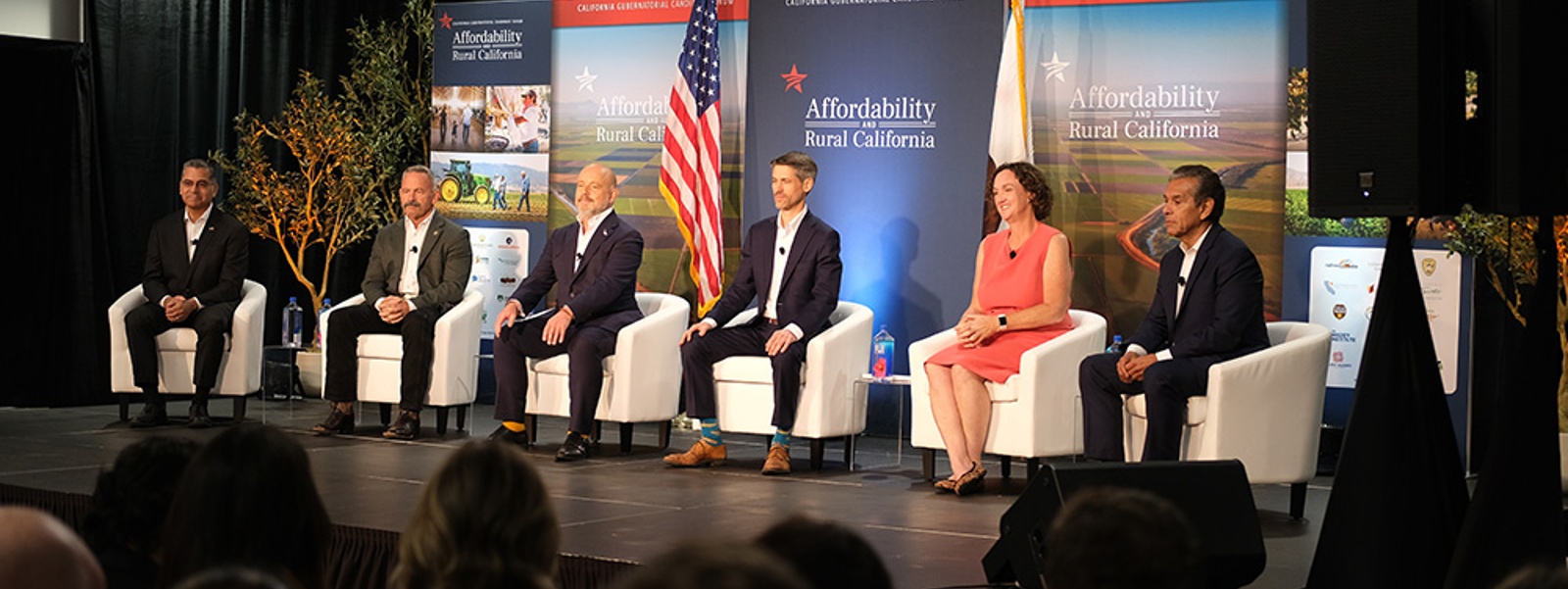
Xavier Becerra, from left, Chad Bianco, Steve Hilton, Matt Mahan, Katie Porter and Antonio Villaraigosa participate in a gubernatorial candidate forum at California State University, Fresno. The April 1 forum, which focused on agriculture, was hosted by the California Farm Bureau and other groups.
Photo/Caleb Hampton


By Caleb Hampton
Six candidates running to be California’s next governor said last week during a televised forum that if elected, they would roll back regulations that have made it challenging to farm in the state.
“The regulatory environment in California is choking off our agricultural communities, choking off our production,” said Katie Porter, an Orange County Democrat and former member of the U.S. House of Representatives. “We’ve gone too far on regulations.”
Four Democrats and two Republicans participated in the “Affordability and Rural California” gubernatorial candidate forum, which was held April 1 at California State University, Fresno.
The forum, which was hosted by the California Farm Bureau and more than two dozen other agricultural groups, kicked off the final stretch of campaigning ahead of a June 2 primary election that will determine which two candidates advance to the general election in November.
“We found it to be a critical time to highlight to candidates that agriculture and our rural counties are important,” California Farm Bureau President Shannon Douglass said.
While candidates offered a range of policy solutions, and some traded barbs, they largely agreed that excessive environmental and business regulations have hurt California farmers. (See related coverage.)
Antonio Villaraigosa, a Democrat and former mayor of Los Angeles, referred to a study from Cal Poly, San Luis Obispo, that found the cost to California lettuce growers of complying with the state’s environmental, labor and food safety regulations increased by more than 1,300% from 2006 to 2024.
“That’s not sustainable,” Villaraigosa said. “There actually is agreement that things are broken in Sacramento.”
Forum participants went to lengths to emphasize any personal ties they had to agriculture.
Former conservative commentator Steve Hilton, a Republican, said his parents had a small farm in Hungary before fleeing communism.
San Jose Mayor Matt Mahan, a Democrat, mentioned growing up in Watsonville, a farming community in Santa Cruz County.
Porter, whose parents and grandparents were farmers, spoke about the importance of 4-H and Future Farmers of America in her upbringing in Iowa.
“I’m not a farmer today, but I thought I would be,” she said.
The gubernatorial candidates suggested differing solutions to address the state’s affordability crisis.
Riverside County Sheriff Chad Bianco, a Republican, said if elected, he would sweep aside state regulations, gut regulatory boards and reduce or eliminate taxes that he blamed for rising costs.
“It’s that simple,” Bianco said.

Photo/Caleb Hampton
Hilton similarly advocated for a dramatic rollback of environmental regulations.
“We’re never going to reduce the cost of groceries or anything else until we abandon the climate dogma that has got us to this point,” Hilton said. “We have to have a complete break from the past.”
Democratic candidates emphasized their willingness to confront policies that had impacted the pocketbooks of residents and business owners. But they largely advocated for approaches that would prioritize economic objectives while still seeking to protect California’s environment.
To reduce energy costs, for example, Mahan said he would take an “all of the above” approach, increasing the production of renewable energy while also seeking to keep oil refineries in the state.
Former U.S. Health and Human Services Secretary Xavier Becerra, a Democrat, said he would declare a state of emergency in order to bypass bureaucratic barriers to build housing and other infrastructure.
Forum moderators Buddy Mendes, a Fresno County supervisor, and Kristin Olsen-Cate, a former California Assembly minority leader, asked the candidates a series of questions about California’s water system and groundwater management.
“I just want to give you more water,” Bianco said.
He vowed to “build massive dams,” deliver more water to farms in the San Joaquin Valley and “do away” with California’s Sustainable Groundwater Management Act, which requires groundwater users to stabilize depleted aquifers.
By 2040, the pumping reductions needed to comply with SGMA are expected to cause about 20% of the San Joaquin Valley’s farmland to be taken out of production.
To minimize the law’s impact on the region, Porter said the economic burden should be borne by the state as a whole, not just valley farmers, while Mahan said he would prioritize groundwater recharge and seek to increase surface water deliveries by improving conveyance infrastructure.
Considering the risks posed by groundwater depletion, getting rid of SGMA “doesn’t make sense,” Mahan said. “We do need to protect groundwater resources.”
Democratic candidates Rep. Eric Swalwell, D-Calif., and billionaire Tom Steyer, who along with Porter, Bianco and Hilton have recently polled high in the crowded race, did not participate in the forum.
Caleb Hampton is an editor at Ag Alert. He can be reached at champton@cfbf.com.

In this issue:
- Governor hopefuls vow to cut regulations
- Farmers gather to talk sustainability projects at dairies
- Engaged members unleash Farm Bureau's true force
- Melissa Hurtado on ag overtime: 'Everyone can win'
- From the Fields: Abi Dirske, Stanislaus County flower farmer
- From the Fields: John Pierson, Solano County rancher
- From the Fields: Celeste Alonzo, Riverside County vegetable grower
- From the Fields: Mitchell Yerxa, Colusa County Farmer
- Ingredient market increases demand for pistachios
- Despite acreage decline, asparagus growers hang on
- Democrats vying for governor criticize overtime law
- Harvest strategies for managing grain quality, safety risks and storage challenges
- Certified Crop Advisers guide growers in smart nutrient management
- Farm Bureau advocacy update: Labor, water, forests and tax relief
- Mentorship program grows next-generation farmers





.svg.png)
