


Farmers gather to talk sustainability projects at dairies
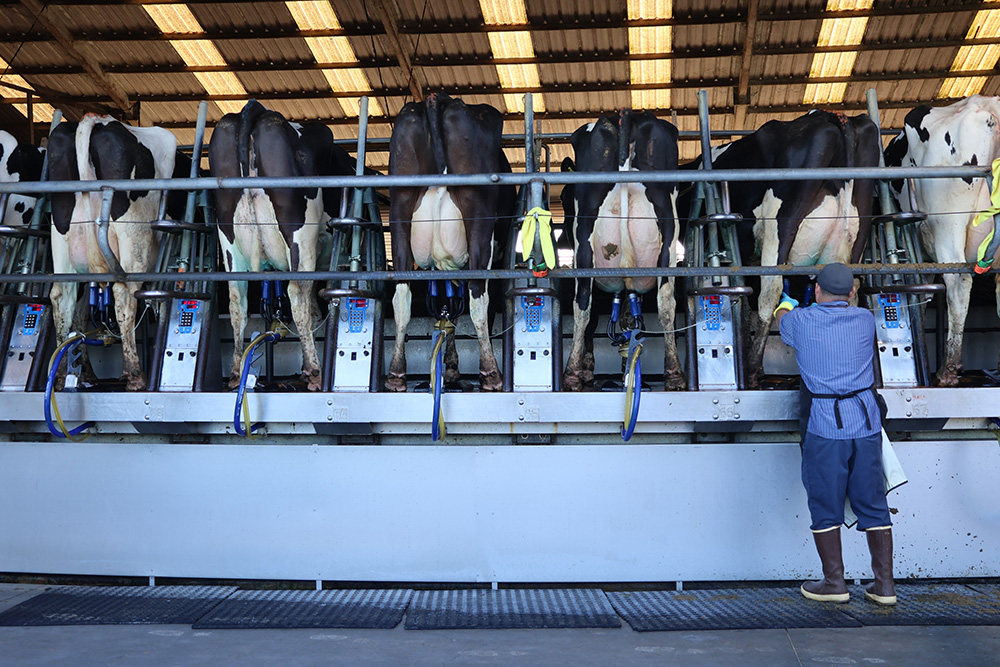
A River Ranch Farms employee milks cows at a Hanford-based facility. Jack de Jong, who owns the dairy, invited a group of summit participants to visit and learn about sustainability efforts there.
Photo/Manola Secaira


By Manola Secaira
California dairy farmers have faced new challenges in recent years as they work to beef up their sustainability practices. About a decade ago, the state passed the Sustainable Groundwater Management Act and legislation setting a target to reduce livestock methane emissions by 40% of 2013 levels by 2030.
“The reality of implementation is right here, right now,” California Department of Food and Agriculture Secretary Karen Ross said.
Ross spoke to dairy farmers and other industry groups at this year’s annual California Dairy Sustainability Summit. The late March gathering, held in Visalia, focused on connecting dairy farmers with tools to save water and reduce methane emissions, and other ways to make their operations more sustainable amid changing state requirements.
“These are all remarkable things that come out of innovation and partnership with incentive dollars,” Ross said.
There’s a lot for farmers to consider. California’s progress toward reducing methane emissions from livestock has historically relied on voluntary incentive programs. But more recently, state officials began the process to potentially create further requirements around those efforts. Alongside that, some farmers have had to reconsider how to access water for their operations as implementation of SGMA’s restrictions on groundwater use move forward.
These efforts feed into California’s overall goals for sustainability and reducing greenhouse gas emissions. But Ross and other speakers at the summit said making this progress happen means ensuring the tools to achieve it are accessible and affordable for farmers.
During a panel on dairy farmers’ outlook, Rochelle De Groot, chief financial officer of Hanford-based De Groot Dairies, said cost efficiency is “the most important consideration for us.”
“At the end of the day, to survive, every decision has to make financial sense,” she said.
At her dairy, De Groot said the family has installed solar panels and a digester, which involves a tarp-like structure covering manure lagoons to capture methane and turning it into renewable energy. She described the solar and digester installations as easy choices.
“Those made financial sense, and you see it in our electric cost, how they’ve cut it almost in half,” De Groot said.
But every farm is different. What works at her dairy might not work for everyone, De Groot said, so the need for innovation is necessary.
Take digesters: Maas Energy Works CEO Darryl Maas said the technology typically works well for dairies with about 3,000 cows or more. At that size, the cost of implementing the system is usually mitigated by the profit farmers can make converting the captured methane into renewable natural gas or burning it for electricity.
For smaller dairies, implementation would likely cost more than it saves. During a panel on the future of methane reduction, Maas said his company is still figuring out a path to affordably bring the technology to smaller farms.
“If the industry’s going to keep expanding to meet the state’s rules, we’re going to have to find a way to abate that methane on 2,000-cow dairies, in the smaller ones,” Maas said.
He said digester expansion is also currently constrained by the logistical advantage of installing them in geographically concentrated clusters. Keeping them grouped together makes it easier to gather the gas from multiple dairies in one collection system.
“As the dairies get further apart, if you have two dairies over here and one over there and one 40 miles that way, you can’t do this anymore,” he said. “You’re going to have to get more creative about how to gather those dairies up.”
BioFiltro Chairman Steven Rowe said for many farmers, technology to reduce methane from livestock is affordable if it gives back a benefit. His company’s technology uses red worms to treat liquid from cow manure, reducing methane emissions in the process and converting the water to be reused for other purposes such as irrigation.
But even if it’s affordable, he said incentives are still important to create adoption.
“What the incentives allow for is more money in the farmer’s pocket, and it allows us to go smaller, smaller dairies and more creative applications,” Rowe said.
Farmers and other summit participants also discussed water scarcity concerns and the evolving impacts of SGMA implementation.
Caity Peterson, associate director and research fellow at the Public Policy Institute of California’s Water Policy Center, said a major focus of her work has been understanding how farmland transitions will unfold in the San Joaquin Valley as SGMA implementation moves forward. In a presentation, she said San Joaquin Valley farms could see 20% reductions in applied water by 2040 due to groundwater pumping restrictions stemming primarily from SGMA but also from other new environmental regulations.
Despite efforts to bring in new water supplies and increase groundwater recharge, Peterson said pumping restrictions will lead to land fallowing. A 2023 PPIC report found that at least half a million acres will likely come out of production in the valley as a result.
Fallowing leads to other consequences.
“We know that feed costs are the biggest slice of that pie of the total cost of production for dairies,” Peterson said. “So, SGMA may change the way that feed crops are produced (and) where they’re produced as a cost of either purchasing them or growing them in-house.”
She said solutions could involve identifying what crops can be grown in water-limited areas. PPIC, along with researchers from the University of California, Davis, and Florida State University, are studying how crops such as wheat and barley can be grown with less than their full water requirements. Such breakthroughs could allow farmers to still make profits from water-limited acres that would otherwise bring no revenue as fallowed fields.
“Dairies are actually better positioned than many because you’re already so familiar with winter forage crops,” Peterson said, adding that dairies in drier parts of the valley may need to tweak their management system.
Speakers at the conference said reaching California’s sustainability targets will be challenging, but there’s hope in the progress already made. Bill Swanson, Stantec vice president of global practice leader for water resources planning and management, said sharing tools and finding partners in the sustainability transition will make reaching these goals possible.
“There is no one silver-bullet solution that can fix everything,” Swanson said. He described the right approach as a “collective solution that’s based on commonly shared information, facts and partnerships.”
“I really have a lot of optimism that this can be done,” he said, “but it’s going to take the collective will of all of us.”
Manola Secaira is a staff writer for Ag Alert. She can be reached at msecaira@cfbf.com.


In this issue:
- Governor hopefuls vow to cut regulations
- Farmers gather to talk sustainability projects at dairies
- Engaged members unleash Farm Bureau's true force
- Melissa Hurtado on ag overtime: 'Everyone can win'
- From the Fields: Abi Dirske, Stanislaus County flower farmer
- From the Fields: John Pierson, Solano County rancher
- From the Fields: Celeste Alonzo, Riverside County vegetable grower
- From the Fields: Mitchell Yerxa, Colusa County Farmer
- Ingredient market increases demand for pistachios
- Despite acreage decline, asparagus growers hang on
- Democrats vying for governor criticize overtime law
- Harvest strategies for managing grain quality, safety risks and storage challenges
- Certified Crop Advisers guide growers in smart nutrient management
- Farm Bureau advocacy update: Labor, water, forests and tax relief
- Mentorship program grows next-generation farmers





.svg.png)
