


Despite acreage decline, asparagus growers hang on
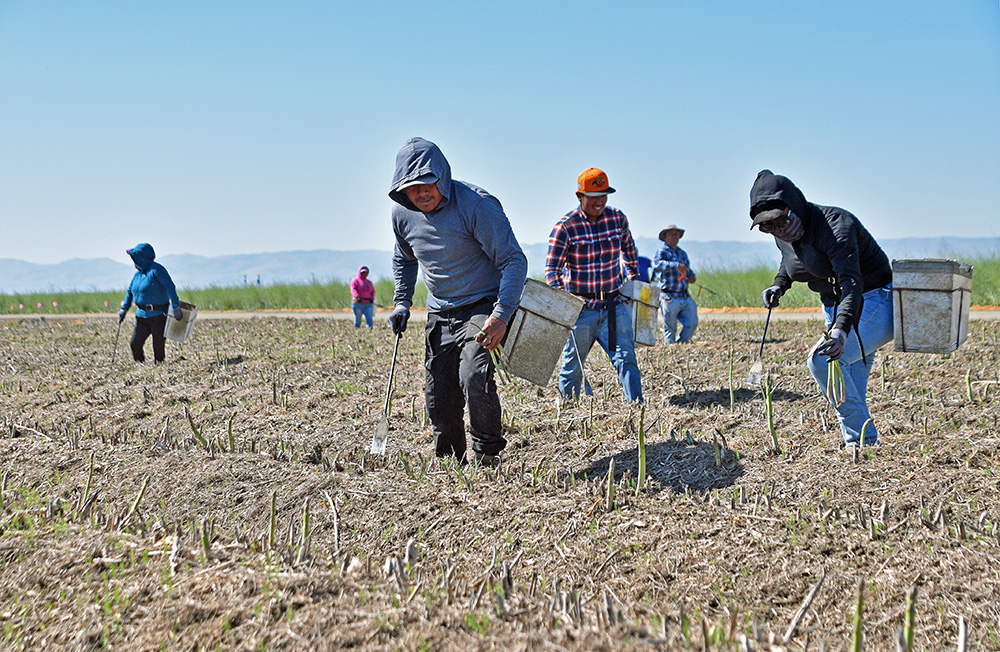
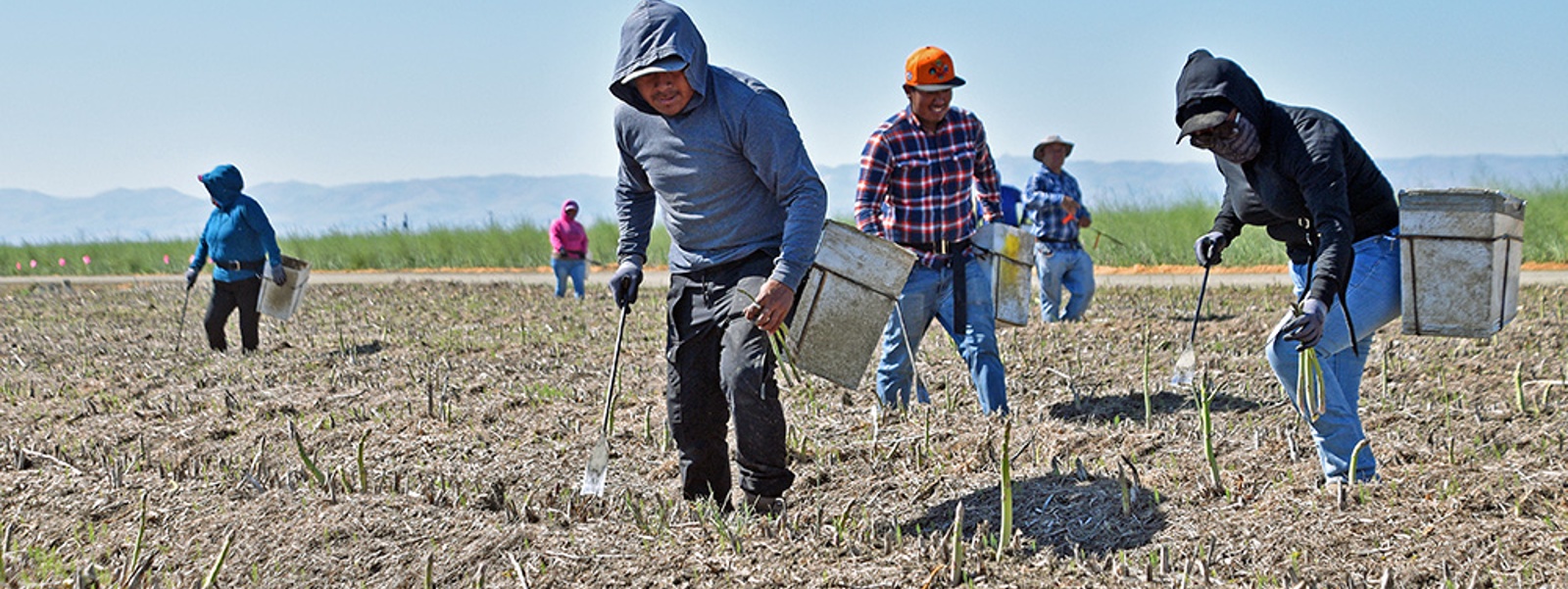
During harvest at a Fresno County asparagus field last month, workers use specially designed long-handled asparagus knives to cut spears just below the soil surface but not so deep that it damages the crown, or root mass. California asparagus acreage has dwindled through the years due to competition from Mexico, but a handful of growers and packers remain in the business.
Photo/Vicky Boyd


By Vicky Boyd
Ever-increasing labor costs in California and free trade that led to a surge in cheaper, duty-free asparagus imports from Mexico have pushed the state’s asparagus industry to the brink of extinction. But a handful of growers and packers continue to hang on, with two expressing a ray of optimism.
“I think we’ve felt better about it the last two years,” said Aaron Barcellos, a partner in the family-owned A-Bar Ag Enterprises near Firebaugh. “Last year and this year, the markets, for whatever reason, haven’t had the (imported) grass, and we’re finding better markets.
“The big question: Can we have more acreage and still be able to keep the price levels where they’re at and the premium some people will pay for it?” he added.
Neill Callas, general manager of Turlock Fruit Co. in Stanislaus County, which grows melons and other crops, said he and the Smith family that owns the operation share Barcellos’ outlook. But Callas was quick to point out they wouldn’t still be in the asparagus business if it weren’t for vertical integration, which includes owning their own land and partnering with Barcellos in R&N Packing in Firebaugh and in sales.
“For both of our families, I think it’s important to diversify, and that’s how we look at it,” Callas said. “We don’t have a Mexican operation. We don’t have a multistate operation, and this is good support for a lot of our key members.”
In addition, asparagus doesn’t take more water than melons, which are the Smith family’s main summer crop. The asparagus ground is in a west-side water district with an exchange contract, meaning it has senior water rights and most years receives a full allocation.
The Smith and Barcellos families have each added a small amount of acreage to their asparagus plantings the past two years, although it’s still significantly less than they had at the industry peak. For the first time last year, the families had to source crowns for replanting from a Washington state nursery because the local one that used to grow them doesn’t anymore.
California production topped 37,000 acres in 2000 before it started to decline, according to U.S. Department of Agriculture figures. Cherie Watte, executive director of the California Asparagus Commission before it was suspended in 2019, blamed the North American Free Trade Agreement, or NAFTA, for the beginning of the industry’s decline. Asparagus was classified as one of the most sensitive commodities under the trade agreement. As a result, tariff reductions had a long phase-in period so growers could prepare.
At one time, each production region—California, Mexico and, to a lesser extent, Peru—occupied relatively separate marketing windows.
“But then the marketing windows started to close, and their quality certainly didn’t match up to ours,” Watte said.
Photo/Vicky Boyd
The California asparagus sector looked into filing antidumping charges against Mexico for flooding the U.S. market with product below the cost of production. Unfortunately, Watte said, the cost to file such a legal challenge was prohibitive.
The nail in the asparagus industry’s proverbial coffin were the minimum wage and agricultural overtime laws, she said. Senate Bill 3 phased in minimum wage increases for all industries, beginning with $10 an hour in 2016 to the current $16.90 an hour.
Assembly Bill 1066 phased in farmworker overtime pay for hours worked beyond the standard 40-hour workweek. Before the law, farmworkers could put in up to 60 hours during a week and receive straight time pay.
The state now has probably fewer than 1,000 acres of commercial asparagus, according to industry estimates. In 2024, USDA discontinued reporting California asparagus acreage because so few growers produce it that maintaining their anonymity would be difficult.
Asparagus is considered a permanent crop, with spears emerging in early spring from spidery masses of roots known as crowns. Depending on the care and field conditions, crowns can stay productive for several years.
The season runs from March until late May. Barcellos said his farm carefully monitors the plants and will end harvest for the season if spear size drops, if spears begin to bloom or if production has reached a set tonnage per acre. Growers don’t want to push the plants too much because that could affect next year’s production.
With the state’s mild spring growing conditions, Barcellos said the farm produces spears that trend toward large and extra-large sizes, or roughly between ½- to ¾-inch diameter. Workers harvest the spears by hand, with the bunches quickly transported from the field to the packinghouse.
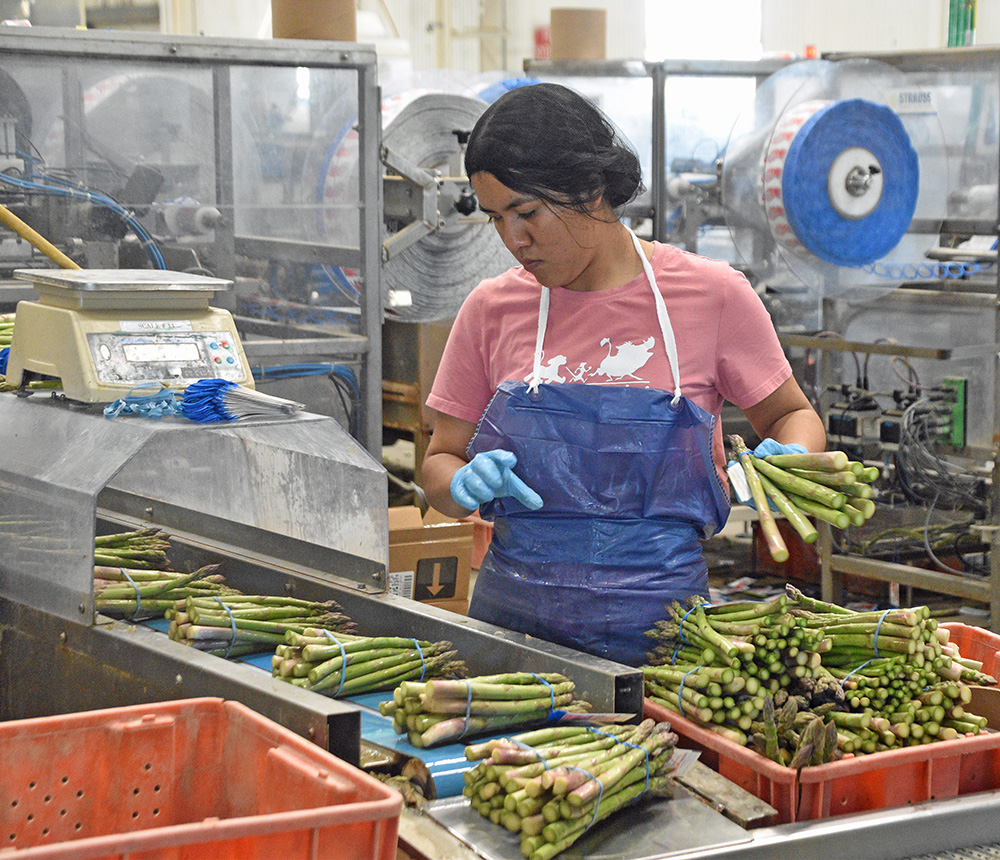
At the packinghouse, workers grade and pack the asparagus into cartons, which then go through a hydrocooler to remove field heat and quickly chill them to maintain quality. Most of the crop is harvested and packed the same day or the next day before being shipped out, Barcellos said.
Because of California’s higher cost of inputs, labor and packaging, Barcellos said the farm spends about twice as much to grow, pick and pack a carton of asparagus as its counterparts do in Mexico.
During the past few years, the families have built relationships with retailers that value quality and are willing to pay for it. Among those are Whole Foods and Florida-based Publix Super Markets.
Despite the challenges the sector continues to face, Watte said she believes California asparagus still has a place. As the current executive director of California Grown, she said the marketing program recently posted on social media a consumer alert about the start of the state’s asparagus season.
“We haven’t given up on the industry,” Watte said. “Our product is so, so superior, and we do it better.”
Vicky Boyd is a reporter in Modesto. She can be reached at agalert@cfbf.com.

In this issue:
- Governor hopefuls vow to cut regulations
- Farmers gather to talk sustainability projects at dairies
- Engaged members unleash Farm Bureau's true force
- Melissa Hurtado on ag overtime: 'Everyone can win'
- From the Fields: Abi Dirske, Stanislaus County flower farmer
- From the Fields: John Pierson, Solano County rancher
- From the Fields: Celeste Alonzo, Riverside County vegetable grower
- From the Fields: Mitchell Yerxa, Colusa County Farmer
- Ingredient market increases demand for pistachios
- Despite acreage decline, asparagus growers hang on
- Democrats vying for governor criticize overtime law
- Harvest strategies for managing grain quality, safety risks and storage challenges
- Certified Crop Advisers guide growers in smart nutrient management
- Farm Bureau advocacy update: Labor, water, forests and tax relief
- Mentorship program grows next-generation farmers





.svg.png)
