


Democrats vying for governor criticize overtime law
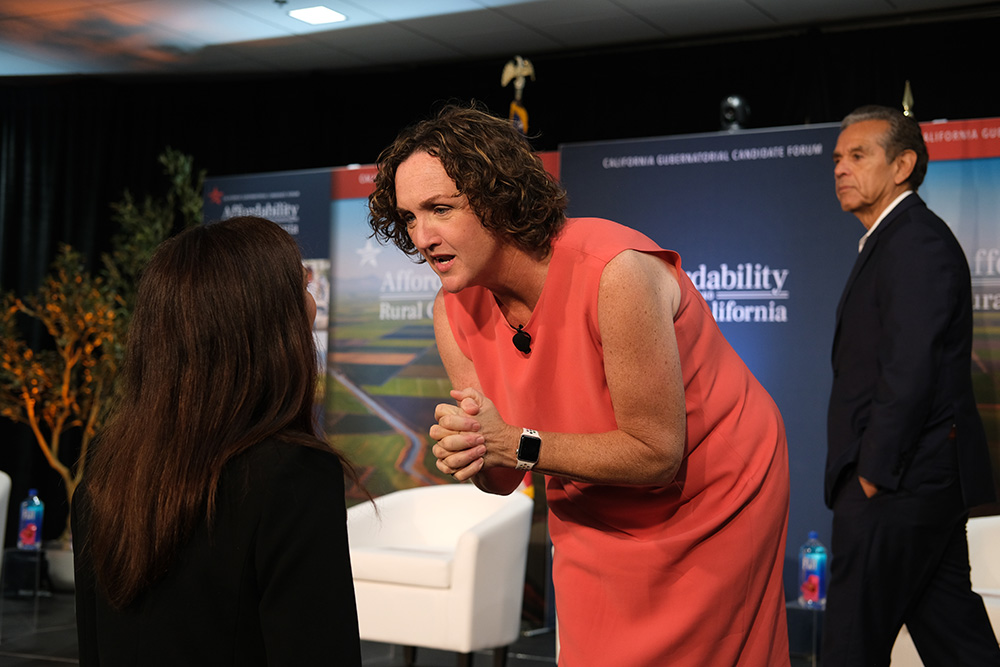
Katie Porter, center, an Orange County Democrat and former member of the U.S. House of Representatives, speaks with Kristin Olsen-Cate, a former California Assembly minority leader from Stanislaus County, before an April 1 gubernatorial candidate forum at California State University, Fresno, that Olsen-Cate moderated.
Photo/Caleb Hampton


By Caleb Hampton
Two Democrats running to be California’s next governor scorned a state law that their own party, along with influential labor unions, celebrated as a major victory a decade ago.
Katie Porter, an Orange County Democrat and former member of the U.S. House of Representatives, cited the state’s agricultural overtime law as an example of policies “that don’t make sense and that drive up costs.”
From 2019 to 2025, the overtime law, which was enacted in 2016, phased in a requirement that farmworkers, like workers in most sectors, be paid time and a half when they work more than eight hours a day or 40 hours a week. Previously, farmers could employ workers for up to 10 hours a day on up to six days a week without paying overtime.
The law was meant to raise wages for farmworkers, but research has shown it ended up reducing overall earnings as employers shortened the workweek to keep their production costs down.
Porter made the comments last week during a televised gubernational candidate forum at California State University, Fresno. (See related coverage.)
Along with other candidates, she promised the agriculture-friendly audience that if elected, she would dial back some environmental and business regulations that had increased costs for farmers and consumers.
“The farmworker overtime regulation has resulted in farmworkers earning less, not more,” Porter said, adding the regulation “does not work.”
Antonio Villaraigosa, a Democrat and former mayor of Los Angeles, agreed with Porter.
“You’re right,” said Villaraigosa, who is a former speaker of the California Assembly.
In December, University of California, Berkeley, professor Alexandra Hill presented ongoing research showing that by 2022, when the overtime law was partially phased in, it had reduced farmworker earnings by about $2,800 a year.
Hill told Ag Alert® earlier this year that the actual impact on farmworkers’ income has likely been greater than that because the law was not completely phased in when the most recent data she analyzed was collected.
In many instances, the overtime law has caused farmworkers to lose roughly a third of their income as their workweek was reduced from 60 hours to 40 hours.
“The goal of that law, ostensibly, was to increase farmworker income. It’s clearly not working that way,” Porter said in an interview with Ag Alert®. “Those are the hard facts.”
Porter said her “touchstones” when it comes to labor laws are that workers get paid what they’re promised and are safe at their workplace.
“If we can’t show that a law is doing one of those two things,” she said, “it should be up on the chopping block, potentially.”
She said she had not studied the overtime issue enough to endorse a specific policy solution, but if elected she would “take a hard look” at it.
Villaraigosa told Ag Alert® he would advocate for a tax credit for the industry similar to those passed in other Democrat-led states following the implementation of their own agricultural overtime laws.
A proposed overtime tax credit, which would have offset the cost to farmers of paying overtime premiums, was voted down in a California legislative committee last year along party lines, with Democrats opposing it.
Senate Bill 921, which is currently in the state Legislature and is sponsored by the California Farm Bureau, proposes the same type of tax credit to pay for agricultural overtime premiums.
Caleb Hampton is an editor at Ag Alert. He can be reached at champton@cfbf.com.


In this issue:
- Governor hopefuls vow to cut regulations
- Farmers gather to talk sustainability projects at dairies
- Engaged members unleash Farm Bureau's true force
- Melissa Hurtado on ag overtime: 'Everyone can win'
- From the Fields: Abi Dirske, Stanislaus County flower farmer
- From the Fields: John Pierson, Solano County rancher
- From the Fields: Celeste Alonzo, Riverside County vegetable grower
- From the Fields: Mitchell Yerxa, Colusa County Farmer
- Ingredient market increases demand for pistachios
- Despite acreage decline, asparagus growers hang on
- Democrats vying for governor criticize overtime law
- Harvest strategies for managing grain quality, safety risks and storage challenges
- Certified Crop Advisers guide growers in smart nutrient management
- Farm Bureau advocacy update: Labor, water, forests and tax relief
- Mentorship program grows next-generation farmers





.svg.png)
