


Paintballs among new tools allowed for hazing wolves

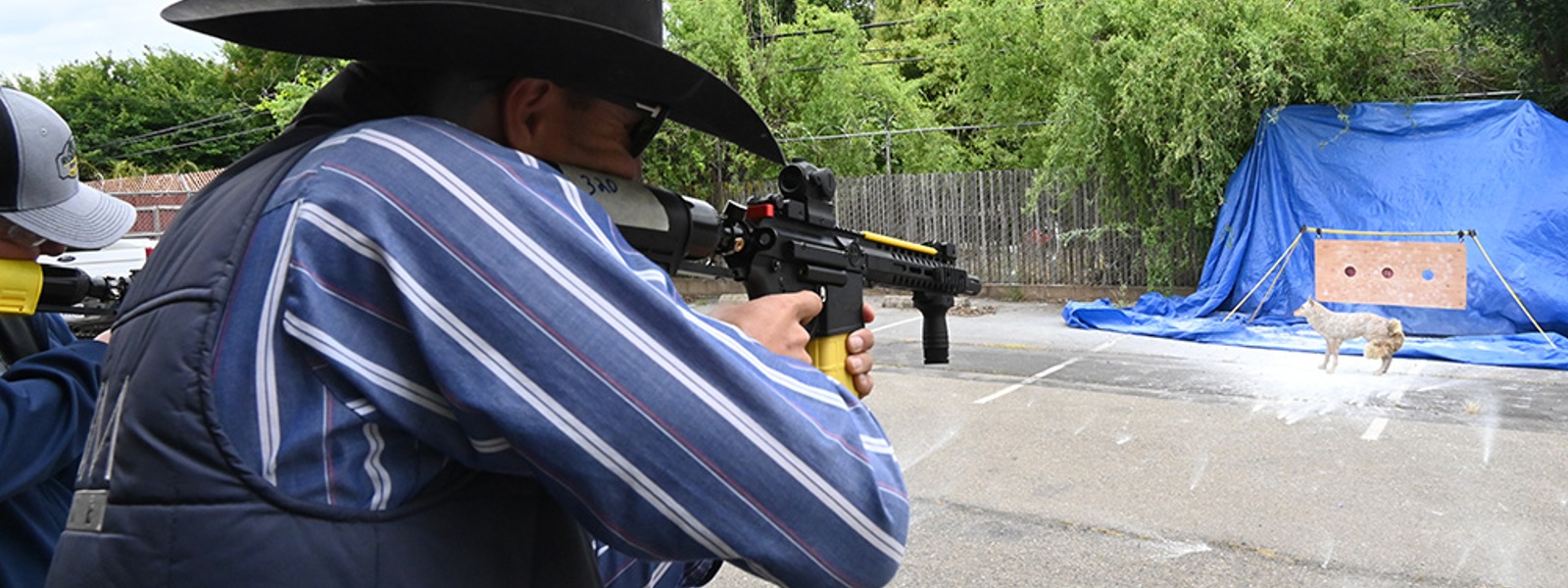
A ranch manager participates in projectile launcher field training. The state has authorized injurious harassment of wolves by trained livestock producers to help reduce wolf-livestock conflicts.
Photo/Tracy Schohr


By Manola Secaira
The California Department of Fish and Wildlife has approved new hazing options for ranchers living in counties with gray wolves present.
State officials have scheduled training sessions throughout impacted areas that, once completed, will qualify ranchers to receive permits to use paint and inert powder projectiles along with sustained pursuit to prevent wolves from attacking livestock.
The newly approved options come after months of conversation between state officials and community leaders living in areas where the protected species has preyed on ranchers’ livestock.
Many impacted livestock producers have long held that the noninjurious hazing options given to them to scare off wolves, including shining bright lights and making loud noises, are not effective. Last year, California confirmed 196 livestock killed by the predator.
Earlier this year, law enforcement officials were authorized to use injurious harassment tools that include pepper balls and rubber bullets. This new development marks a shift to allowing livestock producers to use some injurious hazing methods as well, although what’s allowed is still considered less than lethal.
Steven Fenaroli, managing director of public affairs and communications for the California Farm Bureau, described the changes as a step in the right direction. But he said the new options come with limitations and are not a complete solution.
“Those have limited ranges, and they’re just not the most accurate,” Fenaroli said of projectiles. “There’s more options that we should pursue that are still less than lethal but go toward creating a better divide between humans and predators.”
When used alone, Fenaroli maintained that projectiles can only go so far. He said the “sustained pursuit” approval is part of what can make future hazing more effective.
“The goal isn’t to chase it (a wolf) for miles and miles,” he said. “The goal is to instill fear in the wolf that the cows are not food.”
For many producers living in areas with gray wolves, the goal is to prevent the predators from becoming accustomed to killing livestock for food and encourage them to seek prey elsewhere.
Sierra County Sheriff Mike Fisher said such a goal can be achieved only if wolves preying on cattle face consequences. Last year, CDFW officials confirmed 70 total livestock losses between March 28 and Sept. 10 in his county, although Fisher said he suspects the actual number may be much higher.
A CDFW strike team was deployed to address wolf-livestock conflicts last summer. But after months of nonlethal management efforts, state officials decided to remove a trio of wolves associated with more than half the confirmed kills, with a fourth wolf mistakenly killed in the effort.
Since then, Fisher described the shift in wolf activity as “night and day.” After the the removal of the three habituated wolves, he said there were no wolf attacks for several months.
“During that time, we still saw wolves in the valley,” he said. “But those particular wolves ... were not habituated to cattle, weren’t killing one to five cows a day.”
Fisher described the new hazing options as more frustrating than encouraging. He said the limited range and impact of powder projectiles make them useful in only very narrow circumstances. He said he doesn’t believe the new tools will be successful against habituated wolves.
“When you’re actively working, it’s very difficult to have that tool immediately available,” he said.
Fisher said many ranchers see more potential in using pepper balls, a nonlethal projectile that contains a chemical irritant. Pepper balls have already been used by state officials and law enforcement to ward off other predators such as bears.
Unlike powder projectiles, Fisher said pepper balls can still be effective even when they don’t hit their target because they release chemical irritant into the air.
Although law enforcement can use pepper balls, Fisher said they’re not effective on their own. By the time he gets to the scene after receiving a call about a wolf’s appearance, he said he’s often unable to get there quickly enough to take action.
“In a year and a half for me personally, being so intimately involved in our wolf problem in the Sierra Valley, I have never been anywhere close to being within range to haze a wolf from our pastures,” he said.
But getting pepper balls to livestock producers requires a change to California law, which currently bars civilians from owning or possessing them.
Fisher said he’s interested in introducing a bill to change this law next year with the goal of allowing ranchers to use pepper balls for hazing gray wolves after training.
Sierra County Supervisor and rancher Paul Roen said he’s also frustrated, describing the potential impacts of using powder projectiles as “grossly insignificant.”
“We’re going to jump through every hoop that we can to show that we’re going above and beyond to try to utilize whatever tools available, but at some point, somebody has to do what has to be done,” he said.
Roen said he’d also support a bill to open the door for ranchers to use pepper balls for hazing. He said it’s important to introduce more effective tools that could better prevent wolves from becoming habituated to attacking livestock.
“If we can effectively haze them away, then they stand a better chance of survival, and we stand a better chance of survival,” Roen said.
Pamela Flick, the California program director for the conservation nonprofit Defenders of Wildlife, said her thoughts on hazing tools have evolved as she’s engaged with impacted community members and has seen the state’s wolf population grow.
She said last year’s events in Sierra County only emphasized the need to introduce more impactful hazing options “early and often.” If wolves face negative consequences and can learn to hunt elsewhere, it could prevent the necessity of future lethal removals and help the wolves’ long-term conservation, Flick added.
“By the time the CDFW strike force came out last summer, it was just too late,” she said, noting the department “found out that there were no negative consequences to their actions,” as the wolves continued their behavior of preying on livestock.
With a dozen gray wolf packs confirmed in the state, Flick said she expects conversations on hazing tools will continue evolving. She said Defenders of Wildlife does not expect to oppose a bill allowing ranchers to use pepper balls for hazing after training, certification and authorization by appropriate authorities, as long as pepper balls are tailored to this specific use.
“The more tools that we can provide to livestock producers to reduce conflicts, including these less-than-lethal, more aggressive hazing tools and strategies, that’s better for wolf conservation in the long run,” Flick said.
Fisher said he’s “all for exhausting all means of less-lethal hazing.” But if a wolf becomes habituated and consistently kills livestock, he said lethal removal needs to be an option to make living in areas with wolves sustainable.
“We cannot go through what we went through last year,” he said.
Manola Secaira is a staff writer for Ag Alert. She can be reached at msecaira@cfbf.com.
Reprint with credit to California Farm Bureau. For image use, email agalert@cfbf.com.

In this edition…
• Regenerative label payoff remains murky
• Paintballs among new tools allowed for hazing wolves
• Influence starts with engaged Farm Bureau members
• USDA seeks to ease organic certification process, costs
• From the Fields: Chris Jergenson, Merced and Stanislaus counties organic farmer
• From the Fields: Ben Lyons, Solano County farmer
• From the Fields: Domenic Carinalli, Sonoma County organic dairy farmer and conventional winegrape grower
• From the Fields: Katie Herzog, Monterey County agave grower
• New 'smart' farm tech targets vegetable production
• Growth in organic milk presents market challenges
• Advocacy in Action: Packaging requirements, labor, beef cattle, trade, compost, Roadless Rule and disaster relief
• How you can make the switch to regenerative farming
• Summit seeks to strengthen agritourism
• Leopold award finalists for 2026 selected





.svg.png)
