


New 'smart' farm tech targets vegetable production
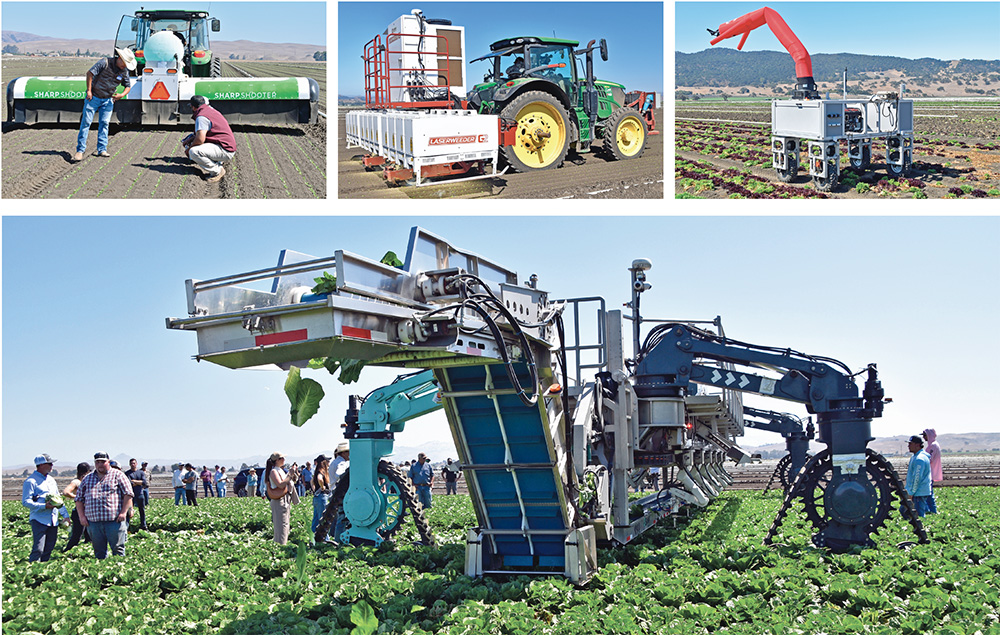
Sami’s autonomous lettuce harvester, above, uses rubber fingers to grab the top of the head while a knife cuts the stem. Verdant Robotics’ SharpShooter, top left, and Carbon Robotics’ LaserWeeder G2, top center, use artificial intelligence to differentiate crops from weeds. At top right, Padma Robotics’ DV-64 uses audio, lasers and a dancing inflatable tube man to deter birds.
Photos/Vicky Boyd


By Vicky Boyd
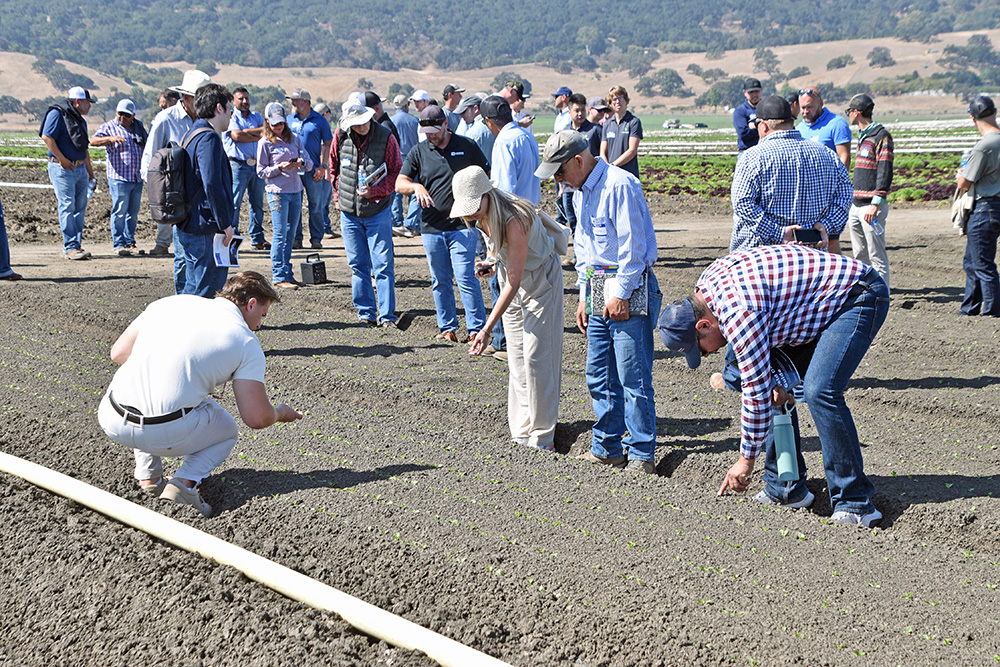
Agricultural technology took center stage during a field day as a dozen developers showed off “smart” weeders and thinners that differentiate weeds from crops, autonomous bird hazers and an autonomous lettuce harvester.
The University of California Agriculture and Natural Resources Connect event, held in August, was designed to bring together stakeholders to discuss growers’ pain points and how they could work together to address them, said Jennifer Clarke, California Specialty Crops Council chairperson.
Nearly 300 growers, pest control advisers, equipment manufacturers, educators and others took in the agricultural tech demonstrations hosted at Sabór Farms’ lettuce fields near San Juan Bautista.
“We all have these different perspectives, different educational levels, different life experiences, and all of that input is what makes something work,” said Clarke, who is also executive director of the California Leafy Greens Research Board. “Otherwise, these guys spin their wheels creating technology we can’t use.”
Hannah Johnson, industry lead for UC ANR Innovate and owner of the consulting firm Hannah Johnson & Co. in Fresno, agreed.
“It’s so critical that the developers, the engineers, the farmers, the commodity boards, the UC system, the investors and the researchers are all at the same table early when these tools are being developed so we don’t waste resources on something that isn’t going to work, that’s not what a farmer needs and isn’t going to hold up in the field,” she said.
Being able to have conversations with technology developers is huge for Mark Mason, manager of Soledad-based Huntington Farms and a technology early adopter.
“It’s give and take,” he said. “It’s a two-way street. I tell them, ‘How can I help you help me?’”
Among the equipment Mason runs are three Mantis Ag Technology lettuce thinners and smart sprayers, which he described as “work horses.”
Mantis machines thin about 30% to 40% of the Salinas Valley lettuce acreage, said engineer Matt Watson as he demonstrated an application using colored water on a bed of young lettuce.
The machines use visual recognition technology to identify the crop and weeds. Then artificial intelligence guides the precision sprayers to simultaneously chemically thin the crop, apply products such as herbicides or liquid fertilizers and perform intra-row banding.
Depending on the crop and weed pressure, Watson said farmers can reduce herbicide use by up to 80%, which he described as a big selling point.
“It’s a huge, huge, huge reduction,” Mason said. “It’s a good story, and people don’t hear it. With this machine, we’ve cut our pesticides a lot, and financially, it’s big.”
In addition to Mantis, Carbon Robotics, Verdant Robotics, Ecorobotix and Niqo Robotics demonstrated weeders and thinners that rely on AI to differentiate crops from weeds. While most machines applied minute amounts of herbicide to remove unwanted plants, Carbon Robotics’ LaserWeeder used lasers to zap weeds, leaving wisps of smoke in their place.
To deter crop-damaging birds, Padma Robotics showed off an autonomous platform rigged with lasers, audio speakers and a dancing inflatable tube man that cruises fields.
Skysense representatives took a different approach, deploying a remotely controlled drone that physically harasses crop marauders while emitting a mix of predator and distress calls. At the same time, the drones can take images of crops and collect high-resolution data.
One of the event’s big draws was Sami Robotics’ autonomous lettuce harvester, which requires only one operator and replaces a crew of 25.
When the Montreal, Canada-based company began developing the machine about three years ago, it knew it had to work with growers if it were to succeed, said Sami CEO Pascal Labrecque. The company focused on California because of its year-round production.
Sami contacted Western Growers’ Vice President of Innovation Walt Duflock, who connected the company with two large-scale lettuce growers.
“If you don’t have the information and feedback from growers, then you’ll never understand what ag tech is really needed,” Labrecque said. “You only learn working with growers and having a machine in the field.”
Using 3D cameras, the harvester scans the lettuce field and selects only mature, high-quality heads. Rubber fingers grab the top of the head, while a knife undercuts the stem. The fingers then put the head on a conveyor belt to be moved to an adjacent bin or up top to a packing crew.
Photo/Vicky Boyd
Labrecque said the machine is a precommercial model that has been tested on broccoli and Romaine lettuce. Next up is iceberg lettuce. As he showed how the harvester worked, two prominent lettuce producers approached him and asked how it would perform with packs other than the current bulk configuration.
Driving much of this technology is labor availability and labor cost, Mason said.
“It’s not that we’re trying to get rid of labor—it’s just not there,” he said.
The technologies also offer opportunities for workers to upgrade their skills so they can repair and operate them.
Mason, who was involved in organizing the demonstrations, said organizers wanted only equipment that was already on the market or within a year of commercialization. They received 40 applications, which they whittled down to a dozen.
The Salinas Valley tech event grew out of the annual three-day regulatory tour the Specialty Crops Council has hosted for lawmakers, regulators, research scientists and Cooperative Extension personnel, Clarke said. One of the stops on the tour involved viewing on-farm technology demonstrations.
“It’s really important to educate these regulators who are writing laws and rules for us, so they get to meet growers and see the fields,” Clarke said. “It’s important to get them out to see we can reduce pesticide use by 80% with some of this equipment. The feedback we get from this tour is amazing.”
The Specialty Crops Council opened the tech demonstrations to growers three years ago. Along with the Leafy Greens Research Board, the council this year partnered with UC ANR Connect, part of UC ANR’s innovation arm and venture firm Farmhand Ventures, to expand the event’s reach.
Vicky Boyd is a reporter in Modesto. She can be reached at agalert@cfbf.com.
Reprint with credit to California Farm Bureau. For image use, email agalert@cfbf.com.

In this edition…
• Regenerative label payoff remains murky
• Paintballs among new tools allowed for hazing wolves
• Influence starts with engaged Farm Bureau members
• USDA seeks to ease organic certification process, costs
• From the Fields: Chris Jergenson, Merced and Stanislaus counties organic farmer
• From the Fields: Ben Lyons, Solano County farmer
• From the Fields: Domenic Carinalli, Sonoma County organic dairy farmer and conventional winegrape grower
• From the Fields: Katie Herzog, Monterey County agave grower
• New 'smart' farm tech targets vegetable production
• Growth in organic milk presents market challenges
• Advocacy in Action: Packaging requirements, labor, beef cattle, trade, compost, Roadless Rule and disaster relief
• How you can make the switch to regenerative farming
• Summit seeks to strengthen agritourism
• Leopold award finalists for 2026 selected





.svg.png)
