


Ventura County's record crop values describe 'only half the story'
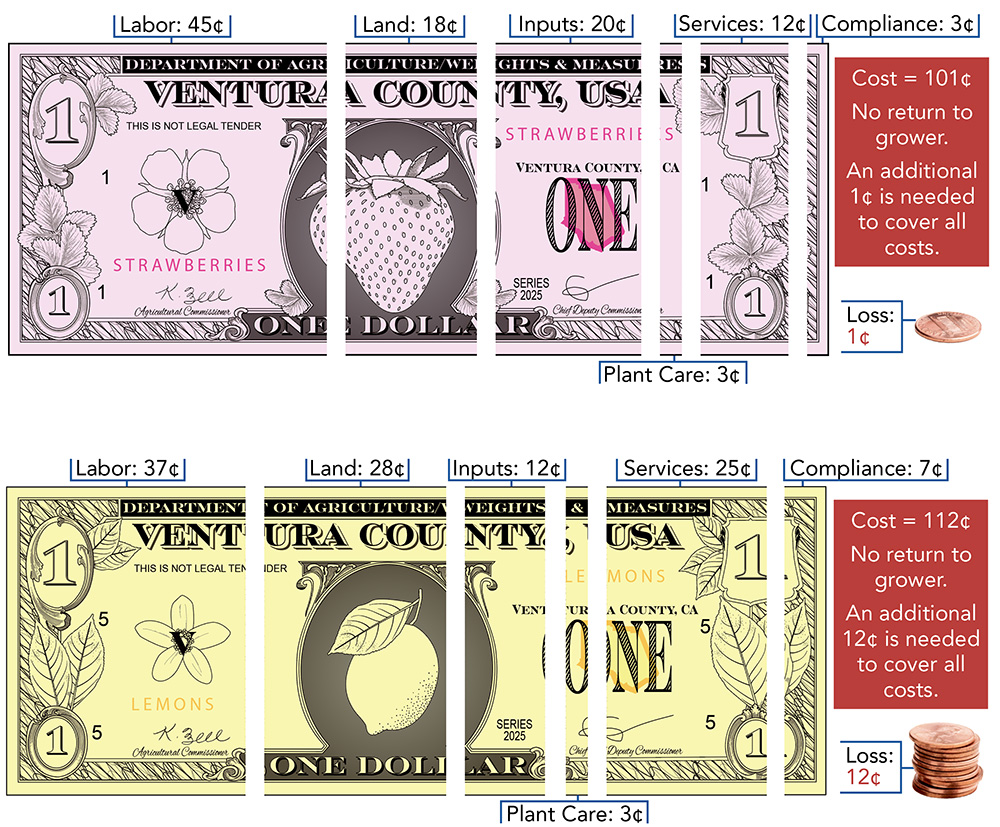
This graphic shows the cost and return per dollar revenue generated by Ventura County’s two top crops—strawberries and lemons. After paying expenses for labor (wages, benefits and workforce), land (leasing, field preparation and planting stock), inputs (irrigation, fuel, fertilizer and packaging), plant care (pest and disease management), services (custom work, postharvest operations and equipment rentals) and compliance (regulatory fees, taxes, insurance, interest, levies and other financial costs), the 2025 crop report found strawberry growers lost 1 cent per dollar revenue while lemon growers lost 12 cents.
Graphic/Ventura County Department of Agriculture/Weights & Measures


By Ching Lee
Ventura County farmers and ranchers generated a record $2.41 billion in gross production value in 2025, but cost estimates in the county’s annual crop report indicate that growers of some major commodities earned little or nothing after production expenses.
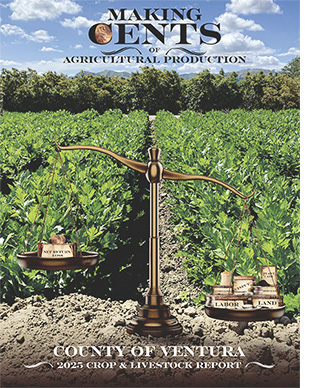 The report, titled “Making Cents of Agricultural Production,” found that production costs consumed an estimated $1.01 for every dollar in strawberry revenue, leaving growers with no return. Lemon growers faced an even larger shortfall, spending an estimated $1.12 for every dollar earned.
The county’s record crop value—which rose 4% from 2024’s $2.3 billion—masks mounting financial pressures on growers, warned Louise Lampara, CEO of Farm Bureau of Ventura County.
“We’re always fighting that perception that farmers are rich because the gross (revenue) is so high,” she said. “That’s only half the story. That’s not even the real story.”
By including the cost estimates associated with producing a crop and the net return to growers, the 2025 Ventura County crop and livestock report represents a departure from traditional crop reports, which typically provide only the gross revenue of agricultural commodities.
But gross crop values alone do not provide a detailed picture of agricultural economics, Lampara said, as gross value measures the value of production before expenses and does not represent growers’ profits.
Ventura County Agricultural Commissioner Korinne Bell said growers have complained for years that publishing a crop’s gross revenue does nothing to illuminate how much it costs to farm.
“It gives a false picture of what’s going on,” she said, adding that the inclusion of production costs and growers’ estimated net return in the crop report “became an opportunity to tell a story that hadn’t been told.”
Using the report’s production-cost data, Farm Bureau of Ventura County estimated that real net returns across major commodity groups have declined about 80% since 2015.
Strawberries remained the county’s leading commodity, with a gross value of about $808 million, up 14% from the previous year. Nursery stock rose 21% to $225 million, while raspberry value climbed 36% to $220 million. Lemon value increased 54% to nearly $182 million.
But higher production values did not necessarily translate into stronger returns for growers, analysis by Farm Bureau of Ventura County found.
Strawberry production costs exceeded the crop’s gross revenue by about $8 million in 2025. Lemon production costs totaled an estimated $203.5 million, compared with $181.7 million in gross revenue.
Bell said she knew lemons have not been profitable for growers, but she was still surprised to see that they lost 12 cents for every dollar generated. The data for strawberries were more shocking, she said, because the crop posted its highest value on record, yet growers still lost an estimated 1 cent for every dollar in revenue after production costs.
“You could have a banner year and still lose money,” she said.
Ventura County farmer Will Terry, who grows strawberries and other crops, said the inclusion of production costs represents “the most important change to the crop report in years,” as the information “adds a dose of reality” to a false perception that Ventura County agriculture is thriving just because gross revenues continue to rise.
“As farmers know all too well, capital-intensive, low-margin businesses get hit particularly hard by cost inflation,” he said. “I expect the 2026 crop report to look even worse as costs continue to outpace revenues.”
The county reported that avocado growers earned about 5 cents for every dollar in sales last year. Celery growers retained about 1 cent per dollar of revenue after estimated production expenses, while pepper revenue also slightly exceeded production costs, with growers earning about 3 cents for every dollar generated.
The report examined six categories of farm expenses: labor, land, inputs, plant care, services and regulatory compliance. Labor was the largest production expense for many of the county’s major crops.
Lampara said the contrast between the record production figure and the cost estimates illustrates the challenges facing the region’s agriculture. She attributed the financial squeeze to policy and production economics, emphasizing that growers increasingly struggle to make farming pay.
The new report “sets the record straight,” she said, pointing to growers’ declining returns even as irrigated farmland has remained relatively stable. County records show 98,470 acres of irrigated cropland in 2025, compared with 98,732 acres in 2024.
The report cautioned that its cost analysis is intended to provide context on production economics rather than serve as a formal economic study. Its estimates focus on wholesale production costs and do not include expenses such as marketing, retail markups or sales taxes.
Bell acknowledged that providing the new information was “a heavy lift.” She initially looked to the University of California Cooperative Extension to do the work but eventually hired someone for the project. It took the new staff person six months of interviewing growers to compile the cost information, she noted.
Bell said growers and the county board of supervisors have responded positively to the new data, with supervisors asking her to continue including cost estimates in future reports. However, the long-term outlook for the project remains uncertain.
It’s unclear whether other county crop reports will begin publishing similar cost data, but Bell said Santa Barbara County’s agricultural commissioner has expressed interest.
Lampara said Farm Bureau of Ventura County’s analysis of the data is available at economicsoftheacre.org, where the organization plans to build an index that tracks the economic health of Ventura County agriculture. She said the index could then be used to “impact check” pending or proposed policy, giving the Farm Bureau a new advocacy tool.
“I have not had anyone in the ag community tell me that they don’t want this story told,” she said. “Everybody’s telling me that it’s about time.”
Ching Lee is senior editor of Ag Alert. She can be reached at clee@cfbf.com. Reprint with credit to California Farm Bureau. For image use, email agalert@cfbf.com.

In this edition…
• View full issue
• California farmers explore seaweed crop
• Soaring costs and low yield dampen walnut prospects
• Lessons learned from being a dot on bankruptcy map
• Ventura County's record crop values describe 'only half the story'
• From the Fields: Bryan Van Groningen, San Joaquin County farmer
• From the Fields: Steven Springer, Yuba County farmer
• From the Fields: Jim Spinetta, Amador County winegrape grower
• From the Fields: Billie Roney, Tehama County rancher
• Market, prices strengthen for sweet potato growers
• Advocacy in Action: A legal victory, air monitoring, kangaroo rat, screwworm and wolves
• Protein boom marks 'paradigm shift' in dairy sector
• California FFA students win in Agricultural Proficiency
• Protecting your herd: Modern solutions for livestock theft