


California farmers explore seaweed crop
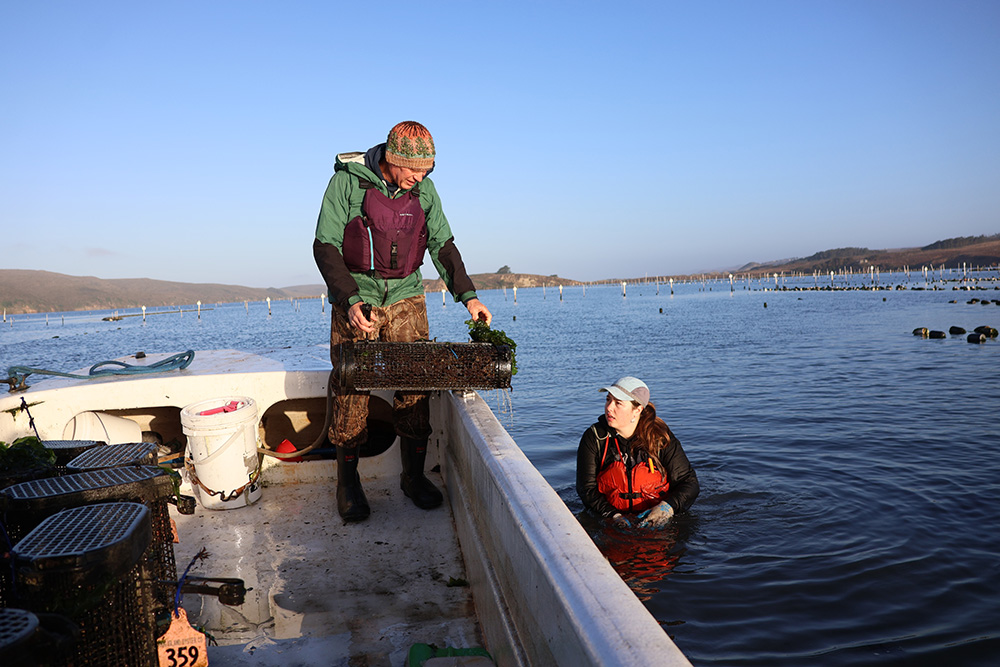
Gary Fleener, senior director of science and policy for Marin County-based Hog Island Oyster Co., left, and Riley Zajon, the company’s quality assurance manager, pull a container of oysters out of the water. The seaweed grows naturally on the equipment and is harvested for food and other uses.
Photo/Manola Secaira


By Manola Secaira
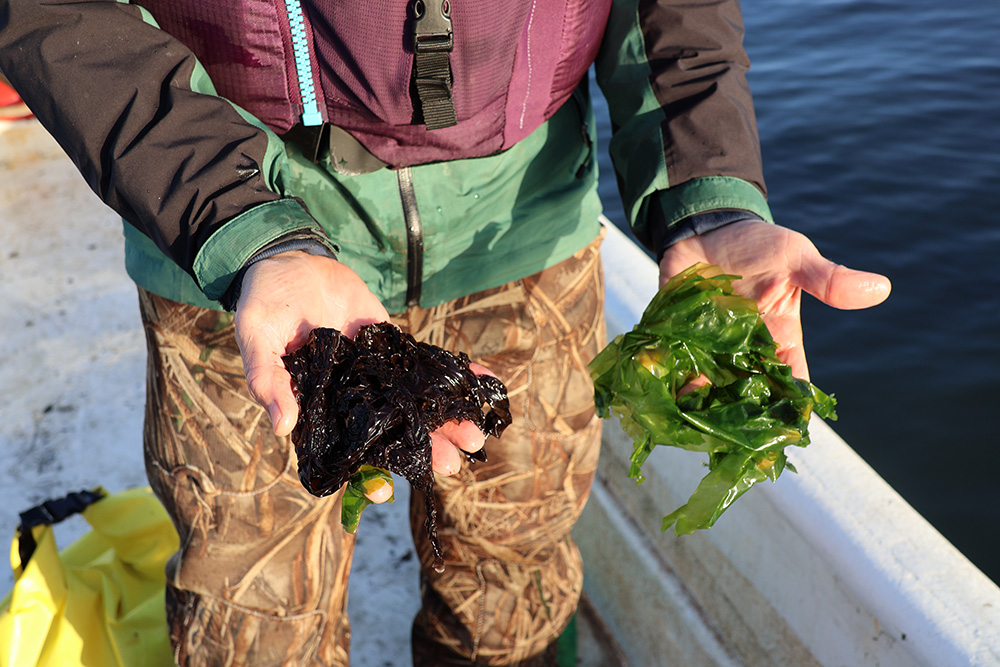
It’s just past sunrise when Riley Zajon, a quality assurance manager with Marin County-based Hog Island Oyster Co., wades into Tomales Bay to fish out some oyster baskets. As she dredges them out of the water, different varieties of seaweed—mainly nori, sea lettuce and ogo—cling to the equipment.
Gary Fleener, the company’s senior director of science and policy, stands atop a small motorboat to receive the baskets. Today, the duo isn’t looking for seaweed. They’re collecting the oysters as part of ongoing work to monitor their health.
But there’s so much seaweed that it’s hard to avoid.
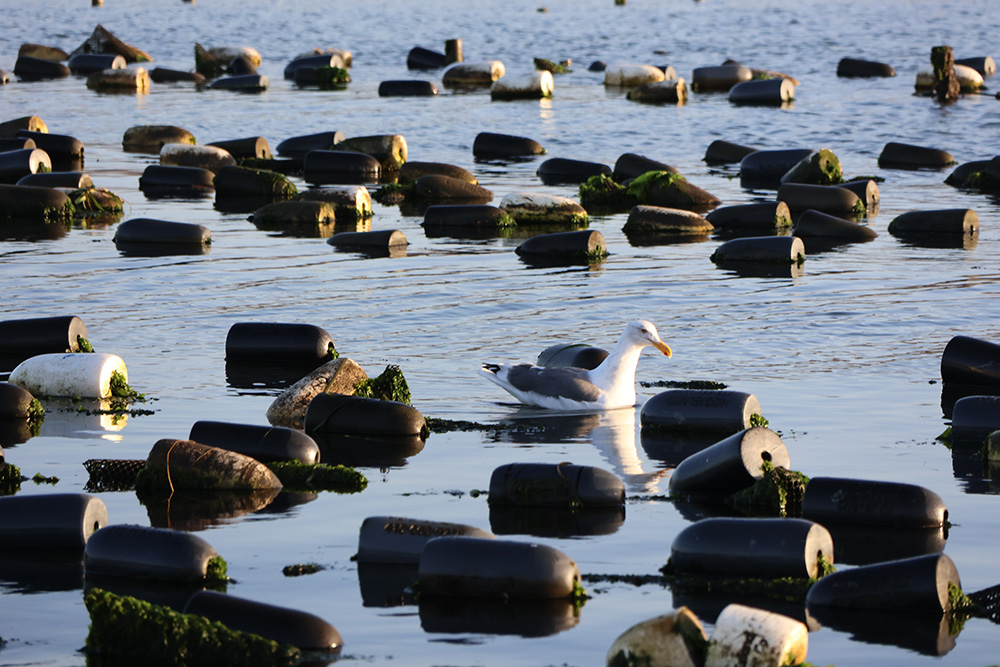
“We can go out and pick 500 pounds of wet weight (seaweed), and somebody would come in behind us and not know” that they picked anything, Fleener said, gesturing to a pile of equipment covered in sea lettuce.
Seaweed grows naturally on the company’s oyster-farming equipment. In 2022, Hog Island received a permit to harvest the seaweed, becoming the first California shellfish company known to do so.
Fleener said if restaurants put seaweed on their menus and educate consumers about it, they can help increase demand for the marine plant as a food ingredient in California.
Seaweed farming in the United States remains in its infancy but has grown in recent years. In 2015, there were just a handful of kelp farms along the Atlantic and Pacific coastlines, according to a 2026 report by the aquaculture nonprofit GreenWave. There are now around 250 permitted seaweed farms across the U.S. and Canada, amounting to more than 6,000 acres.
Kendall Barbery, GreenWave’s director of partnerships and industry engagement, said her company worked with Cal Poly, Humboldt, to open the state’s first commercial, open-water seaweed farm in 2020. She sees it as part of the growing interest in seaweed as a California crop.
“Over the past decade, we’ve come a long way,” she said. “We’re at the point where we have achieved some serious scale and ability to produce and demonstrate viability as a new industry across the U.S.”
The industry’s growth faces barriers in California. No new aquaculture leases have been issued in state waters for more than three decades, GreenWave reported.
Barbery said a big obstacle for would-be seaweed growers is California’s arduous permitting process. State environmental regulations, which have been in place for decades to protect the state’s coastline, weren’t created with seaweed farming projects in mind. Those regulations can make obtaining the necessary permits complicated and costly.
Photo/Manola Secaira
Kaira Wallace, the regulatory and engagement lead for the aquaculture company Ocean Rainforest, said regulatory hurdles can prevent a small or medium-sized business from getting into seaweed farming.
“There’s not an established clear pathway with a defined timeline and a known cost associated with it,” she said.
Wallace said Ocean Rainforest, which is headquartered in the Faroe Islands with operations in California, became familiar with the state’s tricky permitting landscape when it launched an 86-acre demonstration farm growing giant kelp in federal waters offshore of Santa Barbara. The farm operated for two years as a research site.
Wallace described the demonstration farm as a critical steppingstone that helped pave the way for a larger commercial operation, for which the company announced receiving permits in early October. The new, 2,000-acre site is located in federal waters offshore of Ventura County, an area identified by National Oceanic and Atmospheric Administration as one of 10 potentially suitable places around Southern California for commercial aquaculture.
Wallace said the project’s approval was made easier because it is based in federal waters, and NOAA had already vetted the site. The project could help clarify the regulatory process for other seaweed growers looking to enter the industry, she added.
“If we do well with the project, I have no doubts that we’ll see other people starting to consider some of the other aquaculture opportunity areas,” Wallace said.
Barbery said California’s adoption of the Statewide Marine Aquaculture Action Plan in June is another step toward clarifying the permitting process for seaweed and other marine aquaculture operations. The plan calls for the development of an aquaculture pilot program “to lower barriers to entry and promote innovation in marine aquaculture.”
Hog Island Oyster Co. has refined its harvesting process in the years since getting its permit. Nowadays, most harvests occur during the spring and summer. After washing and drying the seaweed, some of it is shared with researchers, with the rest used to create food products such as miso nori butter.
“It’s delicious. We put it on grilled oysters, but it’s also really good on a slice of toast,” Zajon, the quality assurance manager, said. “We’ve also made cookies with nori in it before.”
Although seaweed is often associated with food, most growers say culinary uses are unlikely to become the primary market for California-grown seaweed.
“People aren’t eating huge volumes of giant kelp across the U.S.,” Wallace said.
Photo/Manola Secaira
She said Ocean Rainforest’s California operations focus primarily on producing seaweed-based agricultural biostimulants, products that support plant growth and soil health.
Seaweed-based biostimulants are already sold to farmers, she added, so getting into that market would not be difficult. Ocean Rainforest produces and sells three biostimulant products made with wild-harvested California seaweed and farmed seaweed from Maine and the Faroe Islands.
Fleener said Hog Island is working with a University of California, Santa Barbara, researcher interested in developing seaweed-based biostimulants for strawberry growers.
He said there’s interest in how seaweed farming could help California ecosystems thrive, noting that seaweed can sequester carbon, provide habitat for marine life and filter water by absorbing excess nutrients, among other perks.
“A lot of our food systems tend to have the net effect of really simplifying the ecosystems where they’re taking place: We take out diversity, and we put in efficiency,” he said. “We really need food systems that are co-producing ecosystem health.”
Manola Secaira is a staff writer for Ag Alert. She can be reached at msecaira@cfbf.com. Reprint with credit to California Farm Bureau. For image use, email agalert@cfbf.com.

In this edition…
• View full issue
• California farmers explore seaweed crop
• Soaring costs and low yield dampen walnut prospects
• Lessons learned from being a dot on bankruptcy map
• Ventura County's record crop values describe 'only half the story'
• From the Fields: Bryan Van Groningen, San Joaquin County farmer
• From the Fields: Steven Springer, Yuba County farmer
• From the Fields: Jim Spinetta, Amador County winegrape grower
• From the Fields: Billie Roney, Tehama County rancher
• Market, prices strengthen for sweet potato growers
• Advocacy in Action: A legal victory, air monitoring, kangaroo rat, screwworm and wolves
• Protein boom marks 'paradigm shift' in dairy sector
• California FFA students win in Agricultural Proficiency
• Protecting your herd: Modern solutions for livestock theft