


Soaring costs and low yield dampen walnut prospects
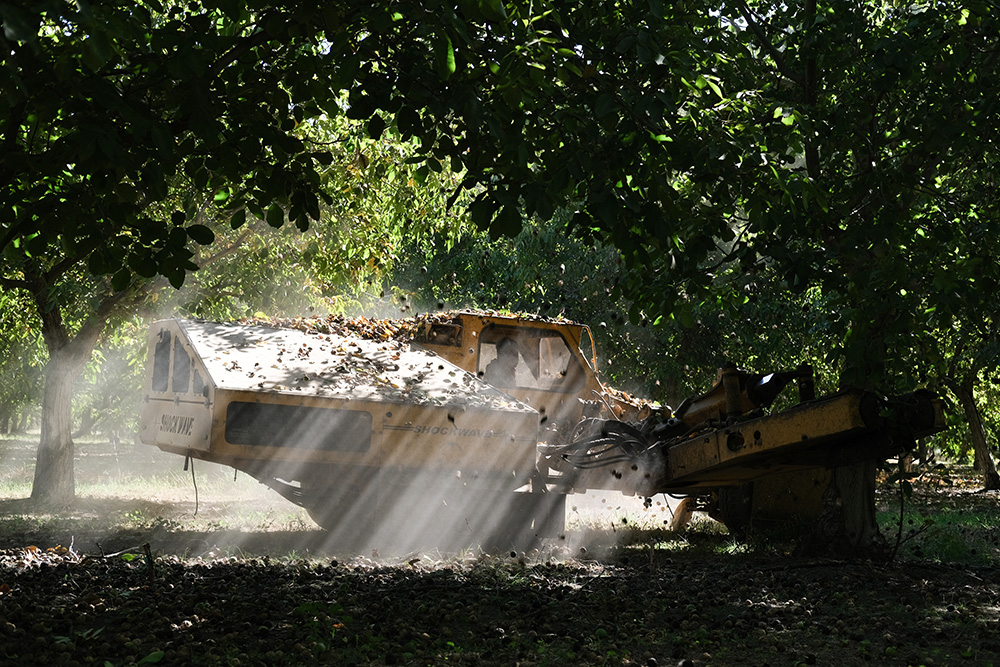
Walnuts are harvested in Solano County. California produces virtually all U.S.-grown walnuts, exporting much of the crop to countries such as Germany, Turkey, Japan, South Korea and India.
Photo/Caleb Hampton


By Caleb Hampton
California walnut growers face the prospect of another year in the red as harvest wraps up this month and handlers market the new crop. Despite increased walnut prices, industry experts said growers could struggle to break even due to rising production costs and low yields.
On Oct. 1, the U.S. Department of Agriculture estimated the state’s crop at 680,000 tons, down 16% from last year.
Don Barton, president of Escalon-based GoldRiver Orchards, a walnut grower, processor and shipper in San Joaquin County, said the company was set to receive its last walnut loads of the season this week.
“We’re receiving the end-of-season trickles,” said Barton, who handles walnuts from throughout the Central Valley. Yields were especially down in the Sacramento Valley and in the industry-leading Chandler variety, he said.
Sutter County grower Ranjit Davit estimated his walnut crop came in 20% to 30% below average.
“We saw smaller-sized nuts,” Davit said.
Inconsistent chill hours during winter and varying temperatures in the spring caused uneven pollination and a lighter nut set, according to an October report from the California Walnut Board and Commission.
Bikram Hundal, vice president of operations for Earlimart-based Sequoia Nut Company/Custom Almonds LLC, a grower, processor and shipper in Tulare County, said he thought the low yields also reflected reduced spending by farmers on crop maintenance and materials.
“If you’re not making money on the farm, you will not be putting any inputs into the orchards,” Hundal said. “Of course, the production will be impacted.”
Last month’s USDA forecast resulted in a “shock” in the market, Barton said, with prices jumping in response to the small crop.
“That certainly slowed down the market,” he said. “There has been some grudging acceptance from some buyers. Others are holding off, hoping the pricing will break downward.”
He said an anticipated deal between California’s major walnut handlers and Germany’s largest importers could soon dictate the price range for this year’s crop.
In 2024, California walnut producers exported about 55% of the state’s crop, according to USDA. The top destinations were the European Union, led by Germany, followed by Turkey, Japan, South Korea and India. Walnut exports were valued at $922 million, ranking fifth among California agricultural commodities.
Robert Verloop, CEO of the walnut board, said prices for growers were expected to be “significantly higher” this year than the 75 cents a pound they received on average for last year’s crop.
However, “they may not go up enough to cover the light crop and higher production cost,” Verloop said.
While each grower has a different break-even price, industry experts said walnut growers generally need to earn at least a dollar a pound to make a profit on their crop, which hasn’t happened since 2017. Prices neared a dollar a pound in 2019 and 2024.
“We were certainly not close to that last year,” Barton said.
The industry’s recent struggles roughly coincided with an explosion of walnut production in China, which transformed during the past decade from being among the top buyers of California walnuts to the world’s top walnut producer, with exports rivaling those of the U.S.
According to experts, competition from China has driven down walnut prices overall and pushed California to prioritize certain markets.
“At first, markets were not used to Chinese walnuts, but they slowly got cheap enough that people started trying them,” Verloop said. “It has taken the bottom of the market away from us and caused us to have to focus on markets that are more quality focused.”
California walnut exporters have faced other challenges, too.
Shipping delays, disruptions and cost increases caused by the U.S.-Israeli war with Iran have resulted in millions of dollars in losses for handlers, which in turn affected the payout to farmers, Verloop said.
Another headwind has been the declining value of the Japanese yen against the U.S. dollar, which Barton said has limited the potential for growth in a key market by raising the cost to Japanese buyers of U.S. commodities.
“It’s not anything growers and packers can control, but it does definitely affect our trading partners’ ability to buy more California walnuts,” he said.
An uptick in domestic walnut sales has provided a bright spot for the industry.
During the past year, walnuts outperformed other nut categories in the U.S. market, according to consumer research conducted by the walnut board.
Verloop said that success is the result of a “full-court press” by the industry group in working with retailers to promote walnuts.
“It’s been a concerted effort of ours over the last three or four years to focus on arguably our largest market,” he said. “It’s a market that we feel has been underdeveloped, and we’re starting to see some real positive movement there.”
To reach younger and more health-conscious consumers, the industry has increasingly promoted walnuts as a fresh produce item, seeking to change perceptions of the nut as “an ingredient that your grandmother used in banana nutcake,” Verloop said.
California’s walnut footprint peaked in 2021 at 390,000 bearing acres, according to USDA. Since 2024, the state’s bearing acreage has hovered around 380,000, according to Sacramento-based Land IQ, which began mapping the industry’s acreage in 2023. More than 9,000 acres are estimated to have been abandoned.
Davit, the Sutter County grower, said walnut producers were hit hard this year by increased fuel prices, even more so than growers of some other crops because walnuts are harvested in three passes, each of which relies on diesel-fueled machines.
“It’s a big factor,” he said.
Growers said they were not optimistic about the crop going forward.
Davit said he plans to continue growing walnuts primarily because his 30-acre orchard is still young, and it would be too costly to take out the trees and redevelop the land with another crop.
“I’m definitely not planting more,” he said.
Hundal, the Sequoia Nut Company/Custom Almonds LLC executive, said the company is considering pulling out its 400 acres of walnuts after this season.
“We’re just wrapping up harvest,” he said. “We’ll see where we end up on the pricing, and we’ll make the call.”
Caleb Hampton is an editor at Ag Alert. He can be reached at champton@cfbf.com. Reprint with credit to California Farm Bureau. For image use, email agalert@cfbf.com.

In this edition…
• View full issue
• California farmers explore seaweed crop
• Soaring costs and low yield dampen walnut prospects
• Lessons learned from being a dot on bankruptcy map
• Ventura County's record crop values describe 'only half the story'
• From the Fields: Bryan Van Groningen, San Joaquin County farmer
• From the Fields: Steven Springer, Yuba County farmer
• From the Fields: Jim Spinetta, Amador County winegrape grower
• From the Fields: Billie Roney, Tehama County rancher
• Market, prices strengthen for sweet potato growers
• Advocacy in Action: A legal victory, air monitoring, kangaroo rat, screwworm and wolves
• Protein boom marks 'paradigm shift' in dairy sector
• California FFA students win in Agricultural Proficiency
• Protecting your herd: Modern solutions for livestock theft