


Market, prices strengthen for sweet potato growers
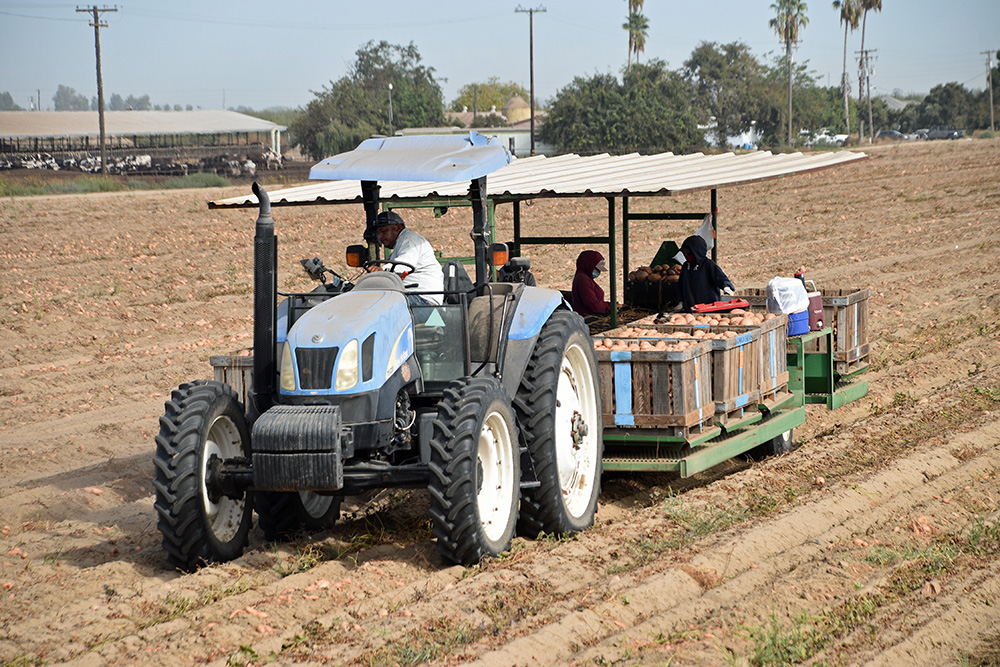
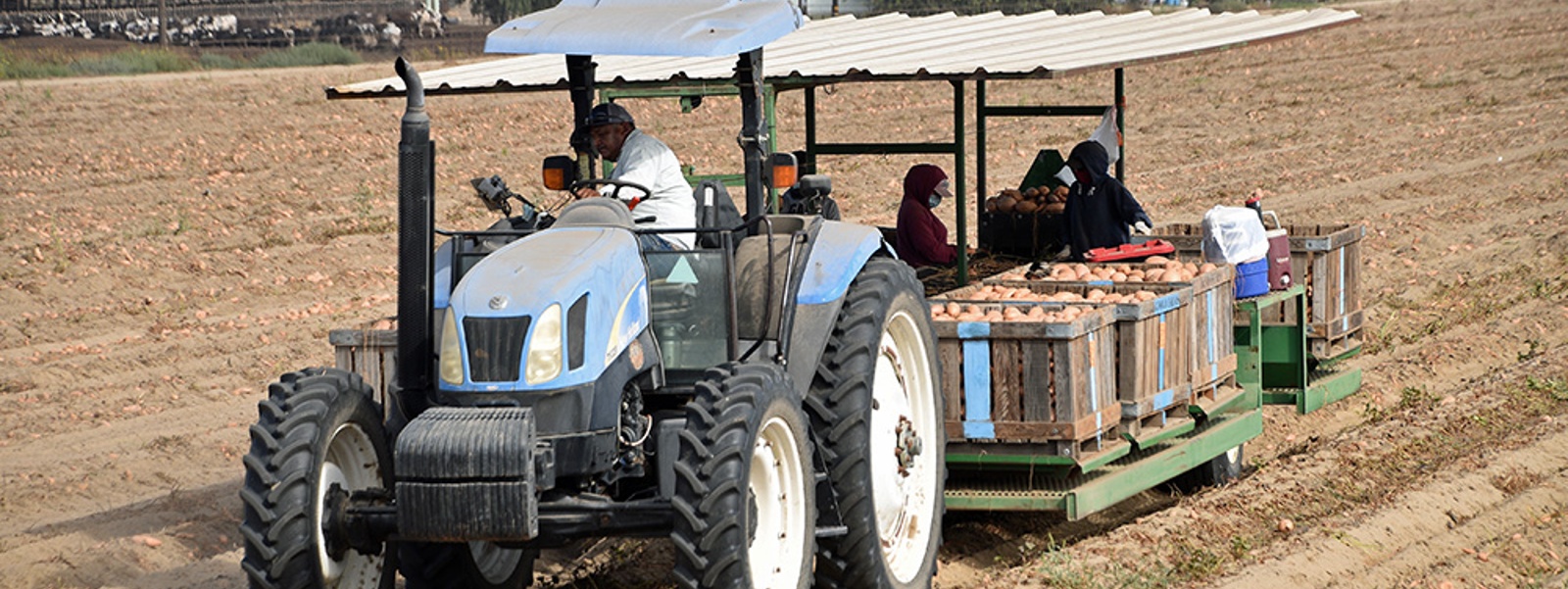
A crew harvests a field of the Bellevue orange-fleshed sweet potato variety near Delhi in Merced County.
Photo/Vicky Boyd


By Vicky Boyd
After suffering from a post-COVID hangover, the state’s sweet potato industry appears to be recovering with stabilized acreage and improved prices over the past year.
“Beginning last year, things finally started getting better, mostly because there were short crops in Mississippi and North Carolina because of weather,” said Scott Stoddard, a farm adviser with the University of California Cooperative Extension.
Jeremy Fookes, director of sales for Livingston-based A.V. Thomas Produce, a sweet potato grower, packer and shipper, agreed.
“Compared to last season, this season definitely has some strength to it for growers, especially with the supply situation,” he said. “It’s one of those seasons where there’s an opportunity to be a little bit firmer with pricing, but it needed to be so with not having a bumper crop and having higher input costs.”
Harvest of this year’s crop, which started unusually early in late July, will continue into November but will taper off, Stoddard said. Spurred by strong early sweet potato prices and a tight market, some growers began to dig the crop in mid-summer before the roots had achieved their overall size potential.
“They wanted to take advantage of good prices,” said Stoddard, who serves Merced and Madera counties. “They churned through acreage because they were only harvesting half a crop.”
This season, Stoddard said he sees good quality and expects average yields of about 80 1,000-pound bins per acre, which could have been larger overall had some growers waited to harvest.
A mid-October storm that dropped up to an inch of rain in many areas likely wasn’t enough to damage unharvested sweet potatoes, thanks to ensuing warm weather that dried out the ground, Fookes said.
Statewide, growers planted about 18,000 acres this season, down from about 21,000 acres six years ago, Stoddard said. Most of the state’s production is centered in Stanislaus, Merced and Fresno counties.
At one time, about one-third to one-half of the state’s sweet potato crop was sold in November, driven by the Thanksgiving holiday.
While the month still accounts for a large portion of sales, Fookes said sweet potato consumption has grown to be more year-round.
He pointed to the root vegetable’s positive nutritional story, versatility and greater use by food service as a few reasons for the shift.
Orange-fleshed varieties remain the biggest market drivers, although red-skinned ones also are popular. Fookes said he’s seen growing interest in specialty varieties, particularly Murisaki, a Louisiana State University release with purplish skin and creamy white flesh.
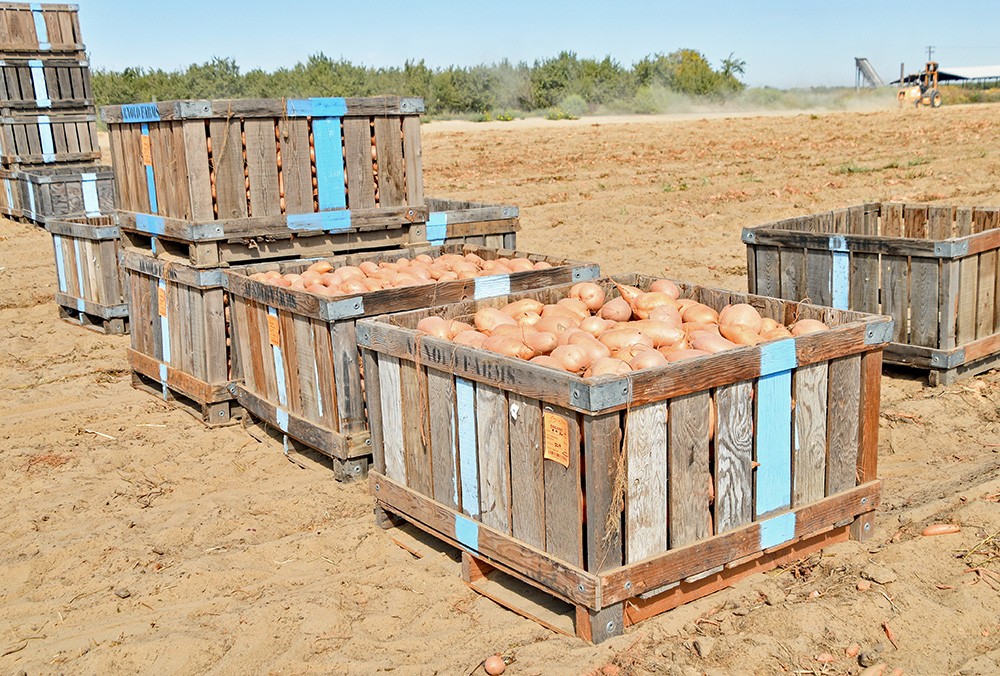
Photo/Vicky Boyd
Increased production and heightened consumer awareness has spurred Murisaki’s expansion beyond traditional Asian markets into more mainstream grocery stores in some parts of the country.
Because California doesn’t have its own breeding program, Stoddard works closely with LSU AgCenter sweet potato breeder Don La Bonte. Based at the university’s Sweet Potato Research Station in Chase, Louisiana, La Bonte said his main goals are developing new varieties that benefit his state’s producers.
From about 30,000 seed-grown lines at the beginning of each season, he whittles them down to 300 at the end of the first year. It may take six to seven more years of selecting and trialing at the research station and in farmers’ fields before La Bonte has a high-yielding, attractive, tasty and pest-tolerant variety he feels comfortable releasing.
As part of screening potential candidates, he sends about 30 advanced lines to Stoddard annually to trial under California conditions. The LSU breeder also travels to California during fall harvest to evaluate trial entries alongside Stoddard and visit with local producers about what they want in new releases.
“We’re looking for varieties that have stability and flexibility and are able to grow in different types of soil,” La Bonte said. “We’re looking for more universal production material with durability and the power to overcome all of the things that nature can throw at it.”
One of the LSU lines that has caught Stoddard’s attention for the past several years is LA 14-11, as it is known experimentally. With maroon skin and orange flesh, he said he sees it as a possible replacement for the long-standing variety Diane. While popular with growers because of its high yields, Diane has a fairly short storage life, he said.
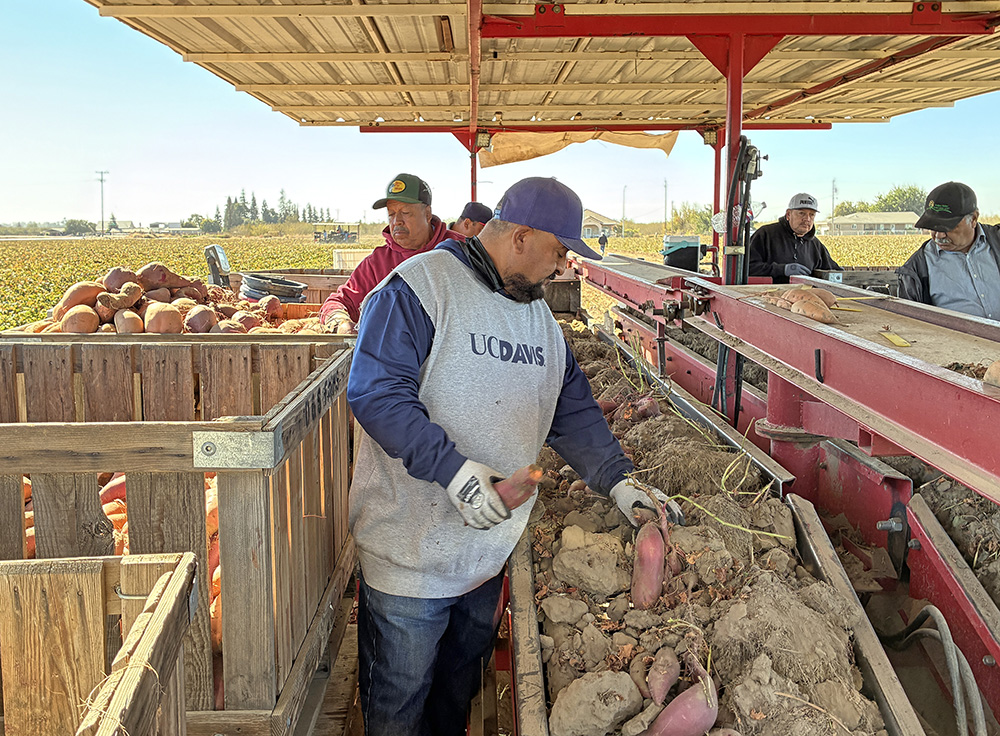
Photo/Vicky Boyd
La Bonte released Vermilion, a red-skinned, orange-fleshed variety, in 2021, and Stoddard saw it as a potential Diane replacement because of its longer storage potential.
Some California farmers have dialed in production techniques to successfully grow the new variety, but he said others haven’t been as fortunate.
As part of their efforts to support the industry, sweet potato grower-packer D&S Farms in Atwater has hosted an LSU variety trial for several years, said farm manager Brian Carter. He and D&S Farms partner Dave Souza like to visit the trial during harvest to talk with La Bonte and Stoddard about the experimental lines.
Carter noted La Bonte has been “very good coming out with new varieties that are better looking and better yielding, and we definitely support him.”
But varietal development isn’t the industry’s only research focus. Total sweet potato production costs run more than $12,500 per acre, with labor remaining the largest portion, Stoddard said. That’s because human hands touch the crop from hot bed production of slips, or plant cuttings, to harvest and packing.
“Labor is a major issue for the sweet potato industry in the U.S., so we need to figure out a better harvest system,” he said.
In response, Mississippi State University, along with several other universities in sweet potato-producing states, has submitted a U.S. Department of Agriculture specialty crop research initiative proposal to develop an improved harvester.
Currently, a crew of about 10 people and one harvester can cover only about 1 acre per day. Stoddard, who is part of the proposal, said increasing harvest to 2 acres per day would be a 100% efficiency improvement and could cut per-bin harvest costs in half.
Vicky Boyd is a reporter in Modesto. She can be reached at agalert@cfbf.com. Reprint with credit to California Farm Bureau. For image use, email agalert@cfbf.com.

In this edition…
• View full issue
• California farmers explore seaweed crop
• Soaring costs and low yield dampen walnut prospects
• Lessons learned from being a dot on bankruptcy map
• Ventura County's record crop values describe 'only half the story'
• From the Fields: Bryan Van Groningen, San Joaquin County farmer
• From the Fields: Steven Springer, Yuba County farmer
• From the Fields: Jim Spinetta, Amador County winegrape grower
• From the Fields: Billie Roney, Tehama County rancher
• Market, prices strengthen for sweet potato growers
• Advocacy in Action: A legal victory, air monitoring, kangaroo rat, screwworm and wolves
• Protein boom marks 'paradigm shift' in dairy sector
• California FFA students win in Agricultural Proficiency
• Protecting your herd: Modern solutions for livestock theft