


Nutrition program benefits growers and inmates alike
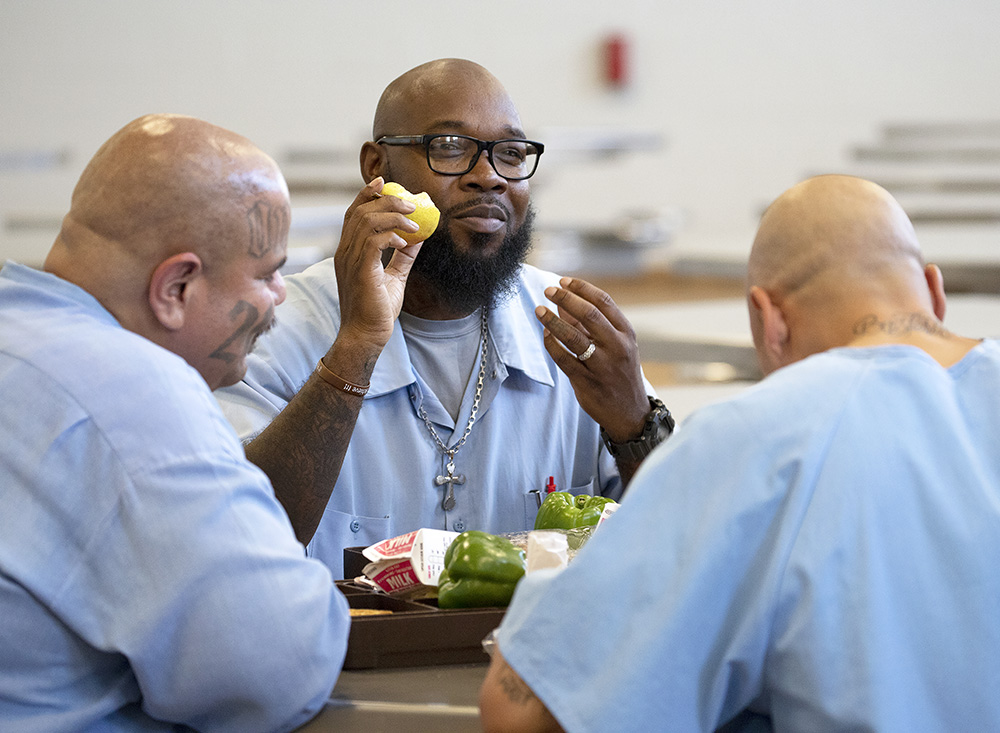
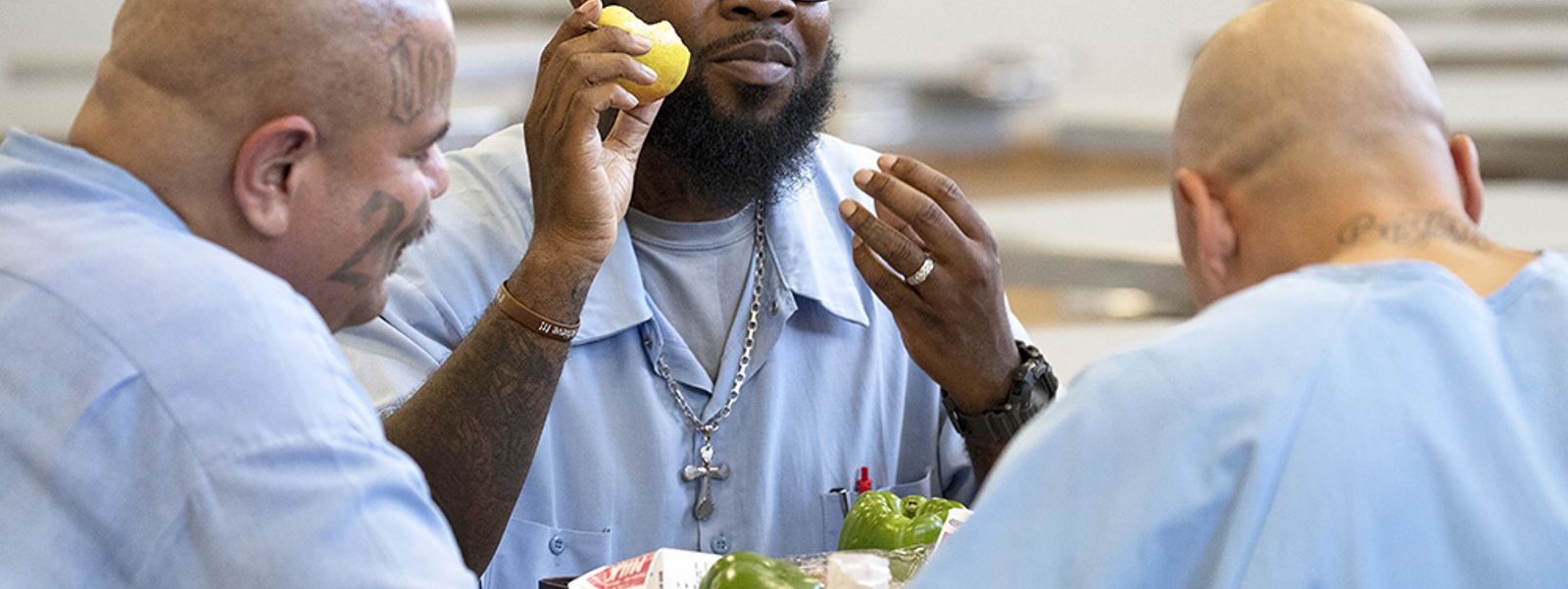
California State Prison, Solano inmate Patrick Range is pictured in 2023 eating a California-grown Bartlett pear that was supplied by Spork Food Hub as part of the Harvest of the Month program.
Photo/Fred Greaves


By Caleb Hampton
Inmates at California State Prison, Solano in Vacaville say a small change in California prisons has made a big difference for people incarcerated in the state.
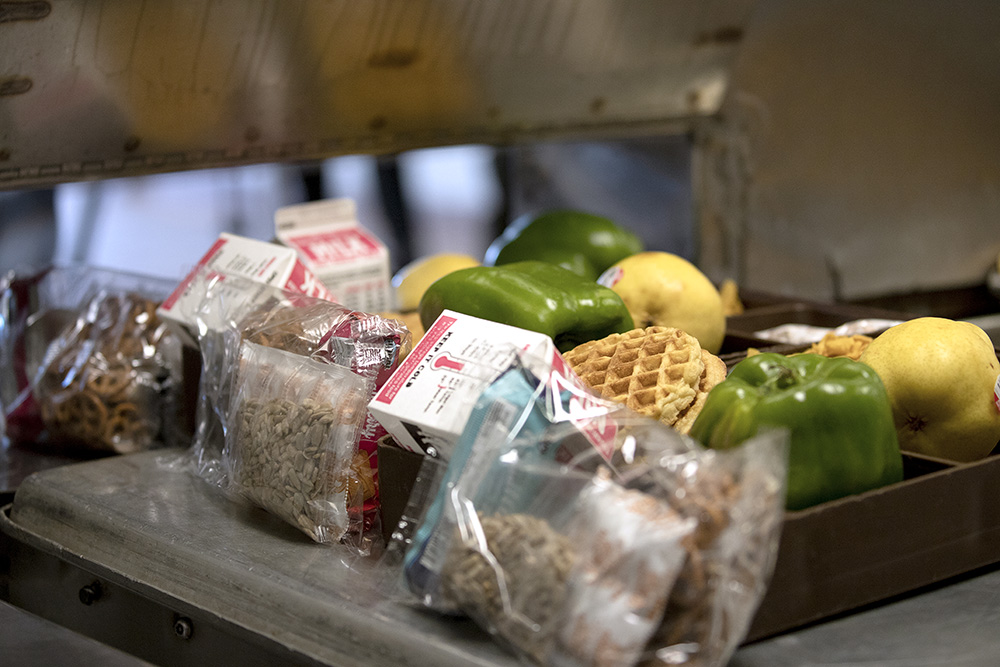
For the past three years, the prison has received regular deliveries of California-grown fruits and vegetables.
“We really appreciate it,” said Andre Pierson, an inmate and chairman of the prison’s Incarcerated Advisory Council, which serves as a liaison between other inmates and the prison’s correctional officers and administrators.
Pierson, who has been incarcerated for 13 years, said he initially struggled to eat the “terrible” food in prison. But recently, he said he has enjoyed bok choy with soy sauce and mackerel with fresh radishes.
More than bringing a new dimension to meals, he said the nutrient-rich foods improve inmates’ physical and mental health, contributing to lower stress levels and violence at the facility.
“You are what you eat,” he said. “It impacts your mood.”
The locally grown produce comes from Harvest of the Month, a joint initiative between Oakland-based nonprofit Impact Justice, University of California’s Nutrition Policy Institute and the California Department of Corrections and Rehabilitation.
The program was created to provide nutrition access for incarcerated people while creating new markets for farmers. It also helps CDCR comply with a 2022 state law that as of last December requires that at least 60% of the food purchased by state institutions be grown or produced in California.
Photo/Fred Greaves
Since launching at three prisons in 2023, Harvest of the Month has expanded to serve all 30 adult prisons in California. During that time, it has provided hundreds of thousands of pounds of produce to 90,000 incarcerated people.
“Harvest of the Month has helped us identify where those products are coming from, identify what products are available and when those products are available,” said Lance Eshelman, departmental food administrator at CDCR.
Eshelman said he initially balked at the prospect of purchasing so much food from within the state while working within CDCR’s food budget of $4.45 per person per day.
“We’re like, ‘How are we going to source from California, which is typically a more expensive product?’” he said.
Since the 2022 law was adopted, the state has allocated some temporary funds to enable compliance. And Eshelman said new partnerships with farms and food hubs helped CDCR make progress in sourcing food that is fresh, local and affordable.
“In order to do this, we had to collaborate,” he said.
Hope Sippola, co-owner of Spork Food Hub in Yolo County, said the hub works with more than 120 small- and mid-sized farms, connecting them with larger markets such as school districts. Since 2023, through Harvest of the Month, it has supplied produce to CDCR, which is the state’s largest food purchaser.
“We try to spread the love of this program across as many farms as we can,” Sippola said.
This spring, the Davis-based food hub was busy shipping carrots from Monterey County and mandarins from Madera County to all 30 state prisons.
Heile Gantan-Keo, program manager for Impact Justice’s Food in Prison Project, said the fresh produce is vital for the inmates’ physical health and their overall well-being.
In nationwide surveys conducted by Impact Justice, more than half of formerly incarcerated people reported they were “rarely or never” served fresh fruits and vegetables while in prison. Instead, they subsisted primarily on foods high in salt, sugar and refined carbohydrates, and experienced significant health impacts as a result.
Researchers have found incarcerated people suffer from high rates of diet-related conditions such as diabetes, high blood pressure and heart disease, as well as immune system deficiencies that contribute to the spread of infectious diseases.
“They want agency over their health,” Gantan-Keo said.
Patrick Range, an inmate at Solano State Prison who suffers from kidney disease, said he was “taking full advantage” of the fruits and vegetables provided by Harvest of the Month to improve his diet—despite facing some food preparation constraints.
“The bell pepper—I’m eating it like it’s an apple,” said Range, who has been incarcerated for 30 years.
Brian Cortez, another inmate at Solano State Prison, said he wanted nutritious food to keep his body in good health so that he can live a rewarding life after he is released from prison a decade from now. He said he has served 14 years in prison since being incarcerated at the age of 16.
The Stockton native added that the locally grown vegetables make it possible for him to assemble meals that remind him of his mother’s Mexican cooking. When a shipment of fresh onions or avocados arrives at the prison, he calls her to ask for recipes.
“This is something really big for the prison community,” Cortez said.
The program is also important for many of the participating growers.
“Farmers are struggling right now,” Sippola said. “I can’t express enough how important it is that we’re getting small and medium farms into a new market.”
Sarah Weil, whose family grows mandarins in Madera County, said low packinghouse prices prompted the farm to begin packing its own fruit several years ago. But the farm’s relatively small acreage and sporadic orders made it difficult to retain picking and packing crews throughout harvest.
“This deal with the prisons, through Spork, has been a huge lifeline for us,” Weil said. “Every week, we know we’re getting an order with enough volume to keep us open.”
According to Eshelman, CDCR’s food administrator, the department has purchased $2.7 million worth of produce from California farmers through Harvest of the Month.
Yolo County farmer Tim Mueller, who also sells produce through Spork, said that money supports not just farmers but communities. And unlike school districts, which provide an important market during the school year, Harvest of the Month purchases fruits and vegetables 12 months a year, enabling farmers to offer year-round work to their employees.
“Farmworkers who stay in one place for a full year—their kids stay in one school for a full year. They shop in their local community. They are part of their local community, part of the church. They’re part of the school,” said Mueller, whose Capay Valley farm employs 40 people. “It creates a much more stable world.”
Caleb Hampton is an editor at Ag Alert. He can be reached at champton@cfbf.com.
In this edition…
• New school sawmill spurs logging interest
• H-2A rule change puts spotlight on work visa program
• Feedback needed to assess state veterinary shortage
• Nutrition program benefits growers and inmates alike
• From the Fields: Josh Barton, San Joaquin County walnut, almond and olive farmer
• From the Fields: Matt Stayer, Shasta County beekeeper and queen breeder
• From the Fields: Jerry Maltby, Colusa County rancher, feedlot operator and rice farmer
• From the Fields: Tiffany Holbrook, Sonoma County egg and poultry producer
• Growers use pressure bombs to fine-tune irrigation
• State targets sharpshooters from Costco grapevines
• Moth damage rises as growers await new insecticide
• Advocacy in Action: California Farm Bureau tackles labor, immigration and forest management
• Four farm safety priorities this National Safety Month





.svg.png)
