


Growers use pressure bombs to fine-tune irrigation
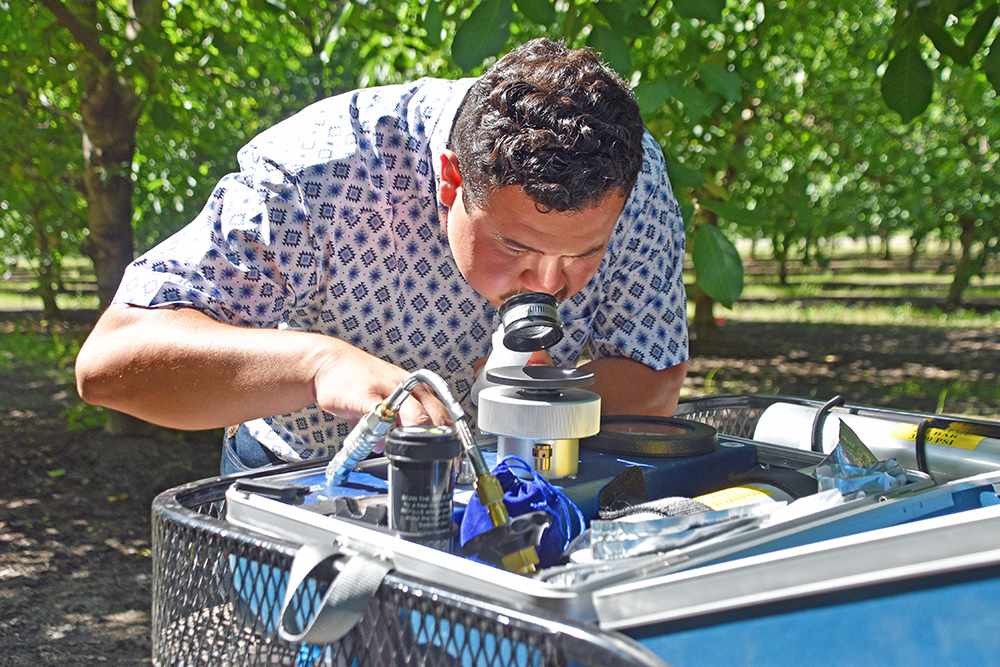
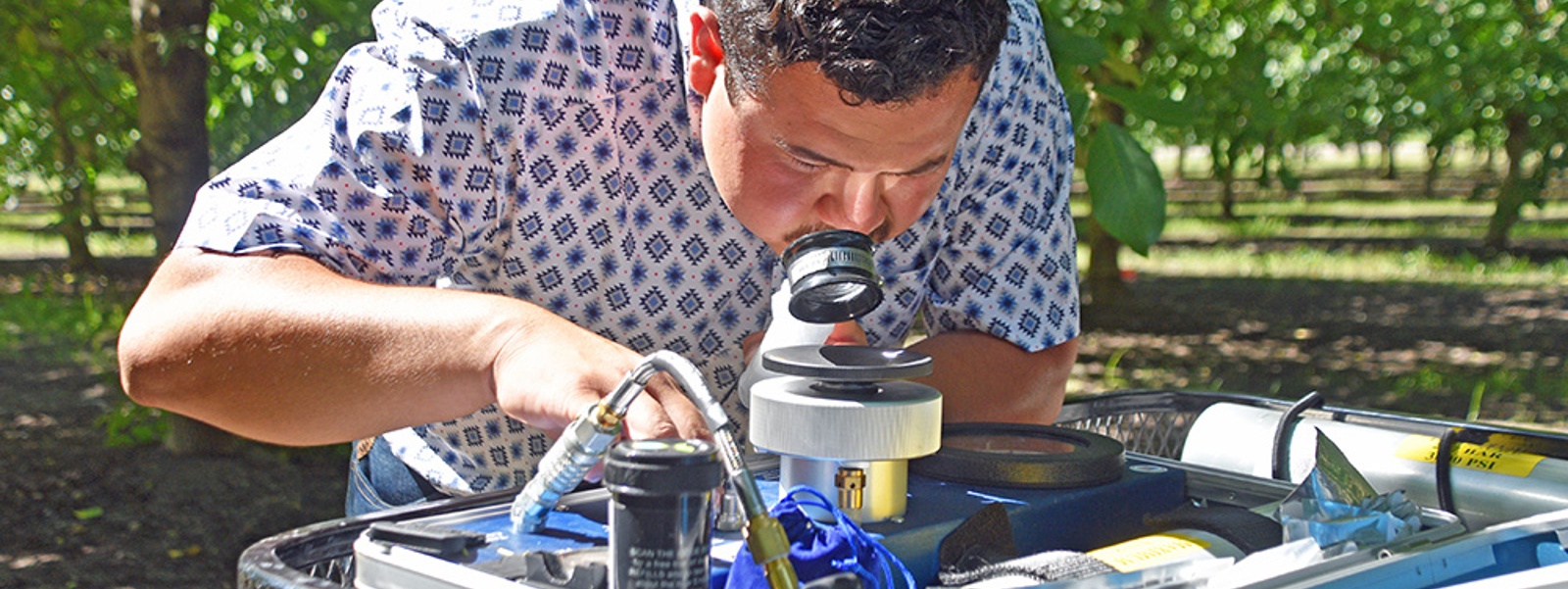
Andrew Malagon, a pest control adviser with Precissi Ag Services in Stockton, adjusts the air pressure on a pressure chamber, or pressure bomb, as he looks through a magnifying glass to watch as a water droplet begins to appear at the cut edge of the petriole, or leaf stem. The reading from the adjacent gauge tells him the midday stem water potential, or how water stressed the tree is.
Photo/Vicky Boyd


By Vicky Boyd
With an eye on tree health and expenses, San Joaquin County walnut producer Richard Thompson has been a longtime fan of using pressure chambers, commonly called pressure bombs, to schedule irrigations.
“I won’t do too much irrigation until I know I can get a good reading with the pressure bomb,” said Thompson, who farms walnuts near Manteca and Farmington. “We’re in the middle of May, and I haven’t given (the orchard) a solid shot yet.”
Not only does the device help him avoid under- or overwatering his trees, but it also helps to time irrigations to Pacific Gas & Electric Co.’s cheaper off-peak weekend periods. Thompson said he learned about the technology more than 10 years ago from the Bartons, who grow walnuts, almonds and olives in Stanislaus and San Joaquin counties.
Josh Barton, vice president of orchard operations for Escalon-based Barton Ranch, said the farm has used pressure bombs for more than 20 years, and he viewed them as one of many tools in the water-management toolbox.
 “I don’t rely solely on one thing over another, and I use a combination of a couple of different things to get a sense of irrigation timing,” he said. “I figure out SWP (stem water potential), then I correlate data from other tools, and it could be as simple as a shovel and soil tube.”
As producers face more pressure from electrical rates, the Sustainable Groundwater Management Act and overall water availability, Barton said the pressure bomb helps his farm better steward its most essential resource—water.
One of the few downsides Thompson said he sees with pressure bombs is that they are labor and time consuming. This year, he’s comparing his results from a Manteca-area orchard with those taken by Andrew Malagon, a pest control adviser with Precissi Ag Services in Stockton.
Malagon and Barton said they liked pressure bombs because they produce nearly immediate results that reflect the actual water status of the tree, not the soil. Nevertheless, they said it’s important to not rely totally on one system.
During a mid-May visit, Malagon and Thompson discussed their pressure bomb results, which showed the trees weren’t water stressed yet. Malagon also compared them to predicted evapotranspiration, or ET, rates taken from a nearby CIMIS weather station.
“Even though the ETs say we need to water for 20 hours, if we look at the trees, they’re within baseline. If we were to water, we would have been over baseline,” Malagon said. “ETs are suggesting we run 20 hours of water, which is a huge thing.”
Pressure bombs have been around since the 1970s, but they’ve been slow to catch on. A survey by the California Department of Food and Agriculture in the early 2020s found they were used on only about 16% of perennial crops.
The technique has been compared to taking the “blood pressure” of a plant to tell how stressed it is. Technically, pressure bombs measure the midday stem water potential, or SWP, of a tree and report it as a negative reading.
Think of it as a water deficit. The greater the number, the more tension the tree needs to pull moisture from the roots through its water-conducting xylem tissue into the leaves.
Walnuts are very susceptible to water stress. Minimizing it can lead to higher quality nuts and a higher yield potential, Malagon said. High water stress also can begin to stunt the trees.
Based on ambient temperature and relative humidity, the baseline reading for a well-irrigated walnut orchard is about minus 4 millibars. Citing University of California research, Malagon said he typically doesn’t recommend irrigating until the SWP drops by minus 2 to minus 3 bars and trees begin to experience low to mild water stress. That’s not a hard and fast rule, and he also factors in predicted ET as well as irrigation system output.
Photo/Vicky Boyd
Work by UC plant scientists Ken Shackel and Bruce Lampinen found that subjecting walnut trees to this type of early-season low to mild stress is beneficial. It encourages tree roots to grow deeper, reduces annual water applications, minimizes later-season nutritional deficiencies and potentially reduces pests without affecting yield.
Barton said he saw improvements firsthand when he began basing early-season walnut irrigation on pressure bomb and moisture sensor readings. On sandier ground, he now waits to begin irrigating about the second week of May. But on heavier ground, he may hold off until late May.
“It made a huge difference because we aren’t stressing the trees nearly as much,” he said. “It confirmed we needed to wait.”
As its name implies, midday SWP readings are taken from 11 a.m. to 4 p.m. when the tree is most actively pulling moisture through the xylem. At the beginning of the season, Thompson and Malagon flagged two sets of representative trees in the orchard where they conduct the stress tests at roughly the same time each visit to maintain consistency.
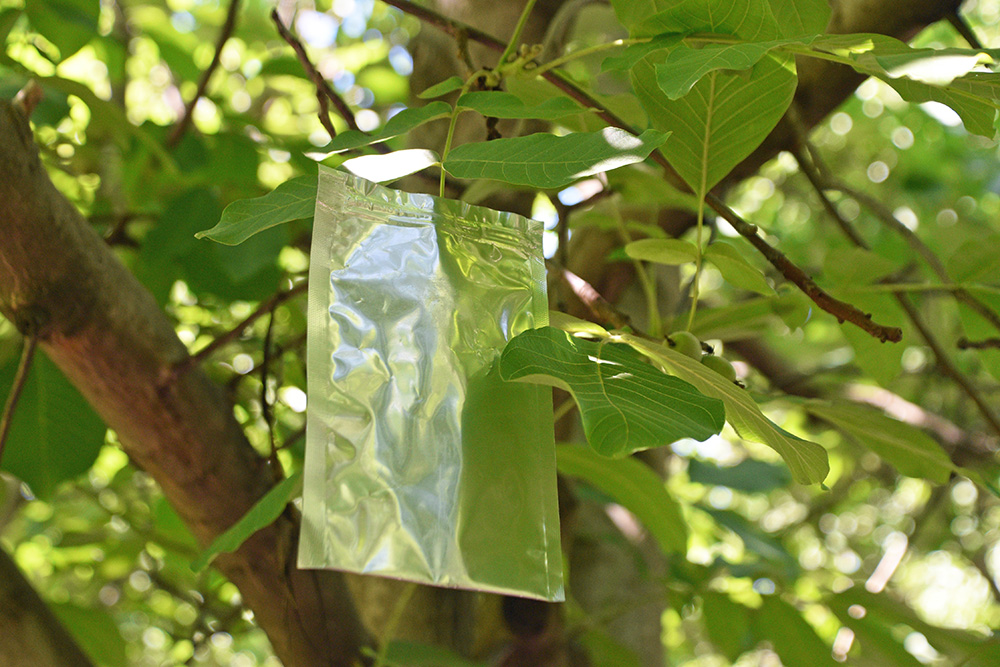
For each sample, they select a shaded interior leaf on a spur without fruit and place a Mylar foil bag around it for at least 10 minutes. This prevents the leaf from losing water and equilibrates water tension of the whole plant.
They then carefully cut the leaf from the tree, remove the foil bag and place the leaf inside the pressure chamber. Only a small part of the leaf stem is visible outside the seal.
The amount of air pressure required to cause water to move from the leaf and barely begin to appear at the cut edge of the petiole is shown on a gauge, and it shows how much water tension the leaf is experiencing.
The more pressure it takes, the higher the water stress. Malagon’s unit uses a tank of welder-grade nitrogen gas as the pressure source, while Thompson and Barton both use hand-pump models that resemble bike pumps.
Vicky Boyd is a reporter in Modesto. She can be reached at agalert@cfbf.com.
In this edition…
• New school sawmill spurs logging interest
• H-2A rule change puts spotlight on work visa program
• Feedback needed to assess state veterinary shortage
• Nutrition program benefits growers and inmates alike
• From the Fields: Josh Barton, San Joaquin County walnut, almond and olive farmer
• From the Fields: Matt Stayer, Shasta County beekeeper and queen breeder
• From the Fields: Jerry Maltby, Colusa County rancher, feedlot operator and rice farmer
• From the Fields: Tiffany Holbrook, Sonoma County egg and poultry producer
• Growers use pressure bombs to fine-tune irrigation
• State targets sharpshooters from Costco grapevines
• Moth damage rises as growers await new insecticide
• Advocacy in Action: California Farm Bureau tackles labor, immigration and forest management
• Four farm safety priorities this National Safety Month






.svg.png)
