


Moth damage rises as growers await new insecticide
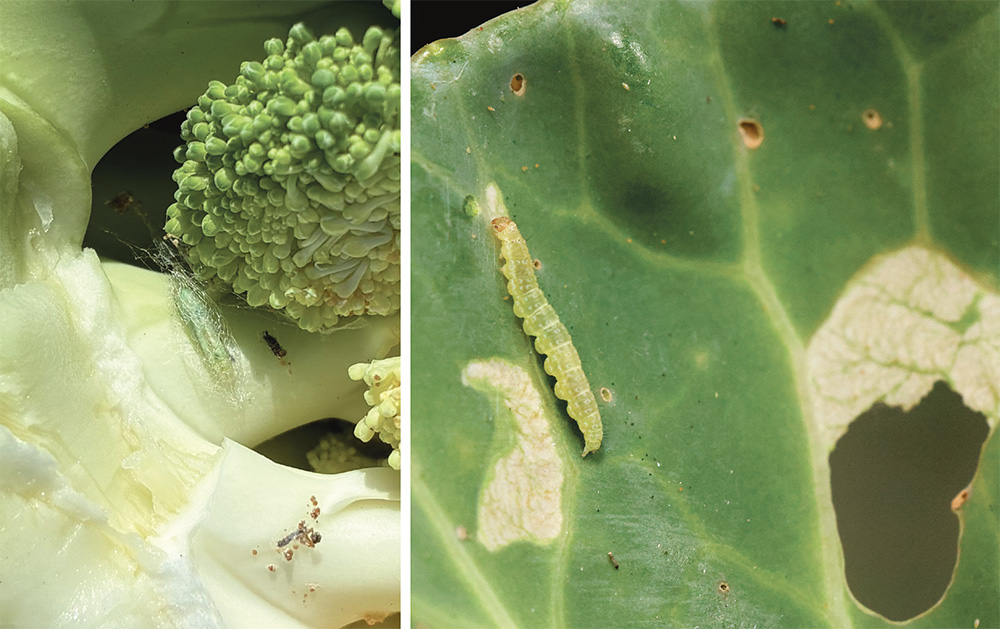
Diamondback moth larva, left, infests a broccoli plant in a Central Coast field. At right, a diamondback moth caterpillar chews holes on leaves, feeds at young plants’ growing points, and eats floral stalks and flower buds of brassica crops. Some growers in 2025 were forced to destroy their crops at harvest because infestations made them unmarketable.
Photos/Courtesy of Ian Grettenberger/University of California, Davis



By Tim Hearden
Broccoli and other brassica growers along California’s Central Coast are bracing for another devastating season of infestations of the diamondback moth, but state regulators appear in no hurry to approve a new federally registered insecticide that could alleviate the damage.
The moth’s larvae bore into developing crops, causing significant losses and soaring rejection rates. Escalating pressure from the insect has led to rising production expenses that can cost growers up to tens of thousands of dollars per acre, according to a recent industry report.
The pest has developed increased resistance to the suite of chemical treatments available to growers. Help could be on the way in the form of isocycloseram, a novel, broad-spectrum insecticide marketed as Plinazolin by Syngenta. The product was registered by the U.S. Environmental Protection Agency last fall and can be used in most states.
But the treatment remains under review by the California Department of Pesticide Regulation, whose spokesman, Juvenio Guerra, offered no specific timeline as to when the review will be complete.
“We have suggested several times to DPR that they need to move on this quickly because the pest is spreading,” said Norm Groot, executive director of Monterey County Farm Bureau. “But California has another process, and we’ve been told it isn’t going to be a quick process.”
Guerra said DPR conducts “a thorough scientific review” of new pesticides that includes evaluating the active ingredients and full product formulations to understand how long the chemicals remain in the environment and how they break down.
The review also considers potential risks to human health and the environment based on specific properties, including toxicity, he said in an email.
“DPR’s review is independent of U.S. EPA’s process and is tailored to California’s specific environmental conditions,” Guerra said, adding the length of review varies.
Diamondback moth larvae damage crops by eating small holes on the leaves, feeding at the growing points of young plants, and chewing floral stalks and flower buds, according to the University of California.
In extreme cases, fields are prepped and farmed for weeks or months only to be disked under when pest pressure overwhelms available control options. Even when total field loss is avoided, the extensive damage can render a crop economically nonviable.
During harvest, what looks to be a perfectly clean head could have a larva inside, said Dylan Beal, a UC Cooperative Extension entomology adviser for Monterey, Santa Cruz and San Benito counties.
“If you look at last year, there’s fields that did not get harvested because of diamondback,” said Mark Mason, agriculture operations manager and pest control adviser at Nature’s Reward in Salinas. “Luckily, it wasn’t us, but there are other growers who did not harvest anything.”
The severity of the damage depends on the time of year, he added. Fields harvested in March tend to fare better.
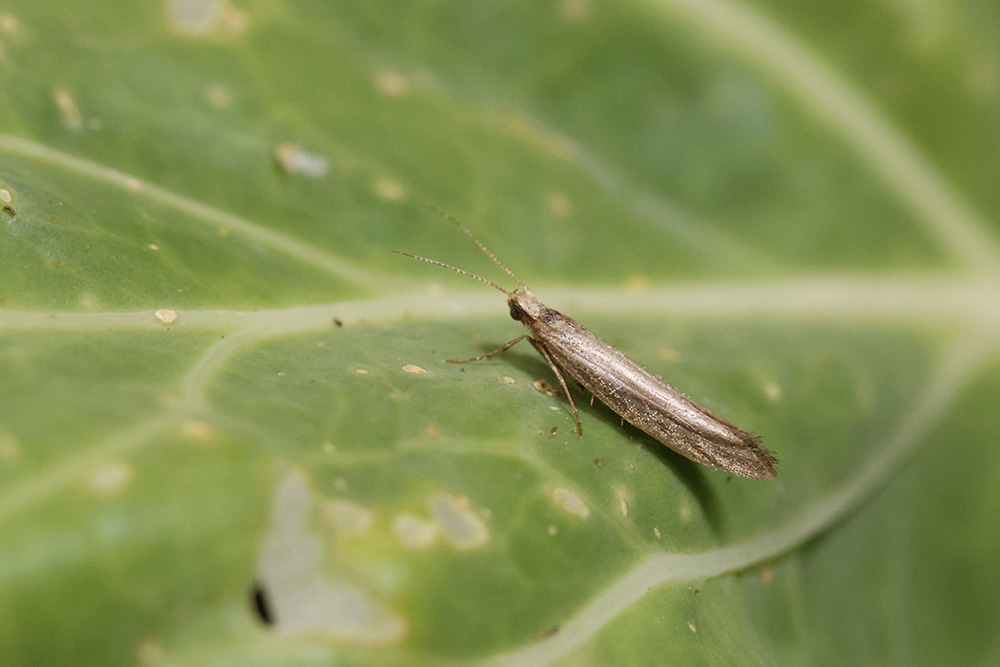
Photo/Courtesy of Ian Grettenberger/University of California, Davis
“But when you harvest in August, that’s when we’re getting smoked,” Mason said. “We’re losing 100% on some fields.”
The infestations aren’t specific to broccoli. Other brassica crops, including cauliflower, Brussels sprouts and cabbage, also are hit, said Ryan Kelly, a Salinas Valley grower and Monterey County Farm Bureau board member.
Cold winter temperatures can neutralize the pest. But Kelly noted this past winter was mild, so it never broke the pest’s life cycle. Then came the unseasonably warm temperatures in February.
“That fired things up much earlier than we normally see,” he said.
In more typical years, growers begin to see foliar damage in the spring, which doesn’t necessarily indicate crop loss, Kelly said. It’s not until late June that infestation levels become high enough to cause financial harm.
Last year, however, the pest showed up in mid-May, with growers observing moth damage surpassing acceptable economic thresholds. By the end of last June, many growers had already lost 20% to 30% of their crops, Kelly said.
Pest damage so far this season doesn’t appear to have reached the levels seen last year, Kelly noted, adding, “hopefully, it stays that way, but we’ll see.”
Growers already have at their disposal a variety of chemical, cultural and biological control methods against the diamondback moth. But the pest has developed resistance to numerous insecticides with different modes of action, forcing farmers to apply sprays more often, significantly driving up costs.
According to a December report by UC Davis and the California Department of Food and Agriculture, broccoli and cauliflower in Monterey County and Brussels sprouts in Ventura County experienced the largest percentage increases in insecticide use in 2024, leading to management cost increases of more than 70% over the previous year in some areas.
In contrast, Brussels sprouts in Monterey County, cabbage in Ventura County, and broccoli and cauliflower in San Luis Obispo County showed relatively minor changes during the same period, suggesting localized differences in pest dynamics, management practices and resistance intensity, the report said.
In making treatment decisions, UC advises growers to sample their fields for caterpillars twice a week during the seedling stage or right after transplanting, at thinning and just before heading.
It’s important to rotate insecticide modes of action to manage diamondback moth and avoid applying more than two insecticides with the same mode of action within a 10- to 14-day period, the university said.
Growers and researchers say Plinazolin isn’t a silver bullet. But it has been effective in Arizona and Mexico, where Kelly is using it.
“It works very well, but it’s like a lot of other crop protection materials: You have to use it sparingly and in a rotational program,” he said. “It’s part of an insect control program along with different types of chemistries and control methods.”
Plinazolin’s lack of availability in California puts the Salinas Valley at a distinct competitive disadvantage, growers say.
“We’ve got neighbors in Yuma (Arizona)or whoever the other states are, and they have a big advantage over us because of regulation,” Mason said. “Really, that’s what people (in California) have chosen. They want to get rid of these chemicals. We’re stuck with having to spray a little bit more, but we are at a big disadvantage.”
Tim Hearden is a reporter in Redding. He can be reached at agalert@cfbf.com.
In this edition…
• New school sawmill spurs logging interest
• H-2A rule change puts spotlight on work visa program
• Feedback needed to assess state veterinary shortage
• Nutrition program benefits growers and inmates alike
• From the Fields: Josh Barton, San Joaquin County walnut, almond and olive farmer
• From the Fields: Matt Stayer, Shasta County beekeeper and queen breeder
• From the Fields: Jerry Maltby, Colusa County rancher, feedlot operator and rice farmer
• From the Fields: Tiffany Holbrook, Sonoma County egg and poultry producer
• Growers use pressure bombs to fine-tune irrigation
• State targets sharpshooters from Costco grapevines
• Moth damage rises as growers await new insecticide
• Advocacy in Action: California Farm Bureau tackles labor, immigration and forest management
• Four farm safety priorities this National Safety Month







.svg.png)
