


New school sawmill spurs logging interest
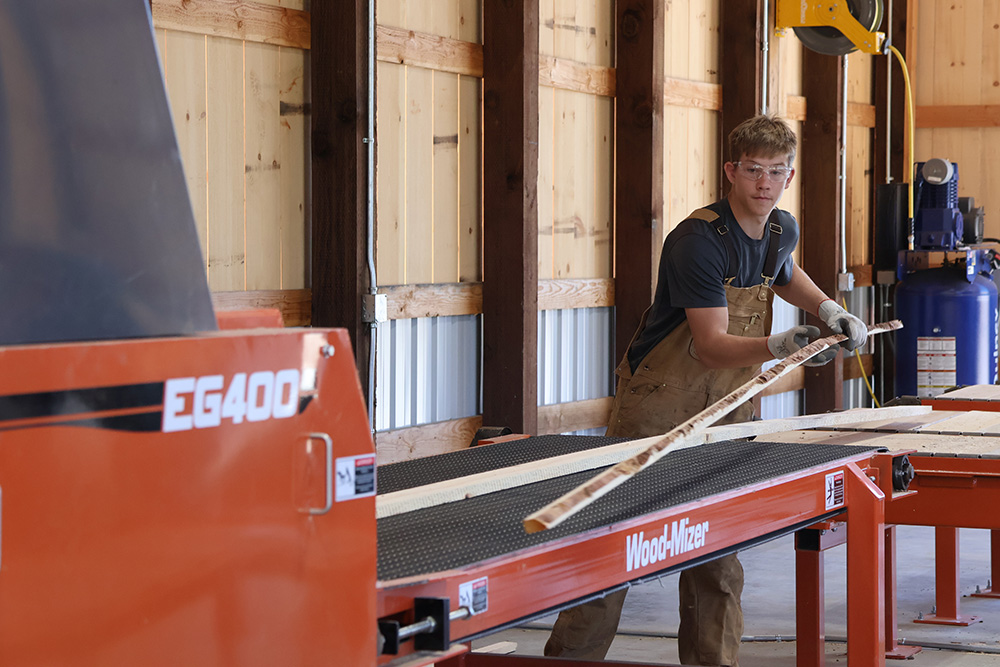
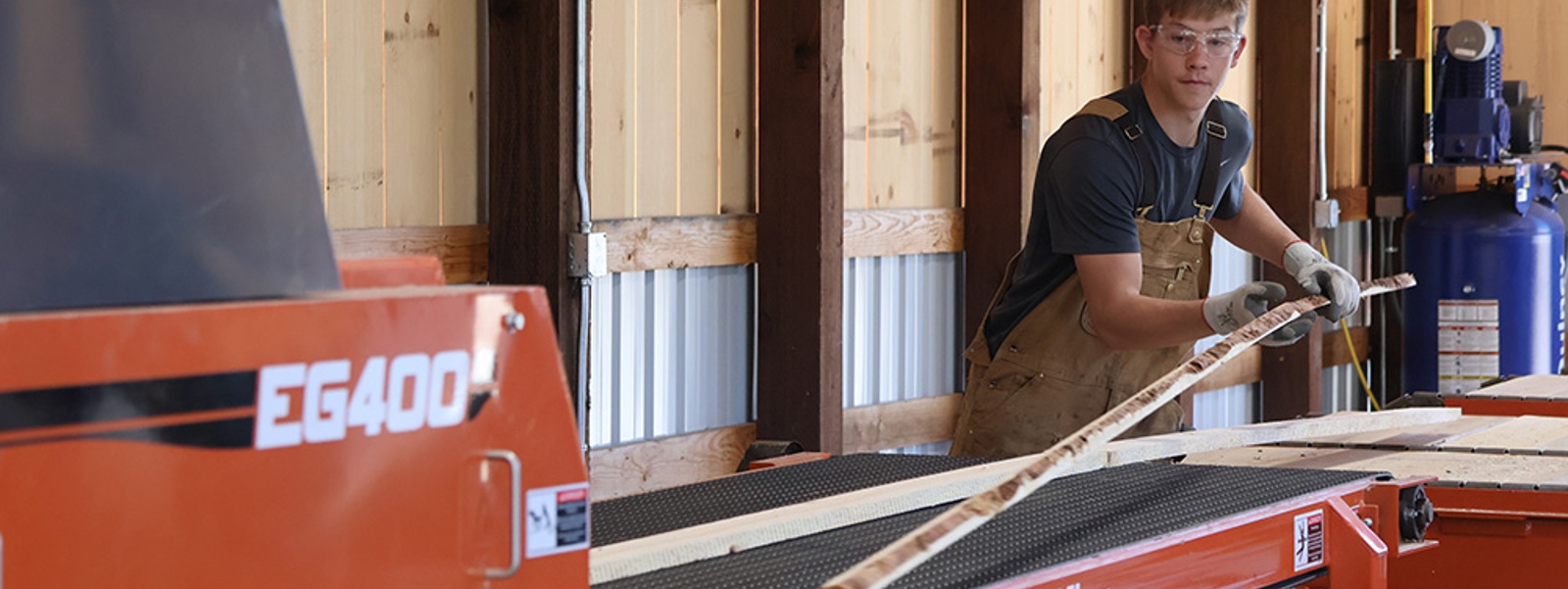
Taten Wiley, a junior at Hayfork High School in Trinity County, removes pieces of wood that have been trimmed off a plank during processing at the school’s newly constructed sawmill, which held its grand opening in May.
Photo/Manola Secaira


By Manola Secaira
Morgan Rourke has always known logging. He grew up in Hayfork, a Trinity County town historically propped up by the region’s timber trade.
His roots in the area run deep: He’s a fifth-generation rancher-farmer there and the third generation in his family to be an agricultural teacher for a high school in the county. He teaches at Hayfork High School, where he was once a student.
“My grandpa was my ag teacher here, in the same facility, and my dad was an ag teacher over the hill at Trinity High School,” Rourke said. “Now I have two of my four boys in our program.”
 Growing up, sawmills were commonplace, and many of his neighbors’ livelihoods revolved around timber. But the industry’s decline during the past few decades—driven in large part by changing environmental regulations—led many sawmills to shutter, affecting communities that had long depended on timber production. Today, only one commercial sawmill remains in Trinity County.
Yet the need for logging persists. State agencies such as Cal Fire have increasingly backed logging and forest-thinning projects as key strategies for reducing wildfire risk and improving forest health.
“There’s a lot of different treatments to make our forest healthy and resilient to fire,” Cal Fire forester Jason Butcher said. “That treatment can range from timber harvesting to fuels management to prescribed fire.”
However, Rourke said the sector still requires people who know how to do the work. That’s why he and other teachers worked to secure grants—including one from Cal Fire—that helped Hayfork High School begin construction on its own sawmill in 2024.
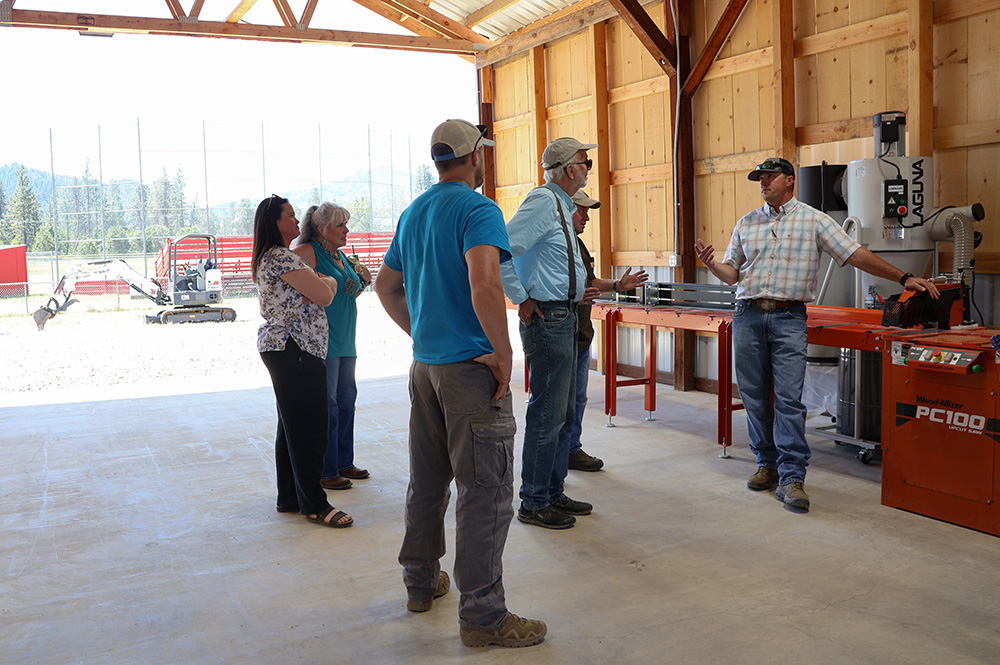
The school held a grand opening in late May for the sawmill, which is now nearly complete. Rourke’s son, Ty Rourke, a junior enrolled in the high school’s agriculture program, spoke to guests at the event.
“We have poured over 200 yards of new concrete, hooked up over a mile of electrical wiring and installed over a million dollars worth of equipment to reach this point today,” he said in a speech. “We have a bit left to go, but we are incredibly excited at what the future holds.”
Sparking interest in the field
The last two periods of the day at Hayfork High School can get loud. Students working at the school sawmill usher logs through a host of machinery that processes the wood into planks.
“We are limited on how many minutes in the day we can run, so we have a double period for that particular class,” said Noah Corp, an agricultural teacher at the school.
He described the mill as an industrial setup, allowing students to crank out about 1,000 board-feet of lumber in 90 minutes.
While it’s small—Morgan Rourke describes it as the nation’s first high school “micromill”—it still gives students a chance to be a part of each step in the lumber production process.
Trenton Thompson, another teacher at the school, said he hopes the experiences stoke much-needed interest in the forestry field.
Photo/Manola Secaira
“We’re starting to see that, potentially, some of the really important things like fire mitigation or ecosystem services are kind of falling to the wayside,” Thompson said, speaking generally about impacts of a shrinking timber sector. “And so, not only are we teaching students these technical skills, we’re teaching them why it’s important.”
Butcher, the Cal Fire forester, said the logging industry’s role in wildfire mitigation is a big reason the agency supported the project through a grant. He said the disappearance of sawmills in certain areas “leaves a hole in forest management,” creating a need for more people to carry out that work.
“You have a glut of supply and you have limited demand because there’s only so many mills that can take (logs),” Butcher said.
A new generation in logging
Ty Rourke said he knew he wanted to pursue an agriculture-related job, and the sawmill program exposed him to new possibilities.
“Even if students aren’t going to go into that industry, it’s going to give them an understanding,” he said. “It’s very important to understand where your food, where your materials, where your raw resources come from.”
Lexus Yang, a junior at the school, said she never saw herself working at a sawmill. Before moving to Hayfork, she described herself as a city girl without any real agricultural experience.
But working at the sawmill this past school year has surprised her. She’s joined two FFA groups—one for natural resources and another for forestry—and it’s given her new ideas for her future.
“I’ve thought about being a forester lately because it’s what I’ve enjoyed,” Yang said. “It’s really giving me insight.”
Morgan Rourke said he’s already seen graduates from the school enter the field. A former student, Ren Winters, now works as a forester for Trinity River Lumber Co. in Weaverville, the county’s last commercial mill. He initially worked as a firefighter for the U.S. Forest Service, an experience that influenced his decision to change course.
Though fighting fires “is a great position,” he said, “I felt like it was putting a Band-Aid on a problem.
“I felt motivated to try to help prevent the forest fires that have been occurring,” he added.
As a forester, Winters makes management decisions for timberlands, including determining when and how to conduct vegetation management and fuel pile burning. He said he’s seen how that work helps prevent wildfires, which is why he’s excited about the school’s sawmill.
“It’s important to support logging through projects like this because our forests don’t stop growing,” Winters said. “We have not been good stewards of our public lands for decades, and programs like this will ensure a workforce for the future.”
Manola Secaira is a staff writer for Ag Alert. She can be contacted at msecaira@cfbf.com.
In this edition…
• New school sawmill spurs logging interest
• H-2A rule change puts spotlight on work visa program
• Feedback needed to assess state veterinary shortage
• Nutrition program benefits growers and inmates alike
• From the Fields: Josh Barton, San Joaquin County walnut, almond and olive farmer
• From the Fields: Matt Stayer, Shasta County beekeeper and queen breeder
• From the Fields: Jerry Maltby, Colusa County rancher, feedlot operator and rice farmer
• From the Fields: Tiffany Holbrook, Sonoma County egg and poultry producer
• Growers use pressure bombs to fine-tune irrigation
• State targets sharpshooters from Costco grapevines
• Moth damage rises as growers await new insecticide
• Advocacy in Action: California Farm Bureau tackles labor, immigration and forest management
• Four farm safety priorities this National Safety Month







.svg.png)
