


Vineyards turn to UV-C light to fight powdery mildew
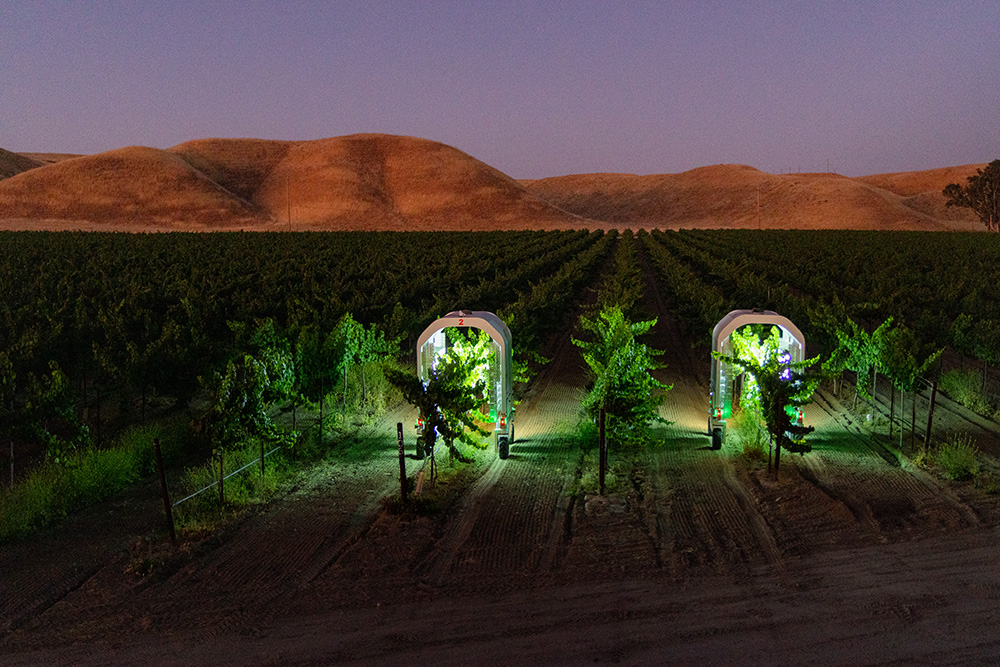
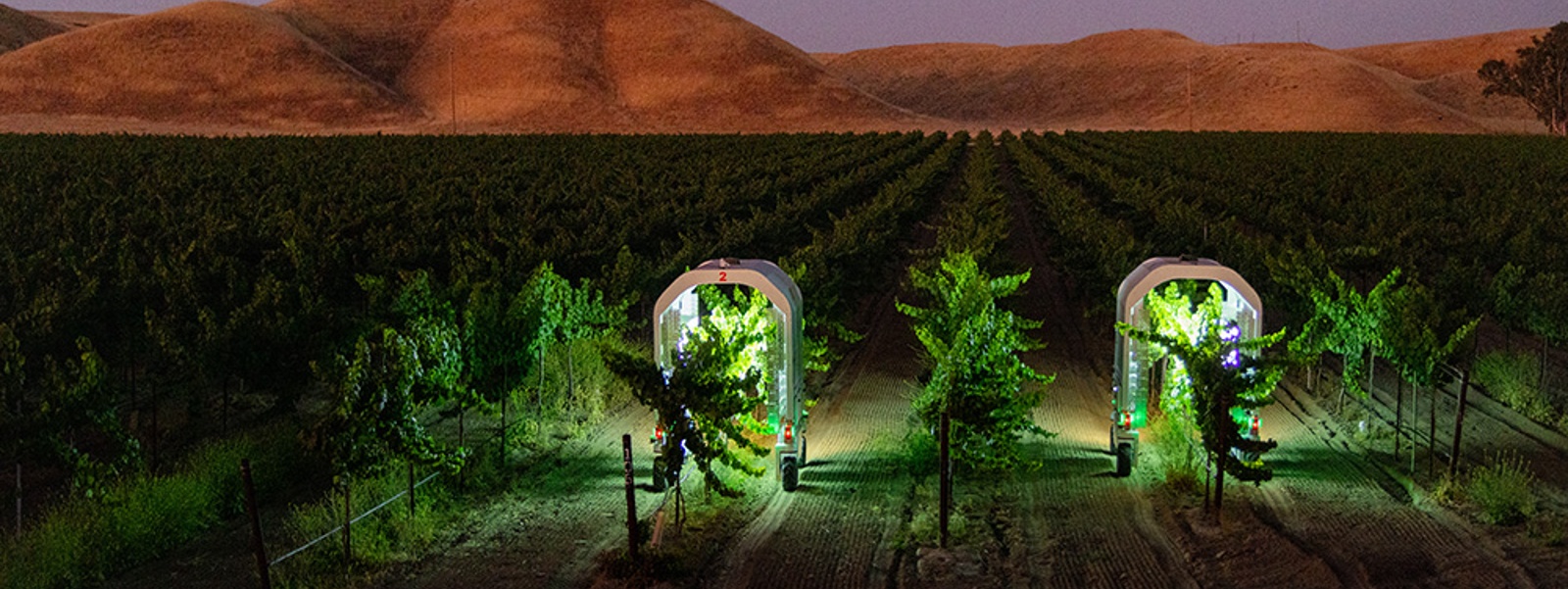
A Thorvald autonomous robot applies ultraviolet-C light to grapevines at night. Winegrape growers increasingly look to the nonchemical disinfection systems to manage powdery mildew in vineyards.
Photo/Jason Henry


By Vicky Boyd
Nonchemical, ultraviolet disinfection systems originally designed for industrial and medical uses have begun to take root in winegrape vineyards to manage powdery mildew.
Norway-based Saga Robotics introduced its Thorvald autonomous ultraviolet-C light-application robot to Central Coast winegrapes three years ago. This season, the company expanded to the North Coast and treated about 2,600 acres statewide, said Caine Thompson, Saga’s general manager for U.S. operations based in Paso Robles.
Applied twice a week at night by the robotic platform, the 254-nanometer low-dose UV-C light disrupts the powdery mildew’s DNA without damaging plant tissue. If the application is made during daylight, the fungal organism can harness blue light from the sun to make a damage-repairing enzyme.
By applying the UV-C to grapevines and fruit at night and allowing three to four hours of post-treatment darkness, the organism can’t repair the damage and dies.
Norm Peters, director of vineyard operations for Oakville-based Silver Oak, said he was attracted to the system because it met the company’s sustainability priorities of putting people first and producing quality vines and wines.
Before using it this spring, Peters researched the Saga system and talked to Central Coast colleagues who had used it the past two seasons. In 2026, Silver Oak tested two Thorvald robots in a 10- to 11-acre pinot noir block near Philo and two in a similar sized block of sauvignon blanc near Oakville.
Silver Oak made an initial fungicide application in April because of a delay getting started with the robots. It then continued with UV-C applications every four days for three months through veraison, or when grapes begin to ripen, in July.
In the sauvignon blanc block, Peters said he also tested the UV-C against botrytis bunch rot by continuing to apply it to half the vines after veraison until three to four days before harvest. In a high-pressure disease year such as 2026, Peters said he was impressed by the cleanliness of the fruit.
“It’s nice when you try something and trial it and it does what it’s supposed to do,” he said. Silver Oak’s winemaker is fermenting the fruit and will determine whether the light treatments affected wine quality, and if so, how.
Silver Oak normally sprays at night, so Peters said making the transition to robots didn’t affect scheduling. One supervisor at each site was trained on the technology and oversaw each robot pair.
“Over the last 10 years with all of the technology, some crew members have been wary,” he said. “In this particular situation, you come in and train somebody how to use the iPad, and it was really empowering.”
Calling powdery mildew one of their biggest pest concerns, Joseph Brinkley, senior director of regenerative organic farming for Bonterra Organic Estates in Hopland, said the farm is always looking for ways to continue innovating, and the UV-C technology fit the bill. The Mendocino County certified organic winegrape producer also seeks practices that mesh with its regenerative philosophies.
This season, it tested six UV-C light robots on about 200 acres of chardonnay by the Russian River because the grape is one of the most mildew-susceptible varieties, and the environment is conducive to mildew.
Photo/Jason Henry
Bonterra’s typical mildew program consists of oil applications every 10 to 14 days beginning a few days after budbreak in April. Depending on the season and mildew pressure, the vineyard may also rotate with wettable or dusting sulfur until the berries reach about 13 degrees brix, or sugar content, sometime in July. After that time, the fruit doesn’t appear susceptible to mildew.
This year in the test blocks, the vineyard was sprayed early in the season because of delays getting the machines deployed. It then continued with twice-a-week UV-C applications until veraison. Brinkley said he was “pleasantly surprised” by the results. The blocks treated with UV-C had as good as or better mildew control than the blocks in which oil and sulfur were used.
“This was such a challenging year for mildew,” he said. “This was one of the hardest mildew years that I can recall.”
After using UV-C light to successfully treat fungal diseases in United Kingdom strawberries, Saga Robotics partnered with Cornell University’s AgriTech branch in 2020 to develop a commercial autonomous UV-C system for winegrapes.
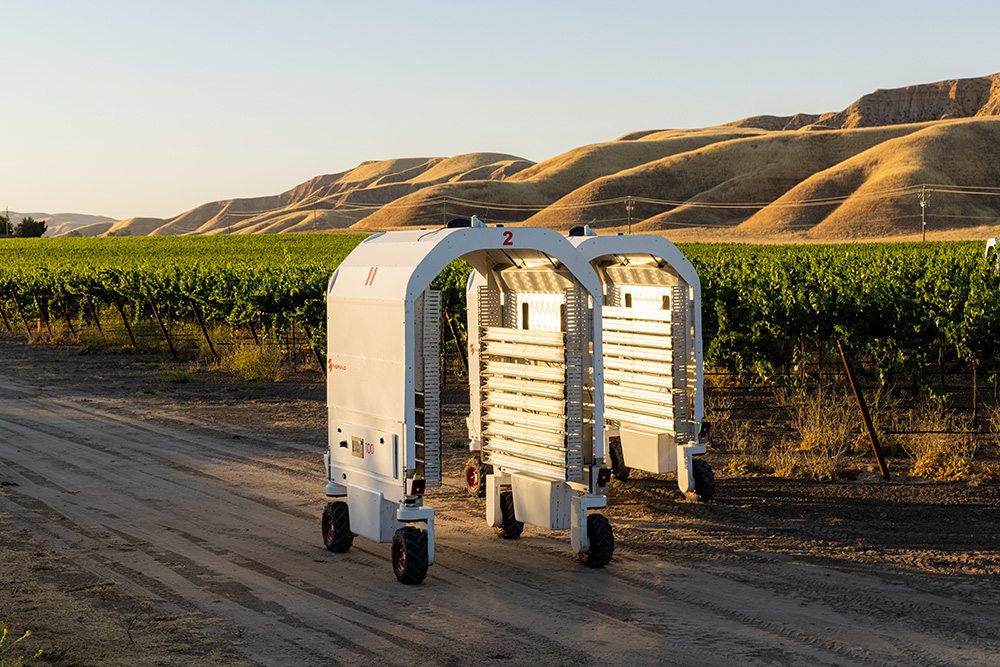
The battery-powered Thorvald robot consists of a horse-shoe-shaped array of UV-C lights, which envelop the sides and tops of vines with light. It can run all night on one charge.
Using sub-inch accurate real-time kinematic GPS, Saga first maps the vineyard, including vine posts, vine spacing and other obstacles, to create what Thompson described as a digital robot highway. The platform can handle rows from 3 to 10 feet wide and most trellis systems with crossarms up to 30 inches.
Over the years, researchers have gained an understanding of how UV-C works on grapevine powdery mildew, said Michelle Moyers, a Washington State University professor and viticulture specialist.
What she and fellow researchers at the U.S. Department of Agriculture and Oregon State University hope to determine with current field trials is how to best use the technology under local growing conditions.
For example, the Prosser Irrigated Agriculture Research and Extension Center where Moyers is based is on Washington’s hot, arid eastern side and has relatively low grape disease pressure. On the other hand, Oregon’s Willamette Valley, where USDA and Oregon State University are conducting trials, has more moderate temperatures and higher humidity that promote powdery mildew.
Since 2020, Moyers and her WSU group have compared a typical chemical fungicide program to applying UV-C light every other week, once per week and twice per week. UV-C light is a contact treatment, leaving no residue. As such, good coverage and having a direct line of sight to the target are king, Moyers said.
After the 2022 season, the WSU researchers added leaf removal to their trials based on their results. The researchers want to determine whether it aids control by enhancing light contact on fruit and leaves much like it does with conventional fungicide applications.
Both Brinkley and Peters said they already pull leaves to increase air flow and improve fungicide spray deposition, so they didn’t have to change for the UV-C light applications.
For producers who want to try the Thorvald system, Thompson recommended they start with a small block and one robot “because you’re changing a lot. You’re moving away from a tractor driver and chemicals to light.”
Vicky Boyd is a reporter in Modesto. She can be reached at agalert@cfbf.com.
Reprint with credit to California Farm Bureau. For image use, email agalert@cfbf.com.

In this edition…
• View full issue
• 2026 Voter Guide
• Advocacy in Action: Legislation, diesel and wolves
• Roadless Rule has kept forests from being managed
• Farm Bureau team seeks solutions in D.C.
• Diesel price spike increases financial stress for farmers
• New date crop hits market as fruit goes 'mainstream'
• From the Fields: Ray Yeung, Yolo County farmer
• From the Fields: Joe Zanger, San Benito County farmer
• From the Fields: Blake Wilbur, Tulare County farmer
• From the Fields: Paul Vermeulen, Stanislaus County almond grower and huller
• Vineyards turn to UV-C light to fight powdery mildew
• Pumpkin growers target trends, Halloween demand
• Calls open for Agricultural Educator of the Year award
• How to effectively manage stored grain fire risks





.svg.png)
