


Farm Bureau team seeks solutions in D.C.
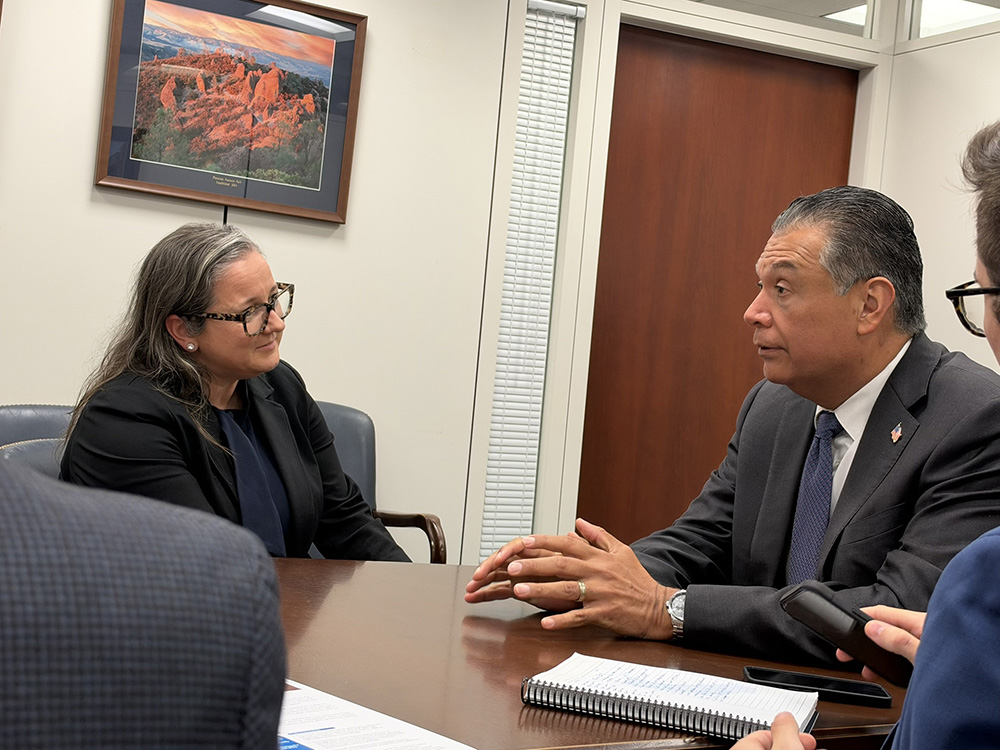
California Farm Bureau President Shannon Douglass, left, speaks with U.S. Sen. Alex Padilla, D-Calif., last month in Washington, D.C. A delegation of more than a dozen Farm Bureau members, staff and executives traveled to the nation’s capital to advocate on issues that affect agriculture.
Photo/Isabella Quinonez


By Caleb Hampton
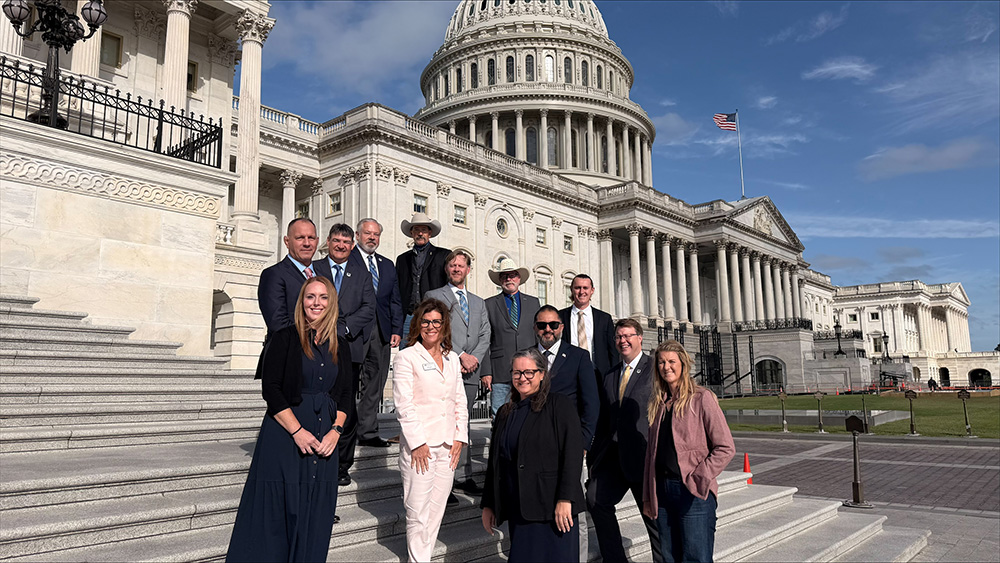
A California Farm Bureau delegation that included more than a dozen of the organization’s members, staff and executives traveled to Washington, D.C., last month to advocate on issues affecting farmers and ranchers.
Among the group’s priorities were discussions around passing a new farm bill and policies related to endangered species and the farm workforce.
“It makes all the difference when lawmakers can hear directly from farmers and ranchers about the challenges they face and the real-world impacts of policy decisions,” California Farm Bureau President Shannon Douglass said. “Our members were able to share specific examples of how they’ve been affected by rising production costs, trade conflicts, labor shortages and other headwinds that have made the current farming environment one of the most difficult in decades.”
The Sept. 21-24 trip included meetings with U.S. Sens. Adam Schiff and Alex Padilla, Reps. James Gallagher, Jimmy Panetta and Mike Thompson, all of whom are California lawmakers, as well as officials and staff at multiple federal departments, congressional offices and Washington, D.C.-based institutions.
In a meeting with officials from the U.S. Fish and Wildlife Service, Siskiyou County rancher Jeff Fowle spoke about the toll the growing presence of gray wolves in California has taken on livestock producers during the past few years.
Last year, California confirmed 196 livestock were killed by wolves, a dramatic increase over previous years. The apex predator is protected by state and federal Endangered Species Act laws, limiting the tools that ranchers can use against them to protect their livestock.
“The wolves that we’re having problems with have no fear. They haven’t been threatened by anything for years,” said Fowle, who raises sheep and beef cattle. “They’re very bold and brazen.”
Last month, President Donald Trump signed an executive order directing the secretary of the U.S. Department of the Interior to determine whether the gray wolf has met the recovery criteria to be delisted or downlisted under the federal ESA, and if so, to begin that process.
While gray wolves in California would still be protected under state law, Fowle said he was hopeful that federal delisting of the species would “serve as encouragement” for state officials to move in the same direction.
Fowle said the federal government could also assist ranchers impacted by wolves by funding more California-based federal trappers.
When livestock are killed by wolves, ranchers can receive compensation if a federal trapper or state biologist confirms the depredation was caused by a wolf. But Fowle said with so many depredations and only two trappers stationed in Siskiyou County, by the time the right person arrives, “often the evidence is already gone.” As a result, he said, ranchers miss out on compensation, and the magnitude of livestock loss caused by wolves is underreported.
A top priority of the Farm Bureau delegation was advocating for passage of a new farm bill. The last farm bill was enacted in 2018 and expired in 2023. Congress then extended that farm bill multiple times before it again expired Sept. 30, leaving farmers and ranchers uncertain about the future of federal programs.
Erin Huston, federal policy consultant for the California Farm Bureau, said the “main sticking point” impeding passage of a bipartisan farm bill continued to be an impasse between Democrats and Republicans around changes to the Supplemental Nutrition Assistance Program, which has historically been addressed in the farm bill alongside agricultural policies and programs.
Photo/Isabella Quinonez
Huston said lapsed farm bill programs were unlikely to be affected before the end of the calendar year.
“We are hopeful that in the lame-duck period after the midterm elections that Congress will come back and prioritize the passage of a compromise farm bill,” she said.
Last year, the Trump administration included some items historically addressed in the farm bill in its One Big Beautiful Bill Act, a major reconciliation package, but other farm bill items were left out.
Critical for California farmers is the expansion of federally backed crop insurance and risk management tools to more specialty crops. Currently, less than a quarter of the roughly 400 commodities produced in the state are covered by direct crop insurance programs, leaving farmers to operate with a limited safety net.
“Crop insurance for specialty crop growers is just typically not as robust as it is for historical program crops,” Huston said. “The longer we delay the farm bill, the longer we’re delaying these important risk management tools.”
The Farm Bureau delegation also advocated for reforms to the H-2A visa program, which allows foreign nationals to work on U.S. farms on a temporary, seasonal basis.
Earlier this year, a bipartisan bill reforming the agricultural guestworker program was introduced in the U.S. House of Representatives. The Securing Agriculture’s Workforce Act would make several changes to the H-2A program, including making it more affordable for employers and expanding the program to include nonseasonal sectors such as dairies.
“It makes it a lot more available to a lot more different types of agricultural employers,” said Bryan Little, senior director of policy advocacy for the California Farm Bureau. “That’s a real important step forward.”
Fowle said he was encouraged by the willingness of lawmakers, officials and legislative staff—regardless of their political affiliation—to listen and engage with the challenges farmers face.
“Despite the strong partisanship that exists there and the interviews we see on the various networks, in one-on-one meetings I heard some positive things,” he said. “I came home cautiously optimistic.”
Caleb Hampton is an editor at Ag Alert. He can be reached at champton@cfbf.com.
Reprint with credit to California Farm Bureau. For image use, email agalert@cfbf.com.

In this edition…
• View full issue
• 2026 Voter Guide
• Advocacy in Action: Legislation, diesel and wolves
• Roadless Rule has kept forests from being managed
• Farm Bureau team seeks solutions in D.C.
• Diesel price spike increases financial stress for farmers
• New date crop hits market as fruit goes 'mainstream'
• From the Fields: Ray Yeung, Yolo County farmer
• From the Fields: Joe Zanger, San Benito County farmer
• From the Fields: Blake Wilbur, Tulare County farmer
• From the Fields: Paul Vermeulen, Stanislaus County almond grower and huller
• Vineyards turn to UV-C light to fight powdery mildew
• Pumpkin growers target trends, Halloween demand
• Calls open for Agricultural Educator of the Year award
• How to effectively manage stored grain fire risks





.svg.png)
