


Former dairy vet looks to improve welfare on farms
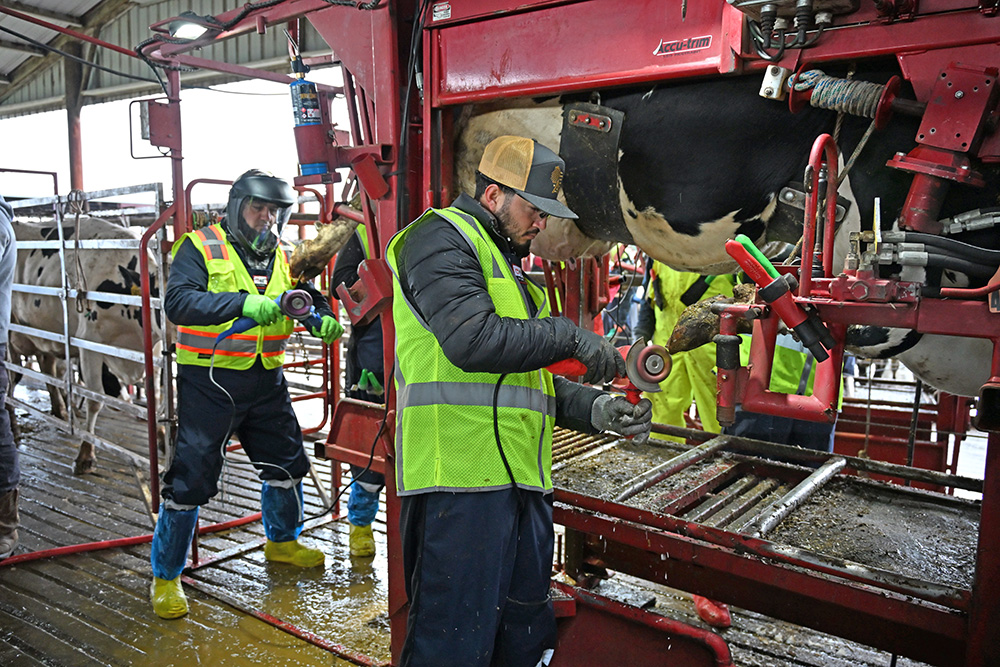
Two participants of Kinder Ground’s Hoof Care Academy practice their skills at a dairy in Escalon.
Photo/Courtesy of Jen Walker


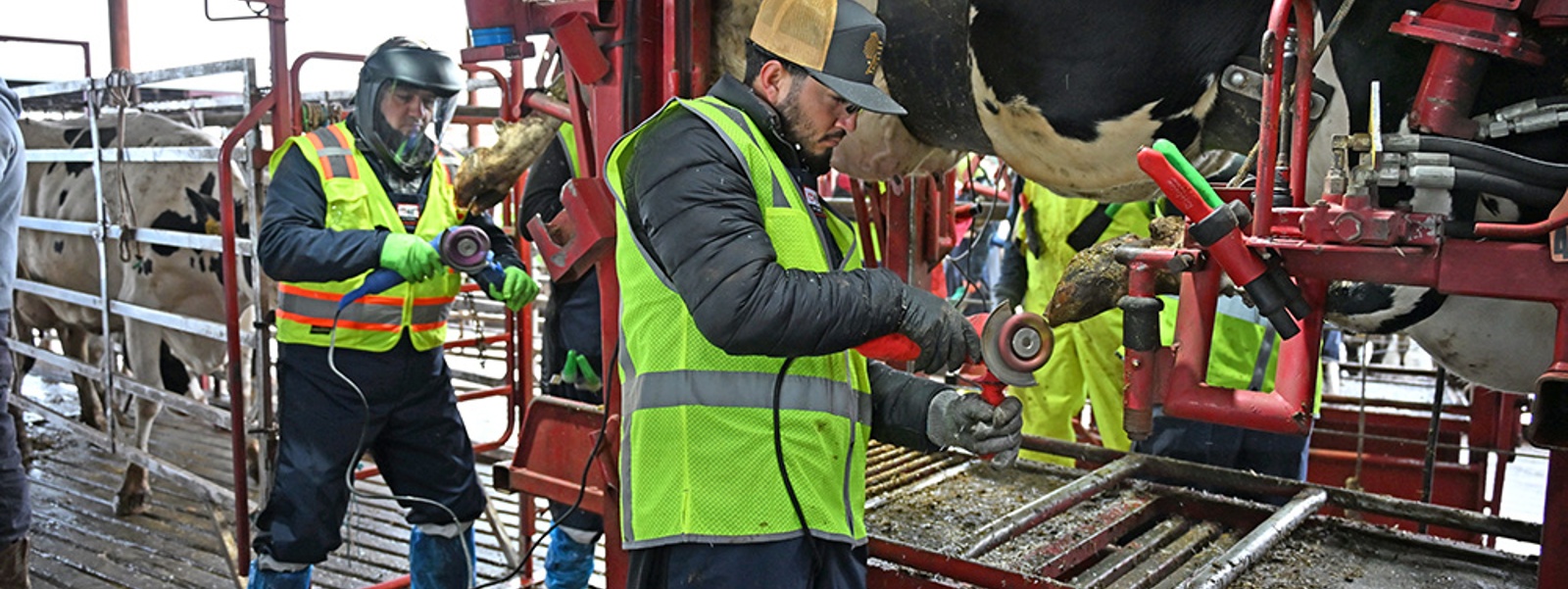
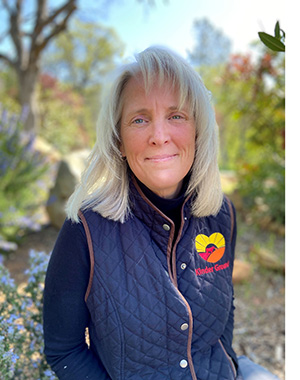
Jen Walker is chief animal welfare officer of Tennessee-based Kinder Ground, which she co-founded in 2022 with Cassandra Tucker, director of the University of California, Davis, Center for Animal Welfare. The nonprofit offers grants and expertise to farmers looking to learn more about animal welfare and how to improve efforts on their farms. A former dairy veterinarian, Walker also worked for food companies, including Danone, where she focused on animal welfare and milk quality. Ag Alert® spoke with her about Kinder Ground and her mission to make welfare improvements more accessible. The interview has been edited for length and clarity.
What kind of projects does Kinder Ground focus on?
It’s very broad. We work with commercial farms who are in the business of raising animals for food at a commercial scale. The idea is for farmers to come to us with ideas. We really like projects that elevate welfare beyond those basics. Sometimes it’s seeing the simplest of opportunities. That’s where I think relationships are important. What we have found is if a farmer can have somebody go in on it with him or her, it’s much easier to take a risk.
But it does range—everything from training and education, travel grants for students studying welfare, somebody who wanted to try giving pigs brushes to jackets on calves to equipment for sheep and goats. That’s because welfare is so broad. So many things impact animals’ welfare.
How do you think of animal welfare in the work you do?
I think of welfare in three basic buckets: Be nice. Things should not suffer. Things that need help should be helped. Then there’s the second bucket: animal health. The third bucket is thriving. It’s beyond not suffering. It’s about a life worth living.
If you don’t have good welfare, animals don’t do well, animals are sick, are injured, they don’t perform as well. That’s waste—the impact of animal welfare on waste in our system is immeasurable. If we could impact that, it would be huge.
 How do you start conversations with a farmer who’s interested in making changes?
We always think: “To fix my cow’s comfort, I need a whole new barn.” Well, we can’t do that. What can we do? A lot of it is just understanding where we can make moves. Our projects aren’t huge. Often, those are the easiest of wins.
And to be honest, the best way to convince a farmer of something is to have them talk to another farmer. They can see another farmer do it. That’s where we’re trying to connect and build a community of farmers.
How did those efforts go?
We’ve done farmer dinners up in Canada where we’ve brought farmers together that are experimenting with pig brushes to share their experience with other farmers, and now we got all kinds of farmers interested in experimenting with pig brushes. We did the Sheep and Goat Stockmanship Field Day at UC Davis. As much as it was showing the equipment and the resources to folks, a lot of it was just about bringing folks together so that they could start talking about it.
The handling system for the goats that we displayed on the stockmanship day, the (farmer using it said they) processed goats in half the time it usually takes. We did a goat handling project in Utah and (that farmer) had the same feedback. She’s like, “Oh my gosh, this was so much easier, so much less stressful on the goats, and we could get it all done and a game changer for how we manage our day.” They save time.
We’ve invested a lot in hoof trimming training. The folks that have sent their employees or professional trimmers that have come (to a training) do their job better. The dairymen see the results in better trimming and getting the hoof health issues corrected sooner.
California farmers must consider extreme heat when thinking of their livestock’s welfare. What tools might be of particular interest to farmers facing this issue?
To be honest, at the moment, the technology I think of that is ready for prime time and useful is nothing fancy. Checking the airflow and airspeed of your fans to make sure you are getting adequate airflow over the stalls and that there are no dead air spaces (is important.) And don’t forget calves, making sure you have good ventilation and shade for calves, even over calf hutches, and shade for all age groups outside.
I think better technology is coming to help cool fans with water that helps minimize water use and waste, and other technologies to help find lame cows, but I don’t think they are ready for primetime.
Are there any new tools or approaches to animal welfare that you’re generally excited about?
The grant we did with the Humane Handling Institute, where we funded their cattle-vision goggles—that’s a game changer.
It’s a computer program that takes input from a camera and digests it, and puts it up in virtual reality goggles so that what you’re seeing is what we think cows would see. It provides a much broader peripheral vision. It changes the colors, because cows don’t have the same rods and cones that we have in our eyes, so they see a different color spectrum. The way their pupils dilate, they don’t dilate quite so fast, and it takes some longer to adjust to the light changes. The way their eyes are positioned on their head, they don’t have great depth perception.
I’d love to see where that’s going and highlight where we can use that technology more. I think every vet school should have it.
I talk about brushes a lot. There’s not an animal in the world that doesn’t like to scratch. Sometimes, it’s because you have an itch, and sometimes it’s just comfortable, right? I really do think that giving animals that opportunity on the farm is essential, and I also think it does provide that moment where the farmer gets to see their animals enjoying something. It’s just a subtle reminder that they enjoy something.
The brushes come in all forms, shapes and sizes. Some are stationary. Some you can secure to a wall or a gate. Just imagine a big, back scratcher, cow size.
We haven’t used them on pigs before because everybody told me pigs would just eat them and ruin them. It turns out not so much. They do ruin some, but now, we’re experimenting with pigs to see which brushes work, which don’t, where to put them.
We have a lot to learn when it comes to brushes and pigs. We’re doing some fun projects trying to figure that out and supporting a project at the Prairie Swine Centre in Saskatchewan. So, those are my two favorite ones. They crack the door open to seeing our animals in a different way.

In this issue...
- Experts seek methane-cutting solutions
- California cherry crops decimated by spring storms
- Agricultural 'roadmap' to guide research priorities
- Why rocket scientists began counting nuts in California
- Advocacy in Action: Wolf rule repeal, safety rules and bird flu tests
- Farms increasingly use drones for aerial applications
- How should walnut husk fly be managed this season?
- Production forecast shows drop in several state crops
- Former dairy vet looks to improve welfare on farms
- How AI is transforming weather forecasting





.svg.png)
