


Experts seek methane-cutting solutions
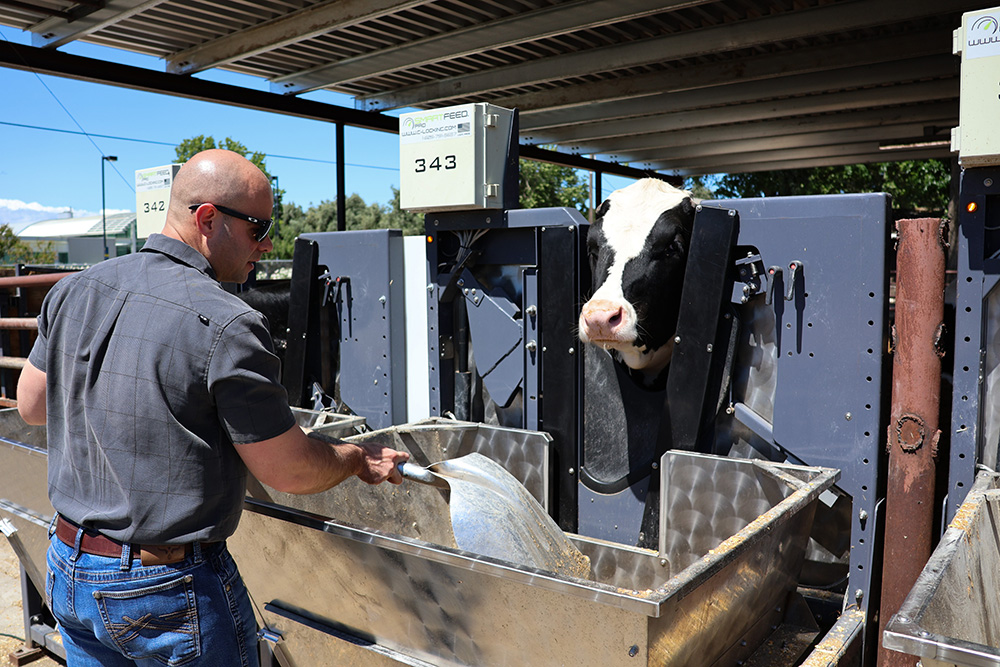
University of California, Davis, postdoctoral scholar Paulo de Meo Filho stirs the feed of a test steer. Steers housed at the UC Davis feedlot eat the feed as part of a study looking to better understand how a compound extracted from red seaweed reduces methane output from cattle.
Photo/Manola Secaira


By Manola Secaira
It doesn’t take much to get a steer’s attention. When Paulo de Meo Filho wants them to eat, all he has to do is stir their feed and they’ll trot over for a few bites.
Getting the steers to eat is important because he’s trying to study the impact of diet on the animals’ methane emissions. As the day-to-day operations lead for the research, De Meo Filho has spent months carefully measuring and monitoring the feed eaten by the research steers, housed at a University of California, Davis, feedlot. Different bins hold different feed for the test cattle.
 “They have an electronic tag that actually unlocks the door if he’s allowed to eat that feed,” de Meo Filho, a UC Davis postdoctoral scholar, said.
Some steers eat regular feed. Others are given feed mixed with a special additive: bromoform extracted from red seaweed. UC researchers and others have spent years studying the compound, which is known to reduce methane output in cattle.
Every couple weeks, de Meo Filho documents exactly how much methane is belched by each steer, aided by a tool that can detect how much is in their breaths. He also takes monthly samples from the rumens of the cattle to send to a lab for further analysis.
Some of the steers are fed the additive during their entire time in the feedlot after they turn 65 days old. The rest receive it for only the first three months.
UC Davis professor of animal science Ermias Kebreab, who leads the research, said comparing the two feeding schedules will help his team determine exactly how much bromoform additive to administer and at what stage of the animal’s development. It’ll also inform their work to find a permanent solution—a goal Kebreab said he hopes can be achieved through gene editing.
“This is all for us to get an understanding of the microbiome development throughout the life of those animals,” he said. “When we do the editing, we can think of… do they need to be at the beginning of life or at the end, or anywhere in the middle?”
Addressing both ends of the problem
It’s common knowledge that cattle produce methane. The California Air Resources Board reports that the dairy and livestock sectors generate more than half the state’s methane emissions.
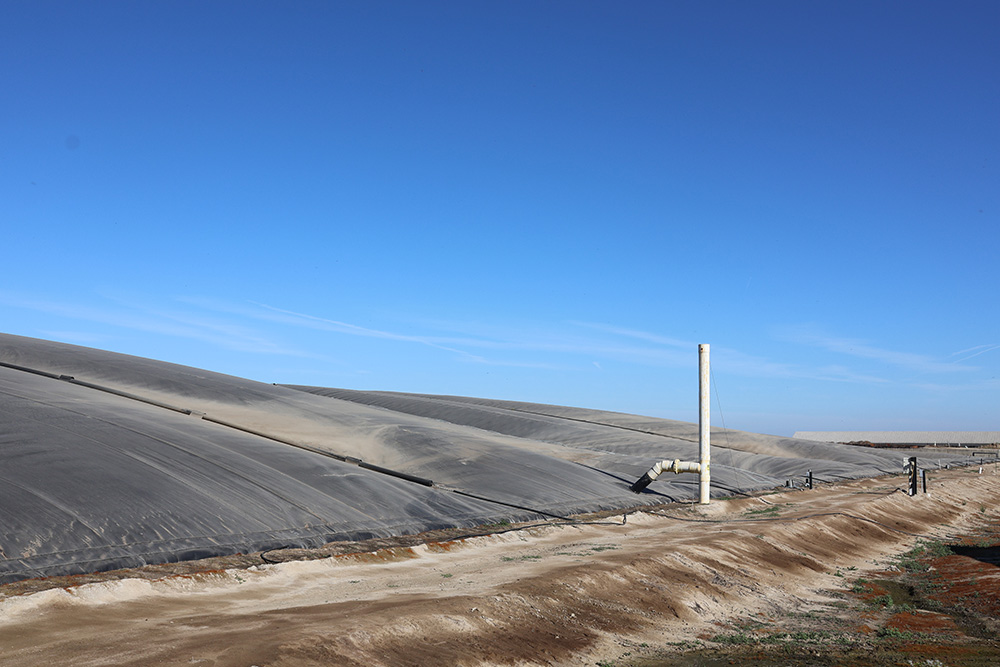
But methane from cattle comes from different sources. Methane from their manure can be handled by anaerobic digesters, which some dairy farms already use. The technology for capturing methane from a dairy’s open manure lagoon and turning it into renewable energy has developed significantly during the past decade.
Amos Ford, remote operations manager for Maas Energy Works, said his company has worked with California dairies to install digesters since 2013. Back then, there were more issues with the technology, he recalled.
“There were a lot of failed digesters, and there weren’t very many successful projects at that time,” Ford said. “Most of the community was very skeptical of them.”
He still describes digesters as “an emerging industry,” but he said they’ve improved a lot since the company’s early days. Covered-lagoon digesters—the kind Maas Energy Works employs—are now more common in California. Ford described them as simpler in design than other earlier alternatives.
“We don’t want anything too fancy and complicated,” said Dallas Spiecker, a spokesperson for Maas Energy Works. “We want to be able to work easily and to be able to maintain it and operate it ourselves.”
Producers also must manage methane coming from cow burps, also called enteric methane. Feed additives with ingredients that suppress methane production in cow rumens are a potential solution. They’re sold by companies such as Blue Ocean Barns and Elanco. This option is relatively new. Kebreab noted the first additive approved for use—Elanco’s Bovaer product—received clearance two years ago.
Despite this progress, the additives have their limitations. Kebreab said they work well on dairies, where cows are given a controlled feed source. It doesn’t work quite as well for livestock such as beef cattle that primarily graze in fields, which is a problem because beef cattle far outnumber dairy cows in the United States.
That’s why Kebreab and other researchers have been studying how to replicate the methane-reducing effect of the feed additives by using CRISPR-Cas9 gene-editing technology to alter the methane-producing microbes in cattle rumens. Kebreab said his ultimate dream is a permanent solution that doesn’t require producers to continue feeding an additive for their cattle’s entire lives.
“What we are hoping to do is introduce this once and that’s it, so the rest of their life, they will have lower emissions, so it would be easy to do in most production systems,” Kebreab said. “You don’t need to keep giving the same additive over and over again on a daily basis.”
A new generation in dairy
The creation of any tool to fight methane production is only step one. Equally important is implementing it, which requires buy-in from dairy farmers.
Producers continue to face mounting regulatory pressure as California moves to meet its pollution-cutting targets. Implementation of a 2016 law requires the state’s dairy and livestock farms to slash methane emissions by 40% from 2013 levels by 2030.
Tulare County dairy farmer Dennis Verhoeven said technologies aimed at cutting methane emissions can be a hard sell for seasoned producers.
Photo/Manola Secaira
“‘This is the way we’ve always done it’ is a thing that you hear a lot from dairymen,” he said. “You really have to be able to not just show them but prove that, hey, this is something that works.”
Verhoeven installed Davis-based BioFiltro’s worm-powered system to reduce methane emissions at his dairy about a year ago. He said the system works for his farm because it came with benefits beyond cutting methane. The system also produces water he can use for irrigation and generates a bit of profit via carbon credits and worm casings sold for compost. That was key to the technology’s success, he noted.
“You need to have a way to make a farmer be able to implement the product without them having to put a ton of money into it,” he said. “The regulations are hard to follow as is. Then to try and add another cost onto it—it’s hard to make that pencil out in finances on a dairy.”
Merced County dairy farmer Simon Vander Woude has a Maas Energy Works digester installed at his farm. The digester has been producing biogas since 2021. He said he had been looking to install a digester for years, but state-funded financial support was needed to viably get a project off the ground. Profit from selling the biogas also helps.
He said checking the digester’s operations is now a part of his everyday work.
“(We’re) in the dairy business, we’re in the beef business, we’re in the milk business, we’re in the farming business, and now we’re in the energy business,” he said.
Like Verhoeven, Vander Woude said technological solutions have to make sense for a farmer’s bottom line.
“Sustainability always has to start with financial sustainability,” he said.
Kebreab said while state incentives are effective for initiating change, permanent success requires solutions that endure beyond financial support.
“It’s not sustainable in the long term,” he said of the incentives. “We have to have a solution that improves productivity or that’s demonstrably affordable that farmers can integrate (it) in their system.”
Kebreab said that’s why it’s important that the solution he’s developing has other potential benefits so that it becomes an easy choice for producers. He noted early research shows red seaweed additives could help livestock productivity. He’s also looking into the possibility that changes made through gene editing could pass from mother to calf, providing an even longer-lasting impact.
Verhoeven said newer people entering the dairy business may also help shift industry practices.
“I think each generation is a little more ready to use different technologies,” he said.
Manola Secaira is a staff writer for Ag Alert. She can be reached at msecaira@cfbf.com.


In this issue...
- Experts seek methane-cutting solutions
- California cherry crops decimated by spring storms
- Agricultural 'roadmap' to guide research priorities
- Why rocket scientists began counting nuts in California
- Advocacy in Action: Wolf rule repeal, safety rules and bird flu tests
- Farms increasingly use drones for aerial applications
- How should walnut husk fly be managed this season?
- Production forecast shows drop in several state crops
- Former dairy vet looks to improve welfare on farms
- How AI is transforming weather forecasting





.svg.png)
