


Farms increasingly use drones for aerial applications
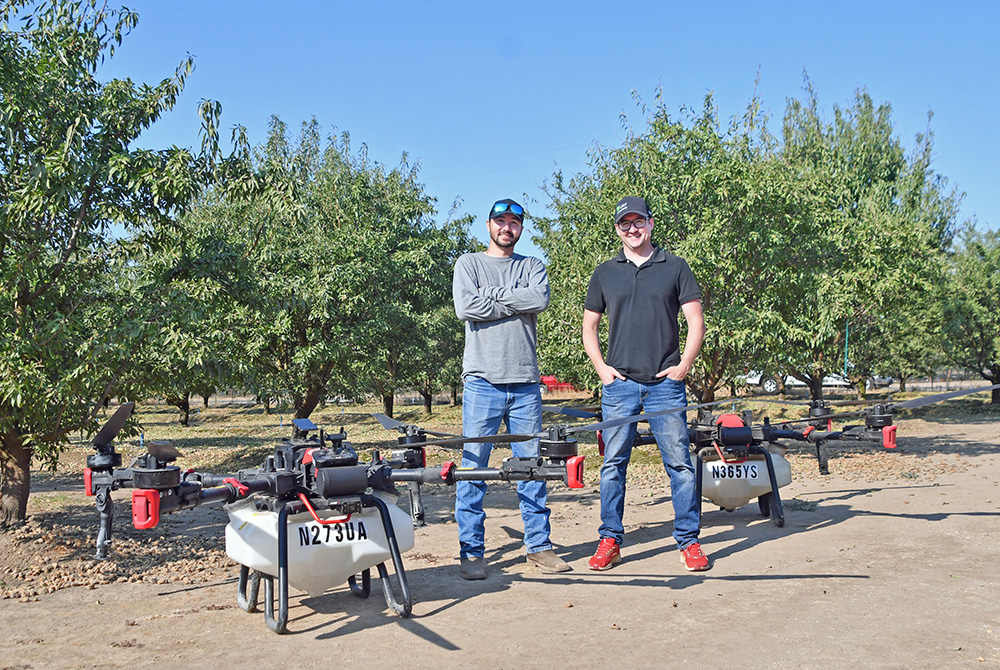
Brothers Brandon, left, and Nicholas Steed show off their agricultural drones. They operate UAV Ag Solutions in Oakdale, an agricultural drone application business. Drones have joined manned aircraft and ground rigs as vehicles that apply agricultural inputs, including pesticides, fertilizers, beneficial insects and cover-crop seeds.
Photo/Vicky Boyd


By Vicky Boyd
Drone operators say they see an uptick in business as agricultural drone application technology improves, farmers become more comfortable with it and more products receive aerial labels.
But they’re quick to point out that the remotely piloted aircraft, also known as unmanned aerial vehicles, are not the be-all and end-all replacement for manned aircraft applications or ground sprayers. Instead, they view drone application as complementary.
Where many agricultural drone operators have seen the greatest interest is from specialty crop producers, said Briana Layfield, president and owner of Temecula-based Ag-Bee LLC. She founded one of the first agricultural spray drone businesses in the state in 2019.
“Vegetable crops have probably adapted drones faster than any other crop,” Layfield said. “When vegetable plants start growing, (growers) can’t get tractors in past a certain growth stage.”
Last winter, her company treated vegetables in the Imperial, Coachella and Pajaro valleys. Other seasons, the company flies coastal vegetable fields from Ventura to Watsonville and has even made drone applications for aquatic weed control, greenhouse shading and beneficial insects.
She also has North Coast winegrape clients with hillside vineyards as steep as 45-degrees. Before one vineyard owner hired Ag-Bee, his crew of 17 workers wearing cleats and backpack sprayers spent three days applying fungicides, she said.
Although the hilly terrain complicated drone flights by interrupting line of sight, Layfield said her company still made the applications in significantly less time and with a fraction of the manpower. Line of sight refers to Federal Aviation Administration regulations that require drone operators to maintain visual contact with the craft without binoculars or other aids.
In addition to applying agricultural materials, Layfield collaborates with drone manufacturers, agricultural chemical registrants, university researchers and producers on field trials to fine-tune the technology to meet real-world farming needs.
Nicholas Steed, who operates Oakdale-based UAV Ag Solutions with brother Brandon, said they’ve also experienced increased producer interest. They’re beginning their second full year in business and have seen return clients.
Among the Central Valley crops they’ve treated are walnuts, almonds, alfalfa and field corn. Recently, a cherry producer hired them to blow raindrops off fruit to minimize cracking.
Steed said orchardists who have embraced regenerative practices and are concerned about soil health also have taken note of drone applications.
“Some guys just don’t like the soil compaction at all,” Steed said about heavy ground sprayers. “They don’t like the tracks that get left in the field even when it’s not wet.”
Jayraj Kahlon, a partner with his brother, Udhay, in the family-owned Kahlon Organization, grows almonds and pistachios in Madera, Merced and San Joaquin counties. Winter rains regularly challenge fungicide applications, particularly in his almond orchards.
“The biggest thing we saw, at least in the Central Valley right at bloom time, is we’d get hit with a lot of late rains, and that hindered tractors getting into the fields,” Jayraj Kahlon said.
Photo/Vicky Boyd
This led the brothers last year to invest in two larger model spray drones and obtain the required state and federal pilot credentials. They also spent more than a month learning the drones’ nuances and how to adjust them for differing physical properties of spray materials.
Although early in the drone application season, Kahlon said they’ve already seen benefits. They recently compared a block where a drone applied 10 gallons per acre of insecticide for leaf-footed plant bugs to another where an air-blast sprayer applied an industry standard 100 gpa.
“That (air-blast) block had more bug pressure than another field we did with only aerial,” Kahlon said, citing Semios’ automated insect camera trap results. “It was pretty interesting because we were putting out 90 gpa less.”
With a single drone, he said he could treat 40 to 45 acres per hour, whereas the air-blast sprayer with a 500-gallon tank could cover only about 5 acres per hour.
“I think for us as a large company, we’re able to cover more ground,” Kahlon said. “It’s not about the quantity; it’s about the quality. We’re able to hit that target area.”
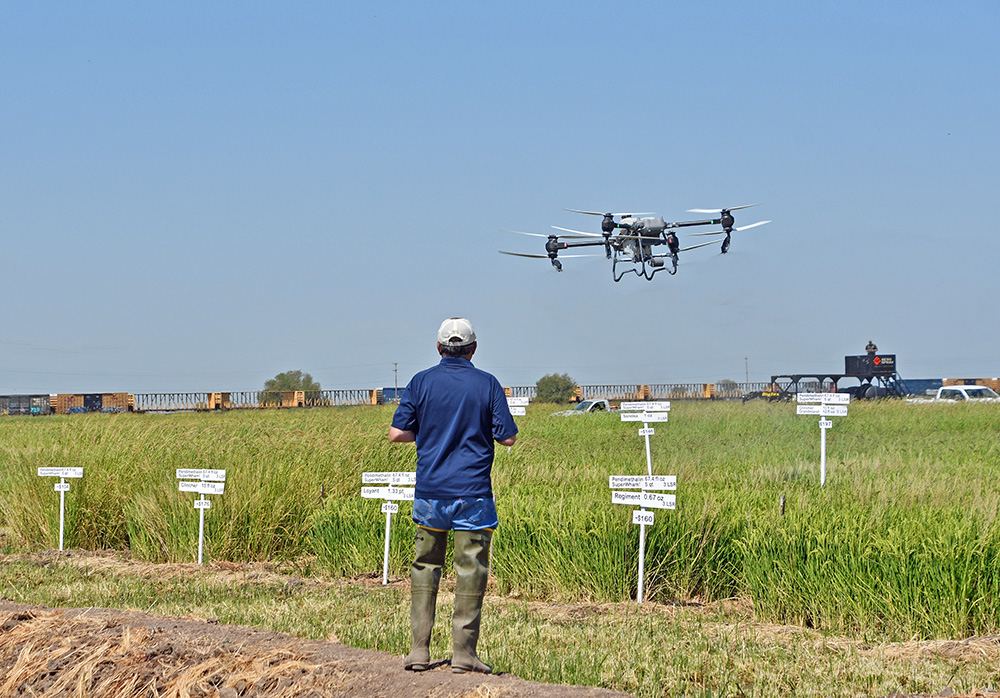
Improved efficiency also was one reason the Rice Experiment Station near Biggs began using a drone last season on its rice fields, said station Director Dustin Harrell. Most are 5 to 10 acres, which are small compared to commercial fields.
The technology worked so well that Harrell purchased a second drone in time for this season. The station also modified the drones so they can seed rice, apply dry materials and spray liquids.
“Now we run two at a same time, and we can do a bigger application more quickly,” he said.
Before the drones, the station hired airplanes to treat the fields and had to wait its turn alongside farmers. Now, Harrell said, the drones fly when a field is ready.
“This year, we’re going to be as self-sufficient as we can and do our best to do everything on station with the drones that we can,” he said.
The station has four licensed drone pilots and follows state pesticide requirements, including county propanil herbicide application caps and filing notices of intent to apply restricted-use pesticides, Harrell said.
The U.S. Environmental Protection Agency allows materials registered for aerial application to be applied by drone as long as the label doesn’t prohibit it. That said, drone operators must follow the same label requirements as manned aircraft.
“You can’t just come up with some rate,” Layfield said. “If the label doesn’t say by air, we don’t do aerial. If it says 10 (gpa), we do 10.”
UAV applicators also must have an FAA Part 137 certificate, which is the same requirement as traditional agricultural aircraft. In addition, they must have a California Department of Pesticide Regulation pest control aircraft pilot certificate, CDPR pest control business license, CDPR qualified applicators license allowing them to mix and load chemicals, and an FAA Part 107 pilot’s license.
If producers are interested in drone treatments, Layfield recommended asking pilots questions beforehand: How do they dial in applications, including calibrating spray output and droplet spectrum? What have they done to test the efficacy of their applications?
Steed said his company continues to conduct trials with its drones as it expands the products it applies and the crops it treats.
“That’s what was important to us—I needed that data to show them not only if it was working but why it was working,” he said.
Vicky Boyd is a reporter in Modesto. She can be reached at agalert@cfbf.com.


In this issue...
- Experts seek methane-cutting solutions
- California cherry crops decimated by spring storms
- Agricultural 'roadmap' to guide research priorities
- Why rocket scientists began counting nuts in California
- Advocacy in Action: Wolf rule repeal, safety rules and bird flu tests
- Farms increasingly use drones for aerial applications
- How should walnut husk fly be managed this season?
- Production forecast shows drop in several state crops
- Former dairy vet looks to improve welfare on farms
- How AI is transforming weather forecasting





.svg.png)
